The Indonesia flood evacuation accelerated on Thursday as rescuers struggled to reach isolated villages in North Sumatra, where rising waters and widespread landslides have pushed fatalities to thirty-four.
Authorities say the destruction has complicated rescue logistics, with emergency crews “cut off from entire districts” after bridges collapsed, roads disappeared and communications networks fell silent across crucial terrain.
Torrential rains triggered the cascading disasters, overwhelming natural barriers and sending torrents of water through communities already vulnerable from a week of severe weather battering multiple Indonesian provinces.
Officials report more than eight thousand residents have been displaced, with many sheltering in public halls, schools and mosques as helicopters deliver food, medicine and temporary supplies across isolated areas.
Emergency workers describe conditions as “unstable and worsening”, noting that additional rainfall expected over the weekend may deepen damage, disrupt evacuations and increase the risk of secondary landslides across lower valleys.
The regions of Central Tapanuli and Sibolga remain inaccessible, with local officers telling rescue teams they have “no viable entry routes” due to a complete collapse of hillside roads.
An official with the disaster mitigation agency said helicopters remain the “only lifeline” to thousands trapped, adding that even air operations face challenges from heavy clouds and ongoing extreme weather.
A spokesperson for the North Sumatra division said, “We cannot communicate with field teams in several areas,” stressing that delays continue to threaten those awaiting evacuation from flooded homes.
Witnesses described chaotic scenes, including families wading through chest-high waters, children carried in makeshift containers and residents climbing roofs as water rapidly filled streets and homes.
Drone footage captured the vast scale of flooding, displaying entire neighbourhoods submerged, agricultural plots destroyed and communities reduced to isolated pockets surrounded by fast-moving currents.
Landslides have buried parts of several districts, erasing small access roads, crushing vehicles and sweeping away infrastructure that once connected remote villages to urban centres.
The government says relief teams are prioritising vulnerable populations, including pregnant women, the elderly and families trapped in homes where water levels remain dangerously high.
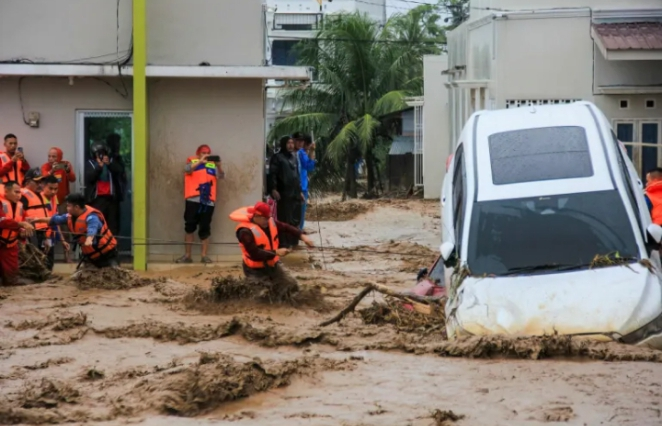
Volunteers in rafts and inflatable boats continue navigating unstable currents to retrieve stranded people, often relying on ropes tied across debris-filled waters to avoid being swept away.
The destruction also wiped out power lines, plunging entire communities into darkness and cutting off radio communication used by emergency units to coordinate rescue strategies earlier in the week.
At least one family among the confirmed dead was discovered trapped under collapsed debris, with responders describing the scene as “devastating and emblematic of the tragedy unfolding”.
A viral clip released by local radio channel Elshinta showed a man balancing a plastic container holding an infant on a rooftop while signalling desperately for rescue assistance.
Photographs from the region show orange-clad rescue teams pushing through muddy water, using flashlights and improvised tools as they move through narrow alleys toward submerged structures.
Additional provinces, including Aceh and West Sumatra, have also reported widespread flooding, with officials confirming more than ten districts in Aceh alone are currently underwater.
Experts warn that saturated soil across the region raises the probability of new landslides, especially near rivers where water has eroded embankments and threatened supports beneath major roads.
The meteorological agency forecasts continued extreme rainfall driven by unusual pressure systems across the region, advising residents to evacuate early rather than wait for emergency alerts.
The Indonesia flood evacuation also coincides with a magnitude 6.6 earthquake that struck Simeulue Island on Thursday morning, sending anxious residents running into rain-soaked streets.
Although the quake caused no immediate reported casualties, officials say the tremor worsened structural risks in several buildings already weakened by repeated flooding and landslides this week.
Neighbouring countries have also been battered by severe weather, with Thailand and Malaysia reporting more than thirty flood-related deaths and hospitals submerged under rising waters.
Sri Lankan authorities confirmed at least thirty-one fatalities following similar disasters, noting that landslides and collapsing embankments continue to leave families displaced and searching for missing relatives.
Regional climate researchers argue that the cluster of disasters reflects extreme-weather volatility, reinforcing concerns that Southeast Asia is entering an era of intensified rainfall and unpredictable storm formations.
They warn that disaster-response infrastructure across the region must be strengthened urgently to avoid future catastrophes, especially as seasonal rainfall patterns appear increasingly irregular.
Communities in North Sumatra are now contending with contaminated water sources, damaged sanitation systems, and limited access to food, raising fears of disease outbreaks in overcrowded shelters.
Local leaders say the psychological toll of repeated disasters is heavy, with families “traumatised and uncertain”, particularly those who lost loved ones or remain unable to locate missing relatives.
Humanitarian groups coordinating relief distribution highlight that many evacuees only managed to escape with the clothes they were wearing when waters overwhelmed their neighbourhoods.
Rescue teams report challenges navigating thick mud, broken trees and landslide debris scattered across kilometres of roadways that once served as vital supply and evacuation routes.
With many villages still unreachable, authorities fear the actual number of casualties may rise once communications are restored and search-and-rescue teams access isolated communities.
Government officials have pledged emergency funds to accelerate repair of critical infrastructure, promising temporary bridges, improved shelter facilities and expanded aerial support for evacuations.
Residents interviewed by local media say they hope the Indonesia flood evacuation efforts intensify rapidly, expressing concern that worsening weather may trap remaining families for days.
Environmental groups say the tragedy underscores the need to enhance climate resilience by restoring mangroves, reinforcing riverbanks and preventing construction in areas prone to recurrent flooding.
They add that long-term strategies must prioritise sustainable land management practices, which could mitigate the severity of landslides in heavily deforested parts of northern Sumatra.
While rain continues to fall, emergency officials urge families living in elevated risk zones to evacuate voluntarily, noting that delayed departures have complicated rescue operations.
As regional storms intensify, Southeast Asian governments face mounting challenges in forecasting extreme weather patterns that now fluctuate rapidly and unpredictably throughout the monsoon cycle.
Meteorologists emphasise that the unusual tropical cyclone affecting Sumatra is part of a growing trend of “rare but powerful” storm systems striking regions previously considered low-risk.
Indonesia’s national government has deployed additional personnel to accelerate relief operations, working alongside local authorities and volunteers operating in dangerous, fast-changing conditions.

The coming forty-eight hours are expected to be decisive as evacuation teams attempt to navigate blocked routes, damaged terrain and continuing rainfall that threatens further destabilisation.
Despite the obstacles, frontline workers say they remain committed to reaching every stranded family, describing the ongoing mission as “urgent, exhausting and vital for community survival”.
About The Author