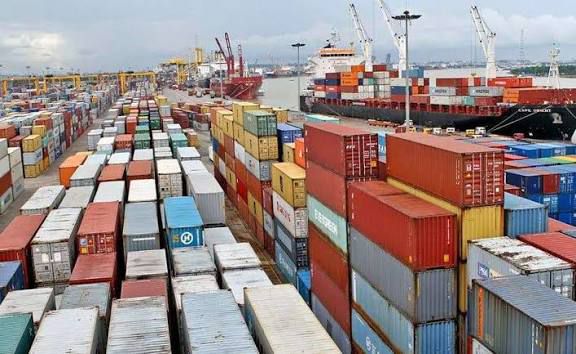
Importers, freight forwarders, and logistics operators across Nigeria’s maritime sector are raising alarm over mounting financial losses linked to persistent container blockages at the Lagos ports, a situation they say is crippling trade flows, inflating business costs, and undermining confidence in the country’s port system.
Industry stakeholders estimate that billions of naira are lost monthly as thousands of cargo containers remain trapped within port terminals or are intercepted after clearance, leading to demurrage, storage penalties, and contractual breaches.
The development has renewed calls for urgent reforms, particularly concerning the alleged duplication of cargo clearance roles by security agencies.
The controversy dominated discussions at a recent stakeholders’ engagement convened by the Nigerian Shippers’ Council (NSC) in Lagos, where operators accused officers of the Maritime Police Command of detaining already cleared containers, often without prior notice or transparent justification.
Container blockage at Lagos ports sparks industry-wide outrage
Maritime experts describe container blockage as the restriction or detention of cargo after it has arrived at the port and, in many cases, after it has been examined and released by the Nigeria Customs Service and other statutory agencies.
Once blocked, such containers cannot exit the port or reach consignees, triggering a chain reaction of costs and operational delays.
Participants at the engagement, drawn from freight forwarding associations, trucking unions, terminal operators, and importing companies, alleged that more than 1,500 containers are blocked monthly at Lagos ports.
They claim that these detentions are often initiated using vessel manifests, even after cargoes have completed statutory clearance procedures.
According to them, the practice represents a breakdown in inter-agency coordination and raises questions about regulatory overlap within the port ecosystem.
“This is no longer an isolated incident,” one importer said.
“It has become systemic, and the financial impact is devastating.”
Importers face rising costs and contract risks
Stakeholders warned that the continued container blockage at Lagos ports exposes importers to excessive demurrage charges imposed by shipping lines, terminal storage fees, and penalties for failing to meet delivery timelines agreed with clients.
They added that the ripple effects extend beyond individual businesses, affecting manufacturers dependent on imported raw materials, retailers facing stock shortages, and consumers grappling with higher prices.
Terminal congestion is also worsened by blocked containers occupying valuable space, slowing down cargo evacuation and reducing overall port efficiency.
Some operators noted that international trading partners are increasingly wary of routing cargo through Nigerian ports due to unpredictability and post-clearance bottlenecks.
Industry leaders cite executive order, demand accountability
The General Manager of Port and Terminal Multiservices Limited, Babatunde Keshiro, identified what he described as a “parallel authority problem” within the ports, arguing that security concerns should be addressed during cargo examination rather than after release.
“Once a container has been examined, cleared, and released, there should be no basis for further delay,” Keshiro said.
“If there are issues, they must be raised at the appropriate stage. Post-clearance interception undermines the integrity of the entire process.”
He referenced a 2022 Executive Order issued to halt the interception of already cleared cargoes, urging industry players to insist on its enforcement.
Similarly, the Apapa Chapter Chairman of the Association of Nigerian Licensed Customs Agents, Emeka Chukwumalu, argued that security agencies should bear the financial consequences of demurrage whenever containers are blocked after clearance.
“If a container is stopped after being duly released, then whoever stopped it should pay the cost,” he said.
Shipping lines accused of enabling the practice
Beyond security agencies, shipping companies also came under criticism during the forum.
The PTML Chapter Chairman of the National Council of Managing Directors of Licensed Customs Agents, Abayomi Duyile, accused some shipping lines of releasing cargo manifests to the Police.
He described the practice as illegal and inconsistent with international shipping standards, warning that it enables post-clearance interference and exposes importers to avoidable risks.
Leaders of trucking associations echoed similar concerns, noting that blocked containers disrupt haulage schedules, idle trucks, and transfer inefficiencies from the ports to road transport operators.
Shippers’ Council moves to protect cargo interests
Responding to the concerns, the Executive Secretary and Chief Executive Officer of the Nigerian Shippers’ Council, Dr Pius Akutah, said the council’s engagement with security agencies is aimed at balancing cargo protection with trade facilitation.
“Our mandate is to protect the interests of shippers,” Akutah said.
“We do not exist to complicate business or add costs. When complaints are brought to us, we intervene, and many of these issues are resolved.”
He stressed that collaboration with security agencies is necessary to ensure safety within the port environment but acknowledged the need to address excesses that negatively impact port users.
The Head of the NSC Complaints Unit, Dr Bashir Ambi, went further, distancing the council from allegations of extortion linked to container blockage at Lagos ports.
“Our reputation matters to us,” Ambi said.
“The Complaints Unit does not collect money from anyone. We are constantly engaging and, where necessary, confronting the Maritime Police over the blocking of already cleared containers.”
He urged stakeholders to resist making unreceipted payments and to submit documented petitions to the council for redress.
Police insist container blocking is security-driven
Reacting to the allegations, the Police Public Relations Officer of the Maritime Police Command, Assistant Superintendent of Police Adebayo Rasheed, defended the practice, insisting that container blockages are driven by intelligence and national security considerations.
Rasheed cited instances where arms, illicit drugs, and contraband were discovered in containers that had already been cleared by other agencies. According to him, the Police cannot abandon intelligence-led operations in the name of trade facilitation.
“Blocking of containers by the Police cannot be stopped,” he said. “Security must not be compromised.”
He, however, advised stakeholders with evidence of extortion or misconduct to report such cases to appropriate authorities.
Uncertain path forward for Lagos ports
As debates continue, industry watchers warn that failure to resolve the container blockage at Lagos ports could erode Nigeria’s competitiveness in regional and global trade.
With ports in neighbouring countries improving efficiency, stakeholders say Nigeria risks losing cargo traffic unless post-clearance processes are streamlined and roles clearly defined.
For now, importers and logistics operators remain caught between security enforcement and commercial survival, hoping that sustained dialogue will lead to reforms that protect both national security and the ease of doing business.
About The Author