

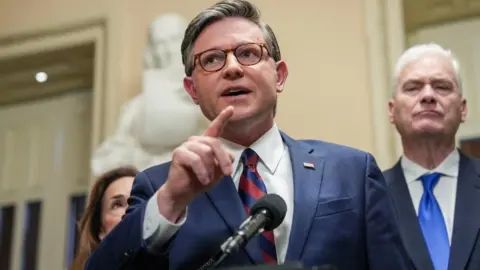
House Republicans extend government shutdown after rejecting a Senate deal meant to reopen the Department of Homeland Security. The decision prolongs airport chaos and leaves TSA agents without pay for more than a month.
The Senate had passed a bipartisan bill to reopen most of DHS, excluding immigration agencies to gain Democratic support. House Republican leaders, however, called the proposal a “joke” and rejected it, insisting funding must cover Immigration and Customs Enforcement.
Speaker Mike Johnson emphasized that Republicans will not support any legislation reopening borders or halting immigration enforcement. His stance has escalated tensions between the House and Senate, leaving DHS operations in limbo as Congress prepares for a two-week recess.
TSA agents, responsible for airport security across the United States, have not received salaries since mid-February. With paychecks delayed, many agents are calling out sick or resigning, resulting in significant reductions at airport checkpoints and long lines for travelers.
The House approved a different funding plan late Friday in a 213 to 203 vote. The measure would fund DHS at current levels, including ICE, for 60 days. The bill now returns to the Senate, where Democrats have indicated it is “dead on arrival.”
Democrats argue that funding for immigration agencies should come with strict reforms. They demand measures such as ending ICE agents’ use of masks during operations, banning racial profiling, and requiring judicial warrants for entering private property.
President Donald Trump intervened, signing an executive order directing the government to pay TSA agents despite the shutdown. The DHS confirmed on social media that agents should begin receiving paychecks as early as March 30, though legal challenges are anticipated.
Airport travel has been widely disrupted. Hundreds of TSA checkpoints are partially or entirely closed. Jim Szczesniak, Houston Airport System’s director of aviation, reported only a third to half of TSA checkpoints are operational, leaving travelers in hours-long queues.
Approximately 50,000 TSA officers are affected by the impasse. Daily staffing shortages have worsened, with hundreds of agents resigning due to unpaid wages. The disruption has impacted air travel schedules nationwide, highlighting the critical role of federal funding in Homeland Security operations.
The shutdown has also intensified political disputes. Senate Majority Leader John Thune criticized Democrats, saying the deadlock was caused by their refusal to agree on a funding package. Thune argued that Trump’s executive order should not have been necessary to rescue TSA operations.
Meanwhile, Senate Democrats, led by Chuck Schumer, defended their position, citing recent federal actions that led to civilian deaths in Minneapolis. Schumer stated that the funding package included TSA, Coast Guard, and FEMA support but emphasized that funding for ICE required accountability reforms.
The controversy surrounding ICE operations has been particularly significant in Minneapolis, where citizens Renee Good and Alex Pretti were killed during federal enforcement actions. Democrats are leveraging these incidents to push for reform conditions tied to any DHS funding deal.
The House Republican plan prioritizes immigration enforcement, insisting DHS funding must include ICE. Democrats, however, oppose unrestricted funding for ICE without accountability measures, creating a legislative deadlock with no resolution before Congress’ break.
Airport security remains under strain as TSA agents continue working without pay. Long lines and delays at airports across the US are worsening daily, and federal intervention has only partially mitigated the operational disruptions caused by the shutdown.
Legal challenges to Trump’s executive order are expected, as the Constitution vests Congress with the authority to authorize federal spending. Experts suggest that the order may face lawsuits questioning whether the president can override congressional funding powers.
The stalemate highlights growing partisan tension over immigration and border security. Republicans insist funding ICE is non-negotiable, while Democrats aim to tie spending to reforms ensuring law enforcement accountability and the protection of civil rights during operations.
In addition to TSA, other DHS components like Customs and Border Protection remain affected. Delays in funding may impair border enforcement, emergency response, and disaster relief operations, raising concerns about the wider implications of prolonged government shutdowns on national security.
Trump’s move to pay TSA agents is politically charged. While it alleviates immediate travel disruptions, it also underscores the growing conflict between the executive branch and Congress over the separation of powers and budgetary authority.
Congress’ upcoming two-week break means legislative solutions for DHS funding are unlikely in the immediate term. TSA agents, ICE personnel, and other federal workers face continued uncertainty, leaving airports vulnerable to extended operational disruptions.
The shutdown has highlighted structural vulnerabilities in federal operations. TSA staffing shortages have forced airports to limit security checkpoint operations, creating cascading delays for airline schedules, passengers, and commercial transport across the United States.
As the political stalemate persists, travelers continue to experience hours-long security lines, flight delays, and cancellations. Airlines have warned that ongoing staffing disruptions may affect travel through the summer, compounding frustration among the flying public.
The House Republican insistence on including ICE funding has intensified partisan clashes. Democrats remain firm on reform conditions for immigration agencies, while Republicans argue any compromise undermines border security and immigration enforcement priorities.
Observers note that the prolonged shutdown may have long-term consequences for federal workforce morale. Unpaid TSA agents and federal employees may consider alternative employment, exacerbating staffing shortages and operational inefficiencies in critical security sectors.
The conflict demonstrates the broader tension in US politics between executive authority, congressional budget power, and partisan priorities. Temporary measures like executive orders may provide short-term relief but do not resolve fundamental disputes over DHS funding.
Experts warn that if the deadlock continues, federal agencies beyond TSA could face operational challenges. This includes Coast Guard missions, FEMA disaster response, and border enforcement tasks, all reliant on continued DHS appropriations for staffing and equipment.
Trump’s executive order is being closely watched for legal precedent. Scholars debate whether unilateral presidential actions can constitutionally circumvent Congress’ spending authority, setting up potential Supreme Court involvement if challenges progress through lower courts.
House Republicans’ refusal to approve the Senate deal prolongs the partial government shutdown, leaving TSA agents unpaid and airport security partially disrupted. Congress’ break delays potential resolution, deepening uncertainty in DHS operations.
The shutdown underscores the high stakes of partisan disagreements over immigration funding, homeland security, and federal employee compensation. Travelers, airport staff, and federal agencies face ongoing operational and financial pressures due to unresolved legislative disputes.
Congress’ failure to reach an agreement emphasizes the fragile balance between political negotiation and functional government operations. While temporary measures may mitigate immediate disruption, lasting solutions remain contingent on bipartisan compromise.
As airports struggle with reduced TSA staffing and operational delays, the impact on public confidence and economic activity grows. Extended shutdowns could have ripple effects on the travel industry, federal enforcement, and public services nationwide.
Read also: Israel Yemen missile escalation raises fears war could widen within weeks
The continuing impasse highlights the need for reform in federal budget processes. Reliance on temporary bills and partisan deadlocks threatens critical infrastructure and national security, illustrating the high cost of political gridlock on everyday Americans.
With Congress on recess and partisan divisions entrenched, TSA agents will continue to face uncertainty. Airport travelers will endure long lines and delays, while debates over DHS funding and immigration enforcement remain unresolved, threatening stability in federal operations.
About The Author
