The Bondi Beach Jewish festival shooting sent shockwaves through Australia and the world, leaving at least fifteen people dead during a Hanukkah celebration by the sea.
What unfolded on Sydney’s iconic shoreline was described by authorities as a targeted terrorist attack aimed squarely at Australia’s Jewish community on Hanukkah’s first night.
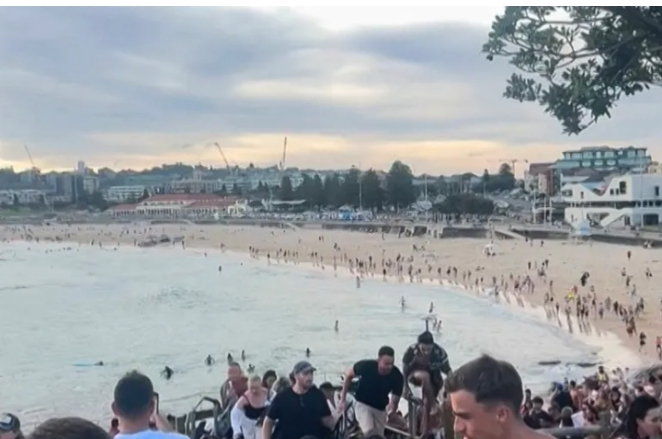
Witnesses recalled screams, panic, and families running for cover as gunmen opened fire amid music, prayer, and candle lighting at Chanukah by the Sea.
“This was beyond comprehension,” Prime Minister Anthony Albanese said, describing a nation struggling to understand violence rarely seen on Australian soil.
Standing before cameras in Canberra, Albanese addressed Jewish Australians directly, pledging unwavering protection, solidarity, and every available resource to ensure community safety.
“You have the right to live, worship, and celebrate without fear,” he said, his voice heavy with grief and resolve.
The Bondi Beach Jewish festival shooting quickly drew condemnation from governments across continents, transforming a local tragedy into a moment of global reckoning.
New Zealand Prime Minister Chris Luxon called the scenes “distressing,” reminding Australians that New Zealanders consider themselves family, united in grief and shared values.
“A place Kiwis visit every day has become a scene of horror,” Luxon said, extending condolences on behalf of his nation.
In Washington, US President Donald Trump labeled the attack “a purely antisemitic act,” speaking during a White House Christmas gathering alongside First Lady Melania Trump.
Secretary of State Marco Rubio echoed that sentiment, stating, “Antisemitism has no place in this world,” while offering prayers for victims and Australia.
At the United Nations, Secretary-General Antonio Guterres said he was “horrified” by what he termed a heinous attack on Jewish families celebrating Hanukkah.
“My heart is with the Jewish community worldwide,” Guterres wrote, noting the symbolic cruelty of striking during a festival of light.
Israeli President Isaac Herzog described the shooting as “vile and cruel,” confirming that at least one Israeli national was among the dead.
“Our brothers and sisters went to light the first Hanukkah candle and were met with terror,” Herzog said in a somber statement.
The Palestinian Foreign Ministry also condemned the violence, rejecting terrorism unequivocally and expressing solidarity with what it called “friendly Australia.”
British Prime Minister Keir Starmer said the news from Sydney was “deeply distressing,” offering condolences to victims, families, and the Australian public.
King Charles III, Australia’s head of state, called the shooting “the most dreadful antisemitic terrorist attack,” saying he and Queen Camilla were appalled.
Germany’s Chancellor Friedrich Merz said the attack struck at shared democratic values and reinforced the urgent need to combat antisemitism globally.
“This is an attack on who we are,” Merz said, pledging Germany’s continued fight against hatred wherever it emerges.
French President Emmanuel Macron vowed relentless opposition to antisemitic hatred, stating that such violence “hurts us all wherever it strikes.”
From The Hague, Dutch Prime Minister Dick Schoof described the reports as “shocking and alarming,” conveying direct sympathy to Albanese.
Finland’s President Alexander Stubb called the attack devastating, emphasizing support for Australia’s Jewish community during profound national mourning.
Iran, through Foreign Ministry spokesman Esmaeil Baghaei, condemned the incident, rejecting terror and killing “wherever committed” without qualification.
European Commission President Ursula von der Leyen said she was shocked, while EU foreign policy chief Kaja Kallas demanded unequivocal condemnation.
Italy’s Prime Minister Giorgia Meloni reaffirmed her country’s firm stance against violence and antisemitism, offering solidarity with victims’ families.
Spain’s foreign minister, Jose Manuel Albares, said hatred and violence have no place in modern societies, expressing horror at the attack.
Ireland’s Foreign Minister Helen McEntee described the shooting as an antisemitic atrocity, extending sympathy to Australia and grieving families.
Middle Eastern leaders also weighed in, with Qatar, Jordan, and the UAE condemning terrorism and expressing condolences to the Australian people.
Turkiye’s Foreign Ministry reiterated its principled stance against terrorism, emphasizing international cooperation to confront global extremist threats.
Lebanese President Joseph Aoun linked the tragedy to broader systems of hatred, warning against ideologies that normalize violence against civilians.
Religious leaders joined political voices, with the UK’s Chief Rabbi Ephraim Mirvis calling the shooting an “unspeakable tragedy.”
“Join me in praying for everyone affected by this heinous act,” Mirvis urged, as Jewish communities worldwide held vigils.
In Australia, the National Imams Council condemned the violence, urging unity, compassion, and shared mourning across religious lines.
“Our hearts are with the victims and all who witnessed this trauma,” the council said, stressing national solidarity over division.
The Muslim World League similarly rejected terrorism in all forms, reinforcing interfaith condemnation of the Bondi Beach attack.
Saudi Arabia’s Foreign Ministry labeled the shooting a terrorist act, wishing the injured a speedy recovery and denouncing extremism.
New York City mayor-elect Zohran Mamdani described the shooting as part of a “growing pattern” of global violence against Jewish communities.
“A holiday of light was turned into darkness,” Mamdani said, calling for renewed vigilance against antisemitic hatred worldwide.

As investigations continue, the Bondi Beach Jewish festival shooting has forced Australia to confront questions about security, extremism, and social cohesion.
For many Australians, the tragedy shattered assumptions of safety, leaving candlelight vigils, flowers, and unanswered questions along Bondi’s sands.
Yet amid grief, international unity emerged clearly, as voices across faiths and borders declared that terror will not define shared humanity.
Read also: Zelenskyy signals readiness to abandon NATO membership bid for peace guarantees
About The Author