Germany has called on France to boost defence spending to strengthen European security, citing concerns about the United States’ future commitment to NATO.
Johann Wadephul, Germany’s foreign minister, stressed that Paris must “put its money where its mouth is” regarding European defence. He noted the importance of acting consistently within national policies.
“Anyone who talks about European sovereignty needs to act accordingly in their own country,” Wadephul told Deutschlandfunk, emphasizing that rhetoric alone will not guarantee Europe’s self-sufficiency.
European powers are increasingly acknowledging they might be left to defend themselves as transatlantic relations face uncertainty, particularly over the U.S.’s readiness to intervene militarily.

At the NATO summit last June, member states pledged to raise defence spending to 5% of GDP by 2035, but Wadephul said progress has been insufficient, especially in France.
“Efforts in the French republic have also been insufficient to achieve this so far,” Wadephul said. “France, too, needs to contribute amid tough discussions.”
Germany last year eased its constitutional “debt brake” to allocate more than €500 billion to defence between 2025 and 2029, demonstrating a concrete commitment to European security.
France, struggling with high public debt, ranks third in the EU after Greece and Italy, creating tensions in Franco-German discussions over defence and investment priorities.
Wadephul’s remarks add friction to the Franco-German alliance, historically central to EU cooperation. Disagreements include pooled debt proposals and a next-generation European fighter jet project.
On the opening day of the Munich Security Conference, Germany’s Chancellor Friedrich Merz warned that Russia poses a threat to Europe and urged stronger U.S.-European defence cooperation.
“In the era of great power rivalry, even the United States will not be powerful enough to go it alone,” Merz said, emphasizing the need to “repair and revive transatlantic trust together.”
Merz also disclosed preliminary talks with Macron on possibly joining France’s nuclear umbrella, sparking debate over Europe developing independent nuclear deterrence capabilities beyond U.S. protection.
Wadephul, representing the Christian Democratic Union (CDU), cautioned against Europe establishing a robust nuclear force, stating: “There are enough atomic weapons in the world.”
He added that “no one in Washington is questioning whether the U.S. would use its nuclear arsenal to defend Europe,” warning against undermining existing deterrence systems with public debate.
Germany’s vice-chancellor Lars Klingbeil affirmed reliance on NATO’s nuclear deterrent and confirmed that Berlin has no plans to acquire independent atomic weapons under current treaties.
Klingbeil welcomed discussions with France about joining its nuclear umbrella, saying: “We’ll see what the outcome is,” signaling cautious exploration without full commitment.
Senior CDU politician Armin Laschet expressed concern that Germany’s participation might send a message to Washington that Berlin is relinquishing the U.S. protective shield voluntarily.
“He [Macron] will not give the German chancellor a say in this nuclear armament issue,” Laschet said, highlighting France’s control over its arsenal and the limits of joint nuclear coordination.
Thomas Röwekamp, CDU defence committee chair, argued Germany must assume more responsibility for European security but avoid actions that replace U.S. nuclear guarantees with European-only capabilities.
Röwekamp called for a “European complement within NATO” to support U.S. atomic capabilities, noting that France has been a key contributor to European deterrence for decades.
The debate reflects broader EU discussions on strategic autonomy, investment in defence, and balancing reliance on NATO while strengthening intra-European capabilities to address modern threats.
German-French friction also arises from trade disagreements, including a stalled EU-Mercosur deal, demonstrating how economic and security issues intertwine in shaping European policy.
Analysts warn that insufficient European defence spending could embolden external actors and undermine NATO cohesion, stressing the importance of concrete financial commitments from member states.
Wadephul’s statements signal pressure on France to increase military budgets and participate more actively in joint European initiatives, emphasizing shared responsibility for continental security.
Merz and German officials continue diplomatic outreach to Macron, balancing the call for increased French spending with careful consideration of nuclear deterrence and NATO obligations.
Experts highlight that strengthening Europe’s defence posture requires alignment between financial contributions, technological development, and political consensus among key EU nations.
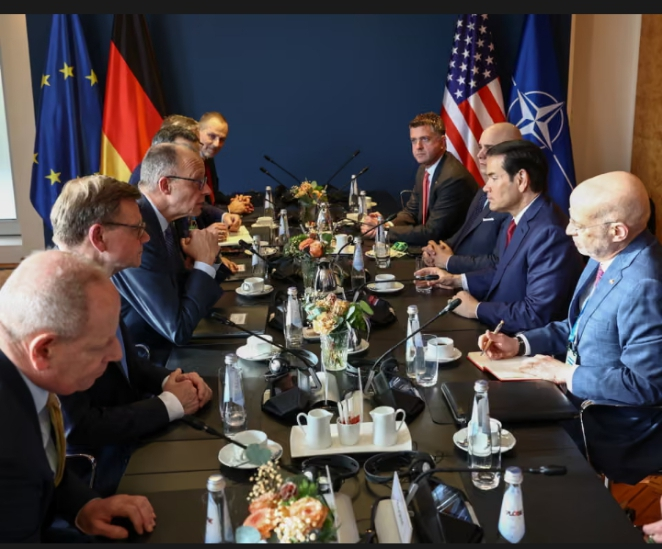
While Germany demonstrates a robust investment plan, France faces domestic challenges that complicate immediate increases in defence spending, requiring negotiation and compromise within the EU framework.
The ongoing discussion underscores the delicate balance between European sovereignty, collective NATO security, and transatlantic trust, illustrating the high stakes of defence policy in a multipolar world.
Germany’s push for higher French defence contributions is framed as a necessity for credible European security, rather than unilateral ambition, stressing shared responsibility for NATO and EU safety.
Read also: US forces board Indian Ocean tanker defying Trump’s Venezuela blockade