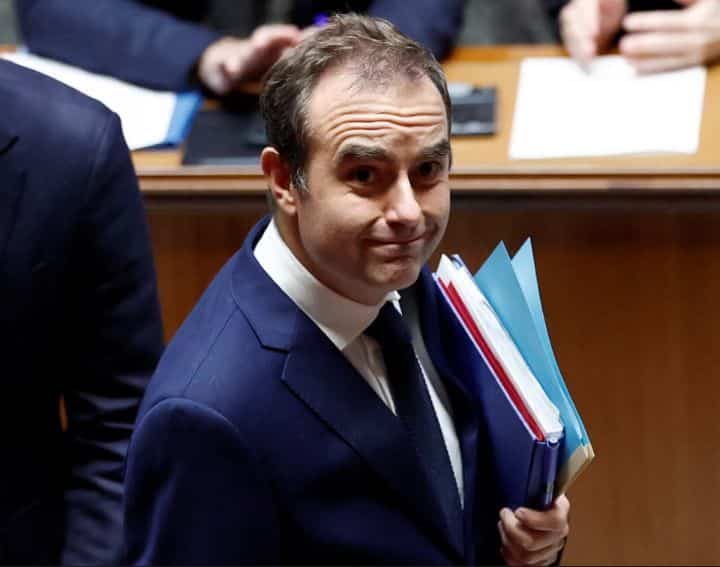

France is on the brink of political turmoil as a swing group in parliament threatened on Friday to vote down the government over wealth taxation.
Prime minister Sebastien Lecornu is under intense pressure to pass a 2026 austerity budget through a deeply divided National Assembly before the end of the year.
Lecornu succeeded two predecessors who were toppled over cost-cutting measures, highlighting the fragile nature of governance amid public opposition to financial reforms and growing inequality concerns.
Earlier this month, Lecornu suspended a controversial pensions reform, allowing Socialist MPs to support him during a confidence vote in parliament, buying temporary political breathing room.

The government has pledged not to invoke constitutional powers to push the budget bill through without a vote, as has been done in previous years to bypass dissenters.
However, Socialist MPs, acting as a swing group, have demanded a tax on the ultra-wealthy, a levy Lecornu has refused to include in the current draft, risking confrontation.
A parliamentary commission earlier this week rejected the draft budget by 37 votes to 11, signaling strong opposition ahead of Friday’s lower house debate on the contentious measures.
The proposed measure from the left, known as the “Zucman tax,” would target people holding at least 100 million euros in assets, applying a minimum two percent levy.
French economist Gabriel Zucman has estimated such a tax could generate around 20 billion euros (£17.5bn) annually from just 1,800 mega-wealthy households, a substantial contribution to public finances.
Parliament is expected to debate a proposal from left-wing lawmakers to introduce this Zucman tax on Saturday, potentially escalating tensions between parties across the spectrum and testing coalition loyalty.
Far-right MPs and the government are firmly opposed to taxing professional assets, the main target of the Zucman proposal, arguing it could discourage investment and entrepreneurship among wealthy citizens.
Instead, Lecornu’s government proposes taxing wealth management holdings exceeding five million euros (£4.4m), a measure expected to raise roughly one billion euros (£872m) from around 10,000 taxpayers nationwide.
Socialist leader Olivier Faure warned that his party would vote to oust the government if no meaningful levy on the uber-wealthy is enacted before Monday, raising the stakes for Lecornu.
“We need to tax the ultra-rich and mega-inheritances,” Faure said. “If there is no progress by Monday, it will be over.” His words underline escalating political stakes across France.
The debate highlights growing public concern over inequality, with critics arguing that France’s wealthiest have largely escaped substantial taxation compared to ordinary citizens over decades of fiscal policy.
Some analysts warn that failing to impose the tax could embolden populist parties, who frame economic inequality as a moral and social crisis requiring immediate government action and legislative reform.
Economists supporting the Zucman tax argue that targeting extreme wealth is necessary to fund social programs and prevent the concentration of economic power in too few hands in France.
Opponents, however, contend that taxing professional assets could prompt capital flight or relocation of high-net-worth individuals to other European countries with lower levies, impacting investment and economic growth.
Lecornu faces a delicate balancing act: appeasing Socialist MPs, managing the far-right opposition, and avoiding alienating business elites whose support is crucial for national economic stability and employment.
Parliamentary votes this week will serve as a litmus test for Lecornu’s political skill and his ability to navigate the increasingly polarized National Assembly over contentious wealth taxation.
Observers note that the outcome could influence broader European discussions on wealth taxation, potentially setting a precedent for similar levies in neighboring countries, particularly in Germany and Italy.
The proposed austerity budget seeks to curb public spending while raising revenues through targeted wealth measures, yet faces skepticism about its feasibility, fairness, and potential social consequences.
Debates in the assembly are expected to be heated, with Socialist MPs pressing for more progressive taxation and government supporters warning against overly aggressive levies on professional assets.
Austerity measures have already sparked public protests, and the addition of wealth taxation could further inflame tensions among voters, complicating Lecornu’s agenda and political maneuvering.
The failure to reach consensus could trigger a government collapse, forcing either early elections or emergency measures to pass a budget and maintain political stability in a fractured legislature.
Political analysts stress that the Socialist swing vote underscores the fragility of Lecornu’s coalition and the necessity of compromise to prevent a parliamentary impasse and widespread political uncertainty.
Observers in Paris emphasize that wealth inequality is increasingly central to French politics, influencing both electoral outcomes and legislative priorities in the context of global economic turbulence.
France’s mega-wealthy, in turn, are closely monitoring developments, with some considering legal and financial strategies to mitigate potential tax exposure if the Zucman tax or similar measures are passed.
Critics of the Zucman tax argue that it could lead to bureaucratic complexity, enforcement challenges, and unintended consequences for wealth management industries, potentially burdening both government agencies and taxpayers.
Supporters insist that targeting ultra-wealthy households is both a moral imperative and a pragmatic solution to fund social programs amid stagnating public revenues and growing social demands.
The coming days are critical, as Socialist MPs have made it clear that their tolerance for delays or compromises on the ultra-rich levy is minimal, putting Lecornu’s government under unprecedented pressure.
Lecornu’s approach will be scrutinized domestically and abroad, with investors and European partners watching for signs of political stability or legislative paralysis that could affect economic confidence.
As France faces this potential political showdown, the debate over wealth taxation illustrates the tension between austerity, fairness, and the challenges of governing a deeply divided legislature.
The outcome could redefine French fiscal policy, setting new standards for taxing extreme wealth and reshaping the country’s approach to economic inequality and social responsibility.
Observers note that the political stakes are high: failure could topple the government, while success would mark a notable victory for Lecornu in a fragmented and increasingly unpredictable political landscape.
International media have closely followed the developments, framing France’s wealth tax debate as part of a global discourse on taxation, social fairness, and economic sustainability.
The final decision will reveal whether the government can maintain cohesion and enforce fiscal discipline, or if France will enter a period of instability with long-term consequences for policy.
French citizens, meanwhile, remain divided on the issue: some view the tax as overdue justice, while others worry about its economic repercussions and potential effects on investment and employment.
Lecornu’s handling of the Zucman tax proposal may define his political legacy, shaping perceptions of his leadership style, negotiation skills, and commitment to balancing economic growth with social fairness.
With the Socialist swing vote holding the balance of power, every parliamentary session is being watched closely, highlighting the razor-thin margins that define governance in today’s National Assembly.
The government’s success or failure could influence upcoming regional elections, with voters using wealth taxation as a litmus test for broader political priorities and party credibility.
France’s wealth tax debate reflects a broader European challenge: balancing fiscal responsibility, social justice, and economic competitiveness in an era of globalized capital and rising inequality.
As the weekend approaches, both government and opposition strategists are expected to intensify lobbying efforts, seeking last-minute compromises or pledges to influence the outcome of the critical parliamentary vote.
The Socialist Party insists it will not compromise on the principle of taxing the ultra-wealthy, sending a clear message that fiscal justice is non-negotiable in its political strategy.
Ultimately, France faces a defining moment: either it passes an ambitious wealth tax and demonstrates fiscal courage, or the government risks collapse, creating political instability and economic uncertainty.
About The Author