


An eye reconstruction breakthrough after car crash restores sight has drawn global attention after a British man regained partial vision following a devastating taxi accident that left him with life-threatening injuries and severe eye trauma.
Chris Hurd, 37, suffered catastrophic damage when a taxi crash in Budapest caused shattered windscreen glass to pierce his face and eyes, leaving doctors initially convinced his right eye could not be saved.
The incident also left him with a broken neck, multiple fractures, and extensive ocular trauma, marking one of the most severe ophthalmic emergency cases handled by specialists involved in his treatment.
Medical teams later confirmed that his eyelids were torn, his iris destroyed, and his retina detached, with one surgeon describing the damaged eye as “more like a raisin than an eyeball” in a stark illustration of the severity.
Despite the grim prognosis, a series of complex surgeries ultimately led to a partial restoration of sight, forming the basis of what specialists are now calling an eye reconstruction breakthrough after car crash restores sight scenario in modern ophthalmology.
According to reporting by The Guardian and corroborating medical details also referenced in a Reuters report on the case, the recovery highlights how staged surgical intervention can preserve vision even in near-total eye destruction cases.

Hurd recalled the moment of impact, saying, “I can remember it like it was yesterday,” describing how glass fragments entered his eye during the violent collision that changed his life instantly.
He added, “There was significant damage… a shower of glass went straight into the side of my face and a lot of pieces directly in my eye,” reflecting the immediate severity of the trauma.
A life-threatening accident that changed everything
The crash occurred while Hurd was travelling in a taxi with his fiancée and a friend when another vehicle ran a red light, striking the taxi with force and triggering a chain reaction collision.
Emergency responders rushed all injured passengers to hospital, where Hurd was placed in an induced coma due to the seriousness of his head, spinal, and eye injuries.
Doctors initially warned that his right eye had suffered irreversible damage and that removal was likely, a diagnosis that marked the beginning of an emotionally difficult recovery journey.
“When I woke up from my coma… there was a high chance you are going to lose your eye,” Hurd said, describing the moment he first learned the extent of the damage.
The emotional toll was compounded by uncertainty over whether he would regain any functional vision, as specialists prepared for a long and complex treatment process.
Eye reconstruction breakthrough after car crash restores sight through staged surgeries
Surgical intervention and retinal repair
The turning point in Hurd’s recovery came after he returned to the UK, where he was referred to a specialist ophthalmic surgeon at the London Clinic for advanced reconstructive procedures.
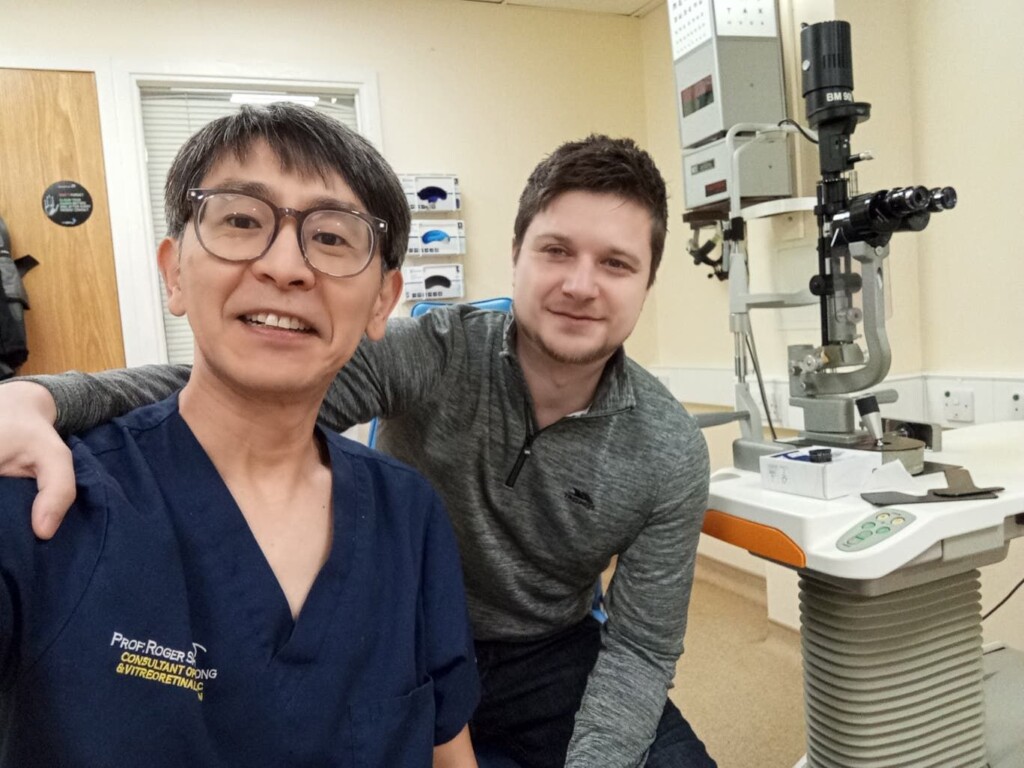
The first surgery focused on stabilising the structure of the eye, sealing ruptures, and preventing further leakage of ocular fluid, a critical step in preserving the eye’s physical integrity.
Doctors then proceeded with retinal repair surgery, reattaching the detached retina and clearing internal bleeding that had accumulated following the trauma.
A key milestone in the eye reconstruction breakthrough after car crash restores sight came when surgeons were able to rebuild the “globe” of the eye and restore pressure stability.
One specialist explained, “The globe was still leaking. It was actually a bit more like a raisin, rather than an eyeball,” highlighting the severity before reconstruction began.
He added, “That was the first step, which is basically making a globe a globe… to repair the rupture, let the eye settle.”
Multi-stage reconstruction and artificial restoration
Once structural stability was achieved, surgeons moved to the second phase of treatment, focusing on restoring appearance and partial function through advanced reconstructive techniques.
This included implanting a silicone artificial iris to replace the one destroyed in the crash, helping restore the visual structure of the eye.
Additional procedures involved inserting donor tissue to support drainage and internal eye health, ensuring long-term stability of the reconstructed organ.
Hurd described the process, saying, “He was able to reattach the retina, remove the blood, and stabilise the puncture wounds,” noting that each surgery built on the success of the previous one.
He later added, “I can see shapes and colour and I have peripheral vision. The good eye does all the heavy lifting,” confirming that while full vision was not restored, meaningful sight had returned.
Medical experts describe a rare but significant recovery
Specialists involved in the case emphasised that severe eye rupture injuries often carry a high risk of permanent vision loss, making Hurd’s recovery particularly notable.
Read also: US Iran ceasefire: Trump declares hostilities over as Senate blocks war halt
One surgeon explained, “Whenever you have a ruptured globe it is not good news… there’s a chance that you will lose that eye,” underlining the initial medical expectations.
He further noted that early intervention was critical, as stabilising the eye structure first allowed for later reconstructive procedures that would otherwise not have been possible.
The case reflects findings also discussed in external reporting by Reuters, which highlighted how modern ophthalmic trauma care increasingly focuses on staged reconstruction rather than immediate removal in severe cases.
The combined medical approach demonstrates how advancements in retinal repair surgery and ocular prosthetics are reshaping outcomes for patients once considered untreatable.
Recovery, resilience, and return to normal life
Beyond the medical achievement, Hurd’s recovery has also been described as a powerful example of personal resilience following life-altering trauma.
He underwent a long rehabilitation process involving multiple surgeries, vision therapy, and gradual adaptation to partial sight.
Despite the limitations in his injured eye, he has regained enough visual function to assist with depth perception and daily mobility.
His fiancée and family played a crucial role in supporting his recovery journey, helping him navigate both physical healing and emotional adjustment.
Doctors involved in his care described the outcome as deeply rewarding, with one stating it was “fulfilling” to see the patient regain meaningful quality of life after such severe injury.
The case also highlights broader advances in ophthalmology, particularly in managing complex trauma cases where traditional treatment options were once limited.
Medical experts say the combination of early surgical intervention, retinal reconstruction, and artificial implants is expanding what is possible in eye trauma recovery.
A milestone in eye surgery innovation
The eye reconstruction breakthrough after car crash restores sight seen in Chris Hurd’s case represents a significant milestone in modern eye surgery, demonstrating how layered surgical techniques can preserve and partially restore vision even after devastating trauma.
While full sight restoration was not achieved, the ability to recover functional vision marks a major step forward in ophthalmic trauma care.

As research continues into retinal regeneration, bioengineered tissue, and advanced prosthetic implants, cases like this may become increasingly common in the future.
For now, Hurd’s story stands as a powerful example of how medical innovation and determination can combine to defy expectations, even in the most severe circumstances.


