Tesla and SpaceX CEO Elon Musk has escalated his conflict with Ryanair’s Michael O’Leary, suggesting he might buy the budget airline after O’Leary rejected installing Starlink technology.
Elon Musk, the Tesla and SpaceX CEO, has recently intensified a public dispute with Ryanair chief executive Michael O’Leary by floating the idea of buying the Irish budget airline.
The disagreement erupted after O’Leary rejected Musk’s proposal to install Starlink satellite internet technology on Ryanair’s fleet of 650 aircraft. Musk, known for his bold social media statements, publicly called O’Leary an “idiot” and suggested that he should be removed from his position.
The escalation has drawn attention across Europe’s airline sector, highlighting tensions between technology innovation and operational cost considerations in low-cost carriers.
The dispute began when O’Leary, during an interview, declined to adopt Starlink technology for Ryanair, citing concerns about fuel consumption.
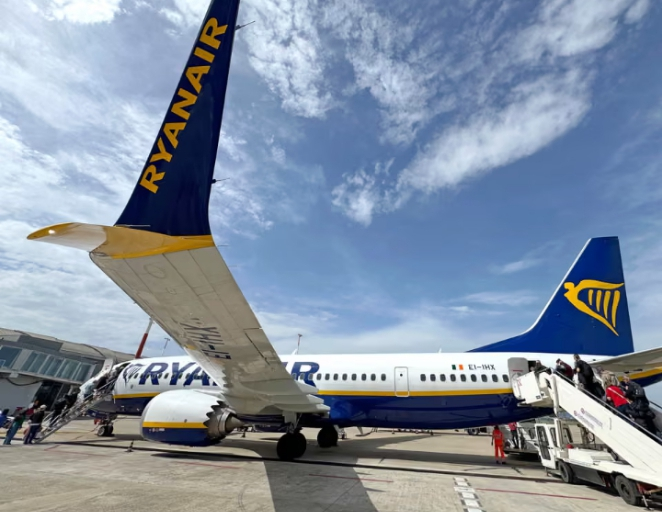
He explained that adding Starlink antennas would result in approximately “2% fuel drag,” increasing the airline’s kerosene costs by $200 million to $250 million annually.
O’Leary also emphasized that Ryanair passengers would not pay extra for internet service. According to him, providing free Wi-Fi would encourage overuse, while charging per passenger was not financially viable.
Musk responded by calling O’Leary’s claims “misinformed” in a post on his social media platform.
The exchange quickly evolved into a public feud. Both men traded insults, with each calling the other an “idiot.” Musk went further, suggesting that O’Leary should be fired.
To escalate the conflict, Musk proposed acquiring Ryanair, asking followers on his platform whether he should “buy Ryan Air and put someone whose actual name is Ryan in charge,” referring to Tony Ryan, the airline’s co-founder who passed away in 2007.
Musk also conducted a poll in which over three-quarters of nearly 900,000 respondents supported the idea of a takeover.
Despite Musk’s dramatic statements, Ryanair’s stock market performance indicated that investors were skeptical. Shares closed nearly 1% lower, reflecting doubts over the feasibility of Musk acquiring the airline.
Analysts note that European Union regulations complicate foreign takeovers, requiring airlines to be majority-owned by EU citizens or citizens of Switzerland, Norway, Iceland, or Liechtenstein. This regulatory framework would make any Musk-led acquisition subject to intense scrutiny.
O’Leary, known for his candid and sometimes controversial remarks, dismissed Musk’s opinions outright. On Irish radio, he stated, “I would pay no attention whatsoever to Elon Musk. He’s an idiot.
Very wealthy, but he’s still an idiot … What Elon Musk knows about flights and drag would be zero.” He reinforced his position by highlighting the financial impracticality of installing Starlink antennas, calculating that each additional dollar spent per passenger would make the service unsustainable for Ryanair.
The feud has included social media jabs and humorous commentary. Ryanair’s official account mocked Musk during a technical outage of his platform, implying that even he needed Wi-Fi.
Musk’s response, asking the airline how much it would cost to buy them, showed he might be serious about exploring the possibility of a takeover, though it also reflects his pattern of bold online statements.
In 2017, for instance, Musk expressed interest in buying Twitter publicly and eventually completed a $44 billion acquisition, renaming the platform X.
Starlink technology represents a growing trend in airline connectivity. Musk has been a vocal advocate for satellite internet on commercial flights, arguing that reliable in-flight internet improves passenger experience and offers airlines a competitive advantage.
Lufthansa and British Airways have already adopted Starlink technology for select aircraft, demonstrating the viability of space-based internet.
However, low-cost airlines like Ryanair face a different set of challenges, particularly around fuel efficiency and cost management, which O’Leary emphasized as his primary concern.
Financial considerations play a critical role in the debate. Ryanair’s model relies on minimizing operational expenses to keep ticket prices low.
Even a small increase in drag or fuel consumption can translate into tens of millions of dollars annually. Adding Starlink antennas, while technologically advanced, would disrupt Ryanair’s cost structure.
Musk, by contrast, focuses on technological innovation and long-term strategic positioning, creating a fundamental tension between the two business approaches.
The feud has drawn attention to Musk’s bold approach to corporate strategy. He frequently uses social media to challenge industry norms and provoke discussions that can influence public opinion and market behavior.
His actions suggest that he is willing to challenge existing business models, even in sectors like aviation, where regulatory frameworks and operational costs are tightly controlled.
Musk’s consideration of acquiring Ryanair, while partially provocative, highlights his interest in combining technology innovation with traditional industries.
O’Leary, aged 64, also emphasized that he is largely disengaged from social media, stating that he is “thankfully” too old to have active accounts.
His resistance to Musk’s suggestions reflects a broader approach in which Ryanair maintains strict control over operational decisions, emphasizing cost efficiency and predictability for passengers.
The airline has consistently prioritized low fares and operational efficiency over technological experimentation, a strategy that has helped it remain competitive in Europe’s crowded budget airline market.
The potential acquisition of Ryanair by Musk, if pursued seriously, would face both regulatory and financial hurdles. EU laws require that airlines remain majority-owned by citizens of EU or affiliated countries, making a direct acquisition by a South African-born billionaire a complex undertaking.
Nevertheless, Musk has repeatedly demonstrated the ability to navigate complex business environments, having successfully launched Tesla, SpaceX, and Starlink while executing the high-profile acquisition of X (formerly Twitter).
His interest in Ryanair could also reflect an intention to modernize budget airline operations through advanced technology solutions, including satellite-based internet and potentially other innovations yet to be revealed.
The public dispute highlights broader trends in the airline industry and technology sector. Satellite internet, while increasingly popular, introduces questions about cost-benefit trade-offs, passenger expectations, and environmental considerations.
Airlines such as Ryanair must weigh potential revenue opportunities from premium services against the operational cost impact of adding new technologies.
Musk’s vision, on the other hand, prioritizes technological integration and the expansion of connectivity, aiming to set a standard for future airline operations across Europe and beyond.
As the feud continues, it has become a case study in the intersection of technological innovation and traditional business models.
The clash between Musk and O’Leary illustrates the differing priorities of visionary tech entrepreneurs and cost-conscious airline executives.
While Musk pushes for modernization and networked innovation, O’Leary focuses on practical economics and maintaining a lean operational structure.
This tension underscores the challenges that arise when disruptive technologies confront established business practices, particularly in industries with strict regulations and tight profit margins.
The outcome of Musk’s public proposal remains uncertain. While social media polls suggest broad interest in a potential takeover, regulatory, financial, and operational factors make any acquisition highly complex.
Investors appear cautious, and industry analysts note that a Musk-led Ryanair would require innovative financing structures, regulatory negotiations, and careful integration of new technologies.
Regardless of the outcome, the feud has spotlighted the broader conversation about technology adoption, airline efficiency, and leadership in high-profile European businesses.
Musk’s proposal also raises questions about the future of airline innovation in Europe. As airlines balance cost management with passenger expectations, the adoption of technologies like Starlink could become a competitive differentiator.

Ryanair’s decision to reject Musk’s proposal for now may be pragmatic, but the ongoing conversation indicates that European airlines cannot ignore the potential impact of satellite-based internet, even in the low-cost segment.
This public feud is more than just a personal spat; it reflects deeper dynamics between technological disruption, operational pragmatism, and regulatory environments in the aviation sector.
As Musk continues to push boundaries and O’Leary maintains a cost-focused approach, the industry is observing a real-time debate about how airlines can integrate cutting-edge technology while remaining financially sustainable.
The clash may also influence how other budget airlines evaluate technological upgrades and passenger services in the near future.
About The Author