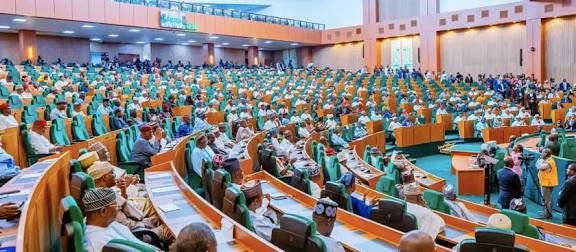
The House of Representatives was thrown into a heated session on Tuesday as lawmakers resumed discussions on the electoral act amendment bill 2025, emphasizing a clause-by-clause consideration of the legislation.
The bill, which has significant implications for the 2027 general elections, was the subject of intense scrutiny following earlier concerns over inconsistencies and procedural gaps.
Earlier this year, in December 2025, the House had passed the amendment bill.
However, a harmonisation committee, comprising leaders of both chambers, conference committee members, clerks of the Senate and House, and legal drafters from the National Assembly’s Directorate of Legal Services, flagged certain unintended consequences and legal inconsistencies.
In response, the House resolved to rescind its earlier approval to allow for detailed reassessment and correction of the legislation.
The motion for rescission was moved under Order Nine, Rule 6 of the Standing Orders by Hon. Francis E. Waiwe (Delta).
He emphasized that the objective was to strengthen the integrity of Nigeria’s electoral framework, ensuring fairness, inclusivity, administrative efficiency, and public confidence in the electoral process.
Lawmakers agreed that a transparent and meticulous approach was necessary, given the high stakes for the 2027 general elections.
Following the adoption of the motion, the House entered the Committee of the Whole, presided over by the Deputy Speaker, to begin clause-by-clause consideration of the Electoral Act Amendment Bill.
However, tensions escalated when the Deputy Speaker initially proposed taking the report in bulk.
Lawmakers immediately objected, stressing that a general review would be inadequate considering the bill’s far-reaching impact on election administration and voter confidence.
The House members insisted that each clause must be individually debated, scrutinized, and voted on.
In response to the protests, the Deputy Speaker halted proceedings and recommenced the session, agreeing to detailed clause-by-clause deliberation.
During the discussions, Clause 60(3) emerged as one of the most contentious points.
This clause provides for both electronic transmission and manual transmission of election results, a dual system intended to enhance reliability and public trust.
Debate over Clause 60(3) was intense. Rep. Bamidele Salam moved to delete the provision for manual transmission, arguing that reliance on manual reporting could undermine technological advances and compromise the credibility of election results.
The motion was seconded by Rep. Kingsley Chinda, who also emphasized the need to modernize the electoral process and minimize human error.
Lawmakers supporting manual transmission countered that completely abandoning a paper-based system could create vulnerabilities and reduce transparency.
They highlighted that in regions with limited technological infrastructure, manual transmission remains essential to ensuring all votes are counted accurately.
When the matter was put to a voice vote, the “nays” prevailed, maintaining the inclusion of manual transmission alongside electronic reporting.
Beyond Clause 60(3), the House also examined provisions related to electoral administration, voter registration, and result verification.
Lawmakers debated safeguards to prevent electoral malpractice, ensure the security of electronic systems, and provide clear procedures for contesting results.
The discussions underscored a shared commitment to balancing technological innovation with practical safeguards for all citizens.
Observers noted that the session reflected a maturing legislative process, where lawmakers actively engaged with legal and technical aspects of the Electoral Act Amendment Bill.
The emphasis on clause-by-clause review demonstrates the House’s determination to address every potential loophole, reduce litigation risks, and enhance the credibility of elections ahead of 2027.
The House of Representatives session ended with a sense of cautious optimism.
Lawmakers agreed to continue reviewing remaining clauses in subsequent sittings, ensuring that the Electoral Act Amendment Bill 2025 will be robust, comprehensive, and ready to guide Nigeria’s electoral process for years to come.
By adopting a methodical, transparent, and inclusive approach, the House signaled its commitment to protecting the integrity of elections, supporting technological advancement while retaining necessary procedural safeguards, and prioritizing public confidence.
The clause-by-clause consideration ensures that every amendment is thoroughly debated, and both electronic and manual systems for transmitting results remain integral to Nigeria’s democratic framework.
About The Author