The El-Fasher massacre has become a chilling symbol of Sudan’s descent into unrestrained brutality as survivors recount scenes of murder, rape, and devastation at the hands of the Rapid Support Forces.
Thousands who fled the city speak of corpses decomposing in the open, streets filled with blood, and families separated or executed in front of one another during the El-Fasher massacre.
Aid workers fear only a fraction of the population managed to escape, while the rest remain trapped under siege or dead in what is now one of Darfur’s darkest chapters.
Reports from humanitarian groups say at least 1,500 civilians were killed when RSF fighters stormed El-Fasher, the capital of North Darfur, beginning the city’s week-long ordeal now known as the El-Fasher massacre.
The Sudan Doctors Network said 460 of the dead were executed inside a hospital, where terrified civilians sought refuge, only to be massacred in cold blood.
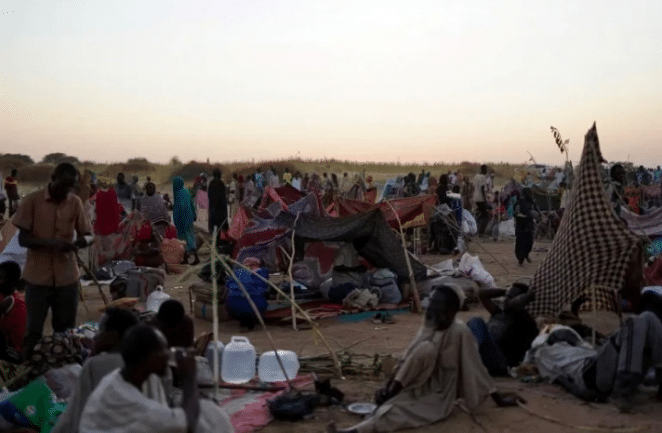
The surviving residents, mostly women and children, trudged barefoot through the desert to Tawila, seventy kilometres away, already a shelter for more than half a million displaced people.
Hayat, a mother of five, recalled RSF gunmen breaking into her home, searching her undergarments, and killing her teenage son as she screamed helplessly during the El-Fasher massacre.
“We saw many bodies lying in the streets and wounded people crying out for help,” she told AFP through a satellite phone. “No one could stop to help.”
Another survivor, Hussein, reached Tawila after being wounded by shelling. He described El-Fasher as a “graveyard of unburied dead” where even the smell of death filled the air.
“The situation was beyond horror,” he said. “We escaped with only the clothes we wore, and still, we thank God we survived.”
Aisha Ismael, who also fled the city, told reporters that RSF fighters used drones to shell residential neighbourhoods day and night. “They hit us with rifle butts when we tried to hide,” she said.
“At 3 a.m., we ran through side streets barefoot, leaving everything behind. Even our shoes were taken from us,” she added, her voice breaking as she recalled the El-Fasher massacre.
Al Jazeera’s correspondent in Khartoum, Hiba Morgan, reported that more than 15,000 displaced people arrived in Tawila in just two days, many severely dehydrated and wounded.
“Children are fainting from hunger,” Morgan said, citing the Sudan Doctors Network. “People have walked for days without food or clean water.”
Mathilde Vu, advocacy manager for the Norwegian Refugee Council, warned that only a small fraction of those trapped in El-Fasher managed to flee the El-Fasher massacre.
“The number of people who made it to Tawila is terrifyingly small,” Vu said. “It shows how deadly the journey has become for those trying to survive.”
United Nations humanitarian chief Tom Fletcher described the situation as “a descent into an even darker hell” and said the El-Fasher massacre represents “catastrophic levels of human suffering.”
Addressing the UN Security Council, Fletcher condemned the RSF’s actions and warned that men attempting to flee faced extortion or execution, while women were subjected to rape and abduction.
“Even the wounded and disabled are stranded, unable to move,” he said. “There is no mercy left in that city.”
The RSF has been accused of systematically blocking aid convoys from entering Darfur. Fletcher said RSF checkpoints have prevented food and medicine from reaching those trapped inside El-Fasher.
In response, the UN released twenty million dollars from its Central Emergency Response Fund to support operations in Tawila and nearby areas overwhelmed by displaced civilians.
UN spokesperson Stephane Dujarric said the world body was “horrified” by the slaughter of 450 civilians at Saudi Hospital, calling it one of the most disturbing episodes of the El-Fasher massacre.
He said patients, doctors, and families who had sought refuge there were executed inside wards. “Bodies were piled in corridors. The hospital is now a tomb,” Dujarric added gravely.
Elderly people, the injured, and those with disabilities remain trapped in the city, unable to flee. Aid convoys are stalled by RSF checkpoints that demand payment or seize relief supplies.
Shayna Lewis, a Sudan specialist, told Al Jazeera that civil society groups had long warned of atrocities in Darfur but that global inaction made the El-Fasher massacre inevitable.
“For over a year, we shouted warnings,” she said. “Everyone saw this coming, yet no one acted. The blood is on the conscience of the world.”
For 18 months, the Sudanese army and the RSF fought for control of El-Fasher, leaving civilians besieged without food, medicine, or fuel. When government troops withdrew, chaos engulfed the city.
The RSF moved in swiftly, torching neighbourhoods and executing men accused of army ties. Women were dragged from homes and assaulted in front of children during the El-Fasher massacre.
Satellite imagery from Yale University’s Humanitarian Research Lab showed red stains covering large sections of the city — evidence consistent with blood pools and mass graves.
Analysts said the evidence leaves no doubt that thousands were killed and buried in shallow pits, their identities lost in the dust of Darfur’s desolation.
International rights groups condemned the killings, calling them crimes against humanity. Amnesty International and Human Rights Watch both demanded an independent UN investigation.
But inside Darfur, there is silence. Internet services are down, communication is minimal, and aid workers describe an atmosphere of total terror as the El-Fasher massacre continues unchecked.
A senior aid coordinator told reporters anonymously that RSF fighters now control access to every major road, using food as a weapon against the starving survivors.
“People eat grass and drink dirty water,” he said. “We are watching a genocide unfold in real time, and no one can intervene.”

In Tawila, children sleep under open skies without tents. Local officials say diseases are spreading, and there is no medicine left to treat the wounded from the El-Fasher massacre.
Mothers have been forced to bury their babies in shallow graves, while elderly survivors sit motionless, staring into the horizon, unable to comprehend their loss.
The UN says the number of displaced people in North Darfur has now surpassed one million, and every hour, more arrive on foot — weak, traumatized, and silent.
Despite global outrage, the RSF has shown no intention of halting its advance. Commanders have reportedly vowed to capture remaining holdouts in the region and erase resistance completely.
Diplomatic efforts to broker a ceasefire have failed, with Sudan’s fractured leadership too weak to impose control over armed groups committing atrocities in its name.
International analysts now warn that the El-Fasher massacre may trigger a wider ethnic cleansing campaign, reminiscent of Darfur’s bloody conflict two decades ago.
The African Union and Arab League have condemned the violence, but no meaningful sanctions or interventions have followed, leaving civilians defenceless.
In refugee camps like Tawila, despair hangs heavy. Families huddle together in silence, haunted by the screams that echoed through El-Fasher’s streets during the El-Fasher massacre.
Humanitarian agencies warn of famine and disease if aid corridors remain blocked. They say Sudan’s conflict, already one of the world’s worst, is fast becoming uncontainable.
The RSF’s brutality has drawn global outrage, yet tangible action remains elusive. For those who escaped, every memory of the El-Fasher massacre is a wound that refuses to heal.
As one survivor whispered before fainting at the gates of Tawila camp: “The world heard our screams — but nobody came.”
About The Author