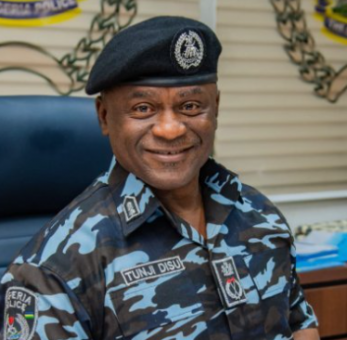
Olatunji Disu appointment as Nigeria’s 23rd Inspector-General of Police has been formally ratified by the Nigeria Police Council, marking a significant transition in the country’s security leadership.
The decision was reached on Monday during a brief but high-level meeting at the Council Chamber of the State House in Abuja.
Presiding over the session was President Bola Ahmed Tinubu, who chairs the Nigeria Police Council.
The meeting, which lasted less than 30 minutes, brought together senior government officials and state governors to consider and approve the nomination.
The swift endorsement underscored a consensus among members of the Council regarding the Disu appointment.
The confirmation followed the resignation of former Inspector-General of Police, Kayode Egbetokun, whose departure was announced the previous week.
In its earlier communication, the Presidency had indicated that the Council would soon convene to deliberate on a successor.
Monday’s gathering fulfilled that constitutional obligation and paved the way for the Disu appointment to take full effect.
Under the provisions of the Police Act 2020, the President’s nomination of an Inspector-General must be reviewed and approved by the Nigeria Police Council.
This statutory requirement ensures institutional oversight in the selection of the nation’s top police officer.
The Council comprises the President, the 36 state governors, the Chairman of the Police Service Commission, and the Inspector-General of Police.
Among those present at the meeting were Vice President Kashim Shettima; Secretary to the Government of the Federation, George Akume; National Security Adviser, Nuhu Ribadu; and Head of the Civil Service of the Federation, Didi Walson-Jack.
Several governors also attended, including AbdulRazaq AbdulRahman of Kwara State, Babajide Sanwo-Olu of Lagos, Dapo Abiodun of Ogun, Abdullahi Sule of Nasarawa, Caleb Mutfwang of Plateau, Lucky Aiyedatiwa of Ondo, and Peter Mba of Enugu.
Deputy governors from Kogi and Delta states, alongside ministers responsible for the Federal Capital Territory, Police Affairs, and Interior, were equally in attendance.
Before his confirmation, Disu had been serving in an acting capacity following Egbetokun’s resignation.
His transition from acting to substantive Inspector-General signals continuity in leadership, while also presenting an opportunity for renewed reforms within the Nigeria Police Force.
Observers note that the Disu appointment comes at a period when public confidence in law enforcement remains a key national concern.
During his decoration ceremony last week, President Tinubu emphasized the weight of responsibility that accompanies the office.
He described the moment as pivotal in Nigeria’s democratic and security journey, urging the new police chief to prioritize professionalism, accountability, and the welfare of officers.
According to the President, restoring trust between the police and citizens must remain central to the new administration’s agenda.
The newly confirmed Inspector-General, 59, brings decades of policing experience to the role.
A native of Lagos Island, he joined the Nigeria Police Force on May 18, 1992, steadily rising through the ranks over the years.
His academic background includes a bachelor’s degree in English Education from Lagos State University, as well as master’s degrees in Public Administration and in Criminology, Security, and Legal Psychology.
Supporters argue that this blend of operational experience and academic training positions him well to address contemporary security challenges.
Security analysts suggest that the Disu appointment will be judged not only by policy direction but also by measurable improvements in crime prevention, intelligence coordination, and community policing.
The Police Act 2020 provides a framework for reform, but implementation has often proven more complex than legislation.
As such, expectations surrounding the Disu appointment extend beyond ceremonial endorsement to tangible institutional transformation.
Nigeria continues to grapple with varied security concerns ranging from banditry and kidnapping to cybercrime and urban violence.
In this context, leadership at the helm of the police force carries both symbolic and practical importance.
The Nigeria Police Council’s unanimous approval signals political backing, yet the ultimate test lies in operational effectiveness and improved public perception.
With the Council’s decision now finalized, Disu assumes full authority as Inspector-General of Police.
His mandate includes strengthening internal discipline, enhancing officer welfare, and fostering collaboration with other security agencies.
As the Disu appointment ushers in a new phase for the Force, stakeholders across the country will be watching closely to see how this leadership transition shapes Nigeria’s security landscape in the months ahead.
Ireport247news
About The Author