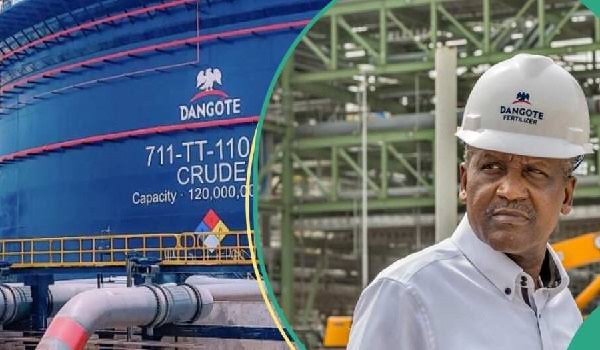

Nigeria’s journey toward energy independence has received a significant boost as the Dangote Refinery continues to reshape the nation’s petroleum landscape, now contributing an average of 20 million litres of fuel daily into the domestic market.
This development was confirmed by the Chief Executive Officer of the Nigerian Midstream and Downstream Petroleum Regulatory Authority (NMDPRA), Farouk Ahmed, who described the refinery’s progress as a defining milestone in Nigeria’s energy evolution.
Speaking at the Association of Energy Correspondents of Nigeria (NAEC) Annual Conference in Lagos, Ahmed outlined ongoing reforms aimed at stabilising fuel supply, promoting investment, and ensuring energy security across the country.
According to him, the commencement of consistent fuel supply from the 650,000-barrel-per-day Dangote Refinery has “changed the supply dynamics” of Nigeria’s downstream sector.
“Without a shadow of a doubt, the operation of the Dangote Refinery has transformed the domestic supply system with an average daily contribution of up to 20 million litres, with potential for further ramp-up,” Ahmed said.
Dangote Refinery: A Game Changer in Domestic Fuel Production
The Dangote Refinery, regarded as Africa’s largest integrated refinery, is strategically addressing Nigeria’s decades-long dependency on imported petroleum products.
With the country’s current fuel consumption averaging 50 million litres daily, the refinery’s output now covers a substantial portion of local demand.
Since its operational ramp-up earlier this year, the refinery has also made major strides in the international market, exporting over 1 billion litres of petrol to countries including the United States and other destinations between June and September 2025.
Ahmed noted that the NMDPRA views the refinery’s performance as a major proof of Nigeria’s refining capability and a turning point toward energy self-sufficiency.
Represented by NMDPRA’s spokesperson, George Ene-Ita, Ahmed emphasised that the refinery’s output demonstrates that the nation can sustain its fuel needs locally while generating foreign exchange through exports.
Energy Security: NMDPRA Pushes for National Strategic Stock
While praising the Dangote Refinery for easing fuel scarcity pressures, Ahmed also stressed the need for long-term planning to safeguard Nigeria’s energy future.
He revealed that the government was intensifying efforts to operationalise the National Strategic Petroleum Products Stock, as stipulated in the Petroleum Industry Act (PIA) 2021.
According to him, the initiative aims to provide a supply buffer against global shocks, disruptions, and emergencies in the petroleum supply chain.
“To further strengthen our energy security, we must operationalise the National Strategic Stock to provide a cushion against major supply disruptions,” he said.
Ahmed explained that the NMDPRA was collaborating with stakeholders to design an implementation framework for the strategic reserves while tightening oversight on product storage, transportation, and distribution nationwide.
Regulatory Oversight and Refining Standards
The NMDPRA chief executive also highlighted the agency’s broader reforms to reinforce transparency, compliance, and safety in the downstream sector.
He noted that licensing procedures were being streamlined and that new standards were being implemented for depot operations and product storage facilities.
“We are accelerating licensing, enhancing standards for storage and depot operations, and enforcing stricter surveillance of product movement to reduce adulteration, hoarding, and transit accidents,” Ahmed said.
Under the PIA 2021, the NMDPRA is mandated to provide technical, commercial, and safety oversight for Nigeria’s midstream and downstream operations.
Ahmed stated that the agency’s regulatory philosophy was not to constrain operators but to serve as a “predictable enabler of development.”
He reaffirmed that accountability, stakeholder engagement, and transparency remain central to the authority’s work, adding that regular stakeholder consultations and public disclosures of rulemaking calendars were key to rebuilding investor confidence in the energy sector.
Dangote Refinery: Symbol of Nigeria’s Industrial Revival
Describing the Dangote Refinery as “a symbol of Nigeria’s industrial resurgence,” Ahmed stated that its success represents more than just domestic refining capacity—it signals a new era of energy resilience, job creation, and foreign exchange conservation.
“The refinery is not only reducing our import bill but also saving billions in foreign exchange and stimulating industrial activity,” he said.
He added that every refinery, pipeline, and megawatt of power was vital to improving citizens’ quality of life through dependable energy access.
Ahmed further explained that the NMDPRA was also advancing Nigeria’s gas utilisation agenda, encouraging investments in Liquefied Petroleum Gas (LPG) and Compressed Natural Gas (CNG) to diversify the nation’s energy sources.
These efforts, he said, align with Nigeria’s long-term goal of expanding the energy mix beyond fossil fuels.
Nigeria’s Future as Africa’s Energy Hub
Looking ahead, Ahmed projected that Nigeria could evolve into Africa’s leading energy hub, powered by sustained collaboration between the public and private sectors.
“If we get this right, Nigeria becomes not just a fossil-fuel exporter but an energy architect for Africa’s future,” he stated.
He called on journalists and the media to highlight both the achievements and challenges of Nigeria’s energy transformation, saying balanced reporting was essential to public understanding of the reforms.
“When you tell the Nigerian story of energy, don’t just report outages,” Ahmed urged.
“Show the refinery producing, the pipeline being welded, and the cylinder being filled. That’s how we track real progress.”
Ahmed concluded by assuring Nigerians that the NMDPRA would continue to measure its success by the real-life impact of its policies on citizens.
“Every regulatory decision we make will be judged not by paperwork but by whether Nigerians see better outcomes in their lives,” he said.
The rise of the Dangote Refinery as a key supplier of 20 million litres of fuel daily marks a historic leap in Nigeria’s quest for energy independence and economic sustainability.
With NMDPRA’s continued oversight and reforms under the PIA framework, Nigeria appears well-positioned to secure stable fuel supply, attract investment, and emerge as a leading energy hub for the African continent.
About The Author