Centrist party Democrats 66 (D66) has emerged as the clear winner in the Dutch election results, according to provisional figures released by the national news agency ANP.
The party, led by 38-year-old Rob Jetten, has captured the majority of votes across the Netherlands, signaling a major political shift and redefining the country’s centrist landscape.
As municipalities across the country concluded their counts, ANP’s aggregated data showed D66 securing an unassailable lead over the far-right Party for Freedom (PVV), headed by Geert Wilders.
This significant result places the D66 party at the heart of coalition negotiations and underscores the public’s renewed interest in progressive centrism.
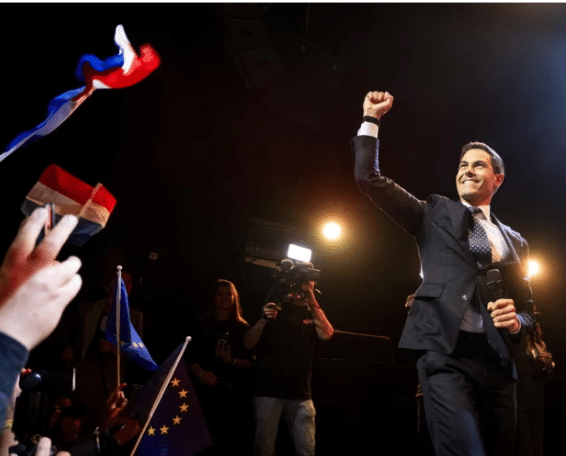
Jetten, known for his calm demeanor and reform-oriented approach, addressed supporters in Leiden as early results rolled in, calling the victory a “mandate for cooperation, optimism, and unity.”
His words resonated deeply in a political climate recently dominated by polarization, with his message of balance and inclusiveness helping D66 regain momentum after years of fluctuating support.

For many Dutch citizens, the Dutch election results represent a turning point. After a period of intense political debate around immigration, climate change, and economic inequality, voters appear to have leaned toward moderation.
Jetten’s campaign focused on restoring trust in government, promoting climate policies rooted in innovation, and emphasizing education and digital transformation.
Provisional counts released by ANP indicate that D66 holds 26 seats, equal to the PVV, but with ongoing counts from Venray and overseas ballots, Jetten’s party could claim a narrow lead and become the largest party in the new parliament.
This potential outcome marks an impressive achievement for a party that, not long ago, was fighting to maintain relevance in a rapidly shifting political field.
The success of Rob Jetten is especially striking given the rise of far-right sentiment in several European countries.
While Geert Wilders’s PVV party made headlines for its anti-immigration stance and criticism of European Union policies, D66’s centrist message offered a counterbalance, appealing to both progressive voters and pragmatic moderates. Many political observers believe this balance helped tip the scales decisively.
The Dutch election results have surprised analysts who initially expected a close contest dominated by right-wing rhetoric. Instead, the outcome revealed that many voters were looking for stability and effective governance.
Jetten’s strategy emphasized dialogue rather than division, focusing on policies that connect environmental responsibility with economic growth.
In his remarks following the release of early results, Jetten praised the Dutch electorate for “choosing collaboration over confrontation.”
His words were greeted with loud applause from party supporters, who viewed the victory not just as a political success, but as a reaffirmation of civic engagement and national unity.
As counting continues in Venray and overseas ballots arrive, officials anticipate that final results will confirm D66’s dominance.
If the party indeed secures another seat, it could command a stronger negotiating position in forming a new governing coalition. For Jetten, this means the opportunity to transform electoral momentum into long-term policy impact.
The D66 party victory also marks a generational change in Dutch politics. Jetten, who became party leader after Sigrid Kaag stepped down, represents a younger, more energetic brand of leadership. His ability to connect with both young voters and established professionals has been a major factor in the party’s resurgence.
Political experts suggest that the Dutch election results reflect widespread fatigue with populist narratives. Although Geert Wilders’s PVV remains influential, its limited growth indicates that many citizens prefer constructive reform to ideological extremism. The D66’s message of pragmatic progressivism appears to have struck the right chord at the right time.
In Leiden, where D66’s campaign headquarters became the focal point of national attention, the atmosphere was electric as supporters followed the vote tally.
Jetten’s smile, broadcast across Dutch television, symbolized both relief and determination — relief at the clear win, and determination to steer the country toward unity.
While the final count is still pending, the tone among political commentators has shifted decisively. Many now speak of Jetten as a potential future prime minister, especially if coalition talks favor D66 as the anchor of a new centrist government.
The party’s consistent stance on climate action, education, and digital innovation provides a framework that could appeal to multiple partners across the political spectrum.
For the far-right PVV, the loss will likely prompt introspection. Although Geert Wilders remains a dominant media presence, his party’s inability to convert momentum into majority support suggests limits to populist messaging in the Dutch context.
Analysts argue that Wilders’s confrontational style may have alienated moderate voters, pushing them toward Jetten’s steadier alternative.
As the Dutch parliament prepares for its next session, attention now turns to coalition-building. With no single party holding an outright majority, negotiations are expected to involve extensive discussions among D66, Labour, the Greens, and potentially centrist conservative factions. The political dynamics of the Netherlands have long depended on cooperation, and Jetten’s leadership style aligns with this tradition.
Observers note that D66’s success was also bolstered by strong urban turnout and strategic campaigning among younger voters.
The party’s emphasis on climate innovation, digital rights, and affordable housing resonated with a demographic eager for forward-looking governance. In cities like Amsterdam, Rotterdam, and Utrecht, D66 recorded some of its highest vote shares in years.
Beyond domestic politics, the D66 party victory may influence the Netherlands’ role in the European Union. Jetten’s pro-EU stance contrasts sharply with the PVV’s Euroscepticism.
This could lead to a renewed Dutch commitment to collaborative European policy on issues such as energy transition, migration management, and trade.
Meanwhile, ANP’s provisional data continue to attract attention from political analysts who view the Dutch election results as emblematic of broader European trends — where centrist parties are regaining ground amid voter fatigue with populist promises. If the final tally confirms D66 as the largest party, it will further cement Jetten’s status as one of Europe’s most promising young leaders.
Despite celebration within D66 circles, challenges remain. Jetten must now navigate coalition negotiations delicately, balancing the expectations of supporters with the realities of compromise politics. His ability to deliver tangible results will determine whether this electoral success translates into sustained public trust.
As the Netherlands awaits official confirmation of the final results, the sense of optimism surrounding D66’s victory is palpable. Across the nation, citizens express cautious hope that a centrist resurgence can bring greater stability and pragmatic leadership.
The coming days will reveal whether Rob Jetten can transform this Dutch election victory into a durable governing mandate. For now, his success stands as a clear message: moderation, dialogue, and innovation remain powerful forces in modern politics.
About The Author