

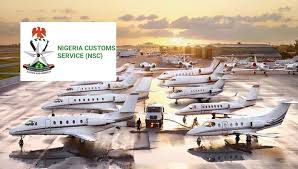
The Nigeria Customs Service (NCS) has bowed once again to pressure from powerful private jet owners as it announced a final one-month grace period for the payment of unpaid import duties on private aircraft operating within Nigeria. The extension, announced on Thursday by the agency’s spokesperson, Abdullahi Maiwada, comes after weeks of enforcement actions and high-level lobbying by jet owners, including business moguls, bank chiefs, and multinational executives.
In what has now become a prolonged standoff between luxury jet owners and the federal government, the NCS said the reprieve followed renewed consultations and mutual understanding between the service and the concerned parties. The decision comes despite a firm enforcement exercise carried out earlier in the year, during which over 60 aircraft were grounded across key airports in Lagos and Abuja over unpaid duties.
“Following consultation and mutual understanding, the Nigeria Customs Service has decided to suspend the enforcement action and extend the window for compliance by one month,” Maiwada stated. “This decision is to allow aircraft owners time to regularize documentation and pay the appropriate customs duty.”
The issue of unpaid duties on private jets has remained a major concern for the federal government. Industry insiders suggest that the total amount owed by private jet owners could run into several billions of naira. Many of the aircraft, often registered abroad, entered the country under temporary importation permits, allowing them limited stay without duty. However, several of these jets have overstayed and continued operations without settling the requisite import tariffs.
In October 2024, the NCS launched a verification exercise to identify defaulters. The agency initially planned to commence the grounding of aircraft on October 14, 2024, but extended the deadline by a month to allow compliance. Yet, enforcement became inevitable when several owners failed to take advantage of the extension.
Aircraft such as the Bombardier BD-700 Global 6000, 6500, and 7500 were among those grounded in a clampdown that began in May 2025. Hangars housing these luxury jets at Lagos and Abuja airports were reportedly sealed, prompting widespread panic among elite jet owners. Multiple sources confirmed that some aircraft were impounded mid-flight or shortly after landing.
The enforcement exercise reportedly triggered a wave of lobbying at the Presidency. Sources within the aviation and customs circles told PUNCH that top executives from the banking sector, oil multinationals, and other business moguls reached out to top government officials seeking political intervention.
Aviation stakeholders argue that the impasse reflects deeper regulatory lapses and lack of coordination between agencies. Speaking exclusively to PUNCH, industry expert Capt. Muhammed Badamosi emphasized the need for collaboration between the Nigeria Civil Aviation Authority (NCAA) and the NCS.
“The NCAA must ensure that aircraft owners are informed upfront about their customs obligations. While NCAA regulates flight operations, Customs handles fiscal compliance. If the processes are aligned from the onset, we won’t find ourselves in this quagmire,” Badamosi explained.
He called for institutional reforms to bridge the communication gap between aviation authorities and fiscal agencies, stressing that cross-agency collaboration could prevent such crises.
While the latest extension is seen as a softening of stance, Customs officials insist it is the final warning. According to Maiwada, “The NCS remains committed to recovering all outstanding duties. After this one-month window, there will be no further extension. Any aircraft found to be in violation will face the full weight of the law.”
The move also aligns with the government’s broader drive to boost non-oil revenue and block fiscal leakages. With the Tinubu administration facing pressure to fund rising public expenditure, analysts say enforcing import duty compliance among the elite sends a strong message on equality before the law.
As the countdown begins on the new grace period, all eyes are now on private jet owners. Will they finally comply, or will the Customs Service be forced into another round of high-stakes enforcement?
About The Author
