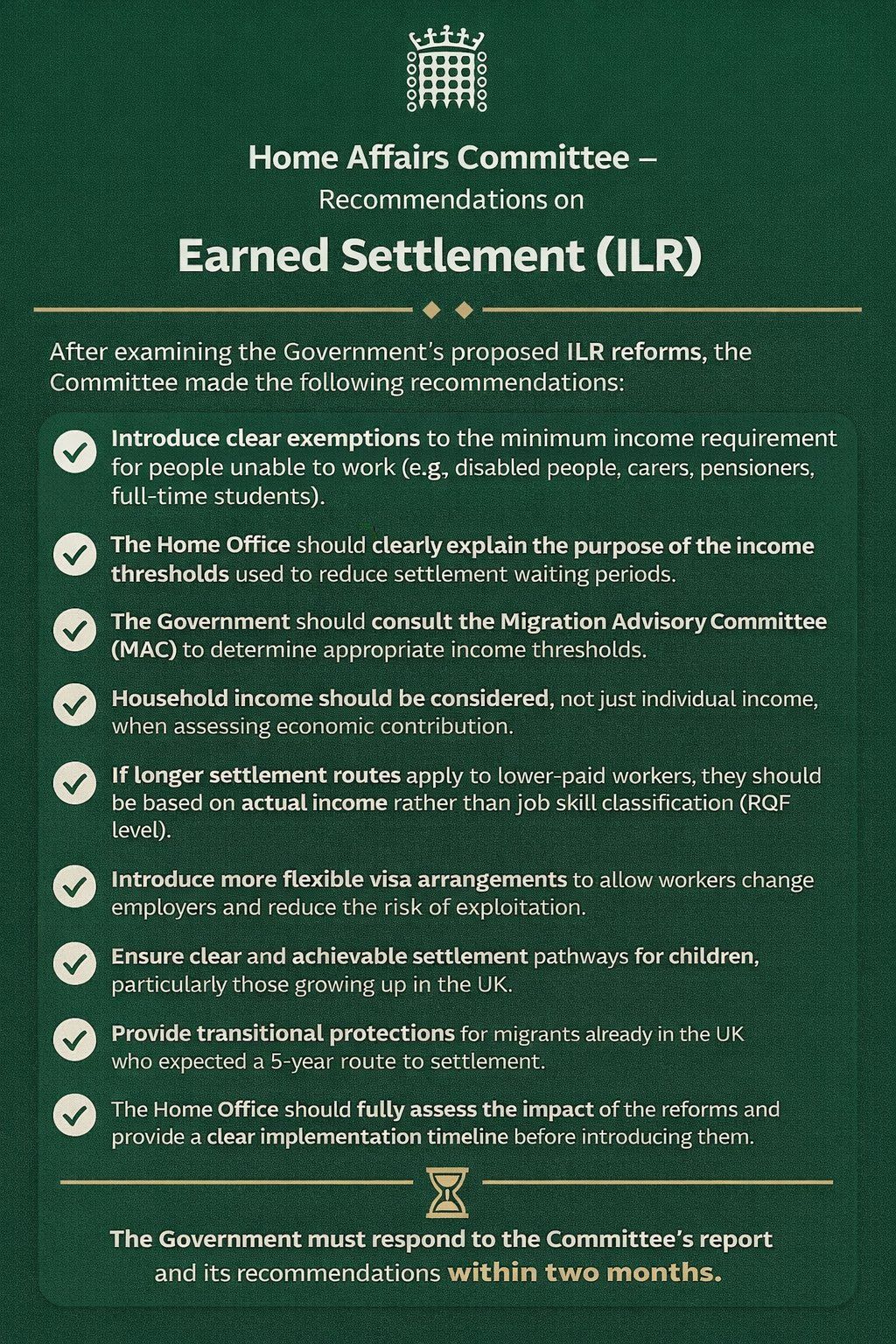

Home Affairs Committee recommendations on earned settlement outline how the UK government should adjust proposed reforms to Indefinite Leave to Remain. MPs examined the policy and issued recommendations aimed at fairness, transparency, and preventing migrant exploitation.
The committee reviewed the government’s proposal to introduce an “earned settlement” model where migrants could qualify for permanent residency at different speeds depending on income, employment contribution, and compliance with immigration rules.
MPs warned that without careful safeguards, the reforms could create uncertainty for migrants already living and working in the United Kingdom. They said the government must ensure the system remains predictable and fair.
The report emphasised that income thresholds should not unfairly disadvantage migrants who cannot work because of disability, caring responsibilities, or education commitments. Lawmakers said exemptions are necessary to prevent discrimination.

Under the proposals, higher earnings could allow migrants to qualify for settlement faster, while lower earnings could extend waiting periods. MPs questioned whether the system adequately reflects the realities of workers across sectors.
They also expressed concern that linking settlement speed primarily to income could penalise people working in socially valuable but lower-paid roles, including many positions within the public service and care sectors.
The committee stressed that economic contribution should be assessed carefully. It warned against policies that treat migrants as purely economic units without considering broader contributions to society.
MPs said the Home Office must provide detailed explanations about how income thresholds would function. They argued that transparency is essential for migrants planning long-term lives in the UK.
The report highlighted the need for independent expert input. The committee said the Migration Advisory Committee should be consulted before any income thresholds are finalised.
Lawmakers believe the Migration Advisory Committee can provide evidence-based guidance about labour markets, wages, and economic conditions across different sectors of the British economy.
Another major concern involved how economic contribution is measured. MPs recommended that household income should be considered rather than focusing solely on an individual worker’s salary.
They argued that many families share financial responsibilities and that assessing total household income would give a more accurate picture of financial stability and integration.
The committee also criticised the idea of basing settlement timelines solely on job skill classification levels. Some proposals linked longer settlement routes to lower-skilled job categories.
MPs warned that using skill classifications such as RQF levels could unfairly penalise workers whose jobs are labelled “lower skill” despite being essential to the economy.
Instead, they recommended that settlement routes should reflect actual income levels rather than rigid occupational categories. This approach would better reflect real economic contributions.

Another key recommendation focused on worker mobility. The committee said migrants should be able to change employers more easily within the visa system.
Restricting workers to a single employer, MPs argued, increases the risk of exploitation because migrants may fear losing their immigration status if they report workplace abuses.
More flexible visa arrangements would allow workers to leave abusive or underpaying employers while remaining legally employed in the UK labour market.
The committee also highlighted the importance of protecting migrant children. Lawmakers said children who grow up in the UK must have clear and achievable pathways to permanent settlement.
Without such protections, children raised in Britain could face prolonged uncertainty about their immigration status despite having deep roots in the country.
MPs emphasised that children should not be forced to navigate complicated earned settlement systems designed primarily for adult workers.
Another major recommendation concerns migrants already living in the United Kingdom under existing rules. Many expected to qualify for settlement after five years of residence.
The committee warned that sudden policy changes could disrupt these expectations. Migrants have made life decisions based on the current settlement pathway.
Therefore, lawmakers recommended transitional protections for those already on the five-year route to settlement. These protections would ensure fairness and prevent abrupt rule changes.
MPs said migrants should not be penalised retroactively for policy reforms introduced after they entered the country under different expectations.
The committee also called for a full impact assessment before any new settlement system is implemented. Lawmakers believe the potential consequences must be carefully examined.
This assessment should evaluate economic impacts, labour market effects, and potential consequences for families, communities, and key industries.
MPs also requested a clear implementation timetable from the Home Office. They argued that uncertainty about timing makes it difficult for migrants, employers, and immigration advisers to plan.

Without a transparent timeline, migrants may face confusion about whether existing rules or new rules will apply to their settlement applications.
The report stressed that major immigration reforms require careful preparation. Administrative systems, caseworkers, and guidance materials must all be ready before the policy begins.
The committee warned that rushed implementation could overwhelm the immigration system and create delays for applicants.
It also stressed that settlement policy should balance economic priorities with humanitarian considerations and social integration.
MPs said permanent residency plays a crucial role in allowing migrants to fully integrate into British society and contribute confidently to the economy.
Long waiting periods or unclear requirements could discourage integration and create insecurity for migrant families.
The committee’s recommendations therefore aim to strike a balance between rewarding contribution and maintaining fairness in the immigration system.
While the government retains the authority to design immigration policy, parliamentary committees often influence how reforms are implemented.
Their reports provide scrutiny, highlight risks, and propose adjustments before legislation or policy changes are fully introduced.
Read also: North Korea fires missiles into the sea as US and South Korea conduct military drills
The Home Affairs Committee said its recommendations are intended to improve the proposed earned settlement system rather than block reform entirely.
Lawmakers acknowledged that the government wants to link settlement more closely to contribution but argued that safeguards must accompany the new system.
By introducing exemptions, fair income thresholds, and worker protections, the policy could potentially function more effectively.
The committee concluded that transparency and fairness should remain central to any reform of permanent residency rules.
It urged the government to consider the recommendations carefully and clarify the policy’s details before moving forward.
The government is required to respond formally to the committee’s report and its recommendations within two months.
About The Author