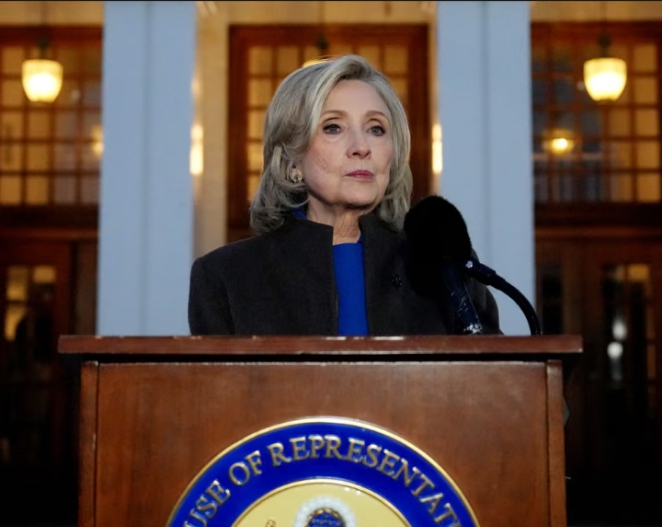

The Clinton Epstein testimony unfolded in Washington as a charged political confrontation, with Hillary Clinton forcefully rejecting claims linking her to Jeffrey Epstein during a Republican-led House inquiry.
Appearing under subpoena, Clinton described the Clinton Epstein testimony as “partisan political theatre”, arguing the proceedings were designed to distract public attention from Donald Trump’s record.
The former secretary of state opened with a “withering rebuke”, insisting she had never met Epstein and possessed no information capable of advancing the investigation’s stated objectives.
According to Clinton, the Clinton Epstein testimony was compelled “fully aware” she lacked relevant knowledge, framing the hearing as an attempt to shield political opponents.
She accused Republican lawmakers of launching a “fishing expedition”, asserting the inquiry insulted voters and undermined serious efforts to address sex trafficking crimes nationwide.
Clinton argued that if lawmakers were genuinely committed to accountability, they would question Trump directly under oath regarding his long association with Epstein.
The Clinton Epstein testimony took place behind closed doors near the Clintons’ home in Chappaqua, following negotiations allowing them to avoid appearing on Capitol Hill.
Lawmakers travelled to New York after agreeing transcripts and video recordings would later be released, despite Democratic objections favoring public testimony.
Clinton emphasized her long-standing advocacy against trafficking, describing the inquiry as selectively targeting her while ignoring other documented Epstein connections.

During her opening statement, Clinton asked repeatedly, “What is being held back? Who is being protected? And why the cover-up?”
The Clinton Epstein testimony was briefly suspended after a photograph from inside the closed session appeared on social media, triggering immediate Democratic condemnation.
The image was traced to Republican representative Lauren Boebert, prompting claims that congressional rules governing closed hearings had been violated.
Democrats labeled the incident “unacceptable”, arguing it compromised procedural integrity and reinforced claims of political grandstanding.
Boebert later defended her actions online, referencing the 2012 Benghazi attack, an episode Clinton previously faced intense congressional scrutiny over.
Following the disruption, Clinton resumed the Clinton Epstein testimony, reiterating her preference for an open hearing accessible to the public and press.
Outside the venue, Clinton told reporters she found questioning repetitive, noting she had repeatedly stated she did not know Epstein.
She described some questions as “quite unusual”, citing references to UFOs and Pizzagate, a widely discredited conspiracy theory.
The Clinton Epstein testimony, she said, strayed from any serious examination of Epstein’s crimes or institutional failures that enabled them.
Democratic committee members echoed her concerns, arguing Republicans failed to question other witnesses about Epstein or Ghislaine Maxwell.
Representative Robert Garcia called for full transcripts to be released within twenty-four hours, stating the public deserved transparency.
Garcia argued the Clinton Epstein testimony demonstrated Clinton’s cooperation, noting she answered every question posed during proceedings.
Attention now turns to Bill Clinton, scheduled to testify under identical conditions as investigators examine acknowledged connections to Epstein.
Bill Clinton has admitted flying multiple times on Epstein’s private aircraft, though he says he severed ties once Epstein’s crimes emerged.
Republicans insist the Clinton Epstein testimony is necessary to understand Epstein’s network, while maintaining no formal accusations have been made.
Committee chair James Comer accused the Clintons of attempting to evade subpoenas, contrasting their response with other former officials’ cooperation.
Comer said the investigation seeks clarity, not prosecution, despite critics arguing its focus appears politically selective.
Democrats counter that Trump’s own Epstein ties have not received comparable scrutiny, raising questions about investigative priorities.

Garcia renewed calls for Trump to testify, citing files involving allegations that were excluded from released Epstein-related documents.
Survivor advocates, Democrats argue, deserve comprehensive answers rather than narrowly framed hearings targeting political rivals.
The Clinton Epstein testimony has revived memories of past Republican-led investigations that ultimately strengthened Clinton politically.
In 2015, Hillary Clinton testified for nearly eleven hours over Benghazi, an appearance widely viewed as neutralizing partisan attacks.
Bill Clinton previously gave sworn testimony during 1990s investigations, experiences shaping the couple’s approach to congressional scrutiny.
Both Clintons argue the current inquiry reflects a familiar pattern of politicized investigations rather than genuine fact-finding.
They maintain the Clinton Epstein testimony exemplifies how serious issues can be overshadowed by partisan conflict.
Republicans dispute that characterization, insisting public confidence requires examining all prominent figures appearing in Epstein-related records.
The Justice Department is believed to retain millions of unreleased Epstein documents, complicating efforts to establish a full historical account.
Bill Clinton has called for complete disclosure of all files, arguing transparency is essential to restoring trust.
As transcripts and footage are expected to be released, both parties are preparing competing narratives surrounding the Clinton Epstein testimony.
For now, the hearings underscore enduring divisions in Washington, where allegations, accountability, and politics remain deeply intertwined.
Read also: Hillary Clinton Epstein testimony dominates US politics as House probe widens
The Clinton Epstein testimony thus stands not only as a legal proceeding, but as another flashpoint in America’s ongoing partisan struggle.