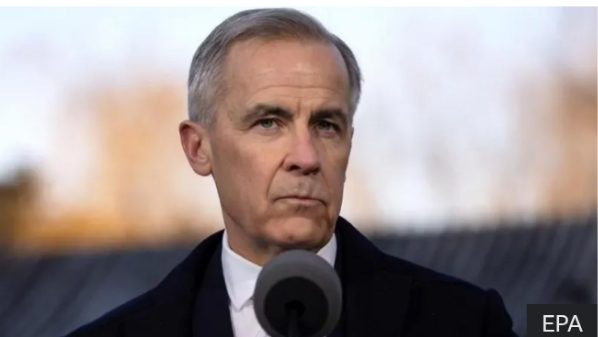
“Carney Calls Canada By-Elections” at a crucial political moment as Prime Minister Mark Carney seeks to convert a fragile minority government into a stable majority administration. The Canadian leader confirmed that voters in three federal constituencies will return to the polls on 13 April, contests that may decisively shift the balance of power in Parliament.
The governing Liberal Party currently holds 169 seats in the House of Commons, just three short of the 172 required for a majority. Winning all three by-elections would give the Liberals full control of the legislative agenda, allowing the government to pass laws without relying on opposition parties and potentially avoid a nationwide election for up to three years.
Two of the races will take place in Toronto ridings widely regarded as Liberal strongholds. The third contest will unfold in a Montreal-area constituency where last year’s result was decided by the narrowest of margins — a single vote. Political observers say the outcomes could either reinforce Carney’s authority or prolong parliamentary uncertainty.
A senior Liberal campaign official described the vote as “a defining test of public confidence,” adding that “Canadians will determine whether the government receives a clear mandate to continue its economic and social programmes without obstruction.”
The Toronto constituencies — University–Rosedale and Scarborough Southwest — became vacant following high-profile political transitions. Former deputy prime minister Chrystia Freeland resigned her parliamentary seat after accepting an international advisory role assisting Ukrainian President Volodymyr Zelenskyy. Meanwhile, former public safety minister Bill Blair stepped down after being appointed Canada’s envoy to the United Kingdom.
Both districts have consistently supported the Liberal Party for over a decade, making them favourable terrain for Carney’s candidates. Local party organisers have already intensified door-to-door outreach and phone campaigns, betting that established voter loyalty and name recognition will help secure decisive victories.
A Liberal strategist noted, “These communities are familiar with Liberal leadership and policies. The challenge is mobilising turnout rather than persuasion.”
Greater uncertainty surrounds the third by-election in Terrebonne, a suburban district near Montreal with a history of competitive races. The seat was long controlled by the separatist Bloc Québécois before flipping to the Liberals in 2025 by just one vote — one of the tightest margins in modern Canadian political history.
The result was later contested, prompting intervention by the Supreme Court of Canada, which ordered a new vote after evidence emerged that a Bloc supporter’s mail-in ballot had been returned due to a printing error. The court’s decision set the stage for a dramatic rematch that could once again be decided by razor-thin margins.
Liberal candidate Tatiana Auguste will face Bloc contender Nathalie Sinclair-Desgagné in what analysts describe as a symbolic battle for Quebec’s political direction. Party volunteers have flooded neighbourhoods with campaign materials while national leaders plan multiple visits to energise supporters.
A Montreal-based political analyst said, “Terrebonne is no longer just a local contest. It has become a national referendum on Carney’s leadership and Quebec’s federal alignment.”
Carney’s proximity to a majority is partly the result of recent political defections. Three former members of the opposition Conservative Party crossed the floor to join the Liberals in recent months, strengthening the government’s numbers and intensifying partisan tensions.
Conservative leaders have criticised the defections as undemocratic, alleging that Liberal officials used political pressure and strategic incentives to persuade opposition lawmakers. Liberal representatives strongly deny those claims, insisting that the defectors acted independently based on policy alignment and leadership confidence.
One opposition figure argued that voters chose those representatives under a different party banner and that switching sides distorts democratic accountability. Liberal officials counter that Members of Parliament are elected to serve constituents first and must be free to support policies they believe best represent national interests.
If the Liberals capture all three ridings, Carney would gain the parliamentary authority to advance legislation more swiftly, particularly in areas such as economic reform, climate policy, and international diplomacy. Minority governments often depend on negotiations with smaller parties to pass bills, slowing decision-making and increasing political uncertainty.
A majority administration, by contrast, would grant the prime minister greater stability and bargaining power both domestically and abroad. Observers say that international partners often prefer dealing with governments that face fewer legislative obstacles at home.
Majority control reduces unpredictability and enables long-term policy planning and clearer fiscal commitments, according to constitutional scholars.
Recent national polling indicates that the Liberal Party could secure a majority if a general election were held today, suggesting favourable public sentiment toward the government’s performance. Economic stabilisation efforts and diplomatic initiatives have helped strengthen Carney’s approval ratings, though critics argue that cost-of-living concerns remain unresolved.
Political analysts caution that by-elections often produce different turnout patterns compared with general elections, sometimes favouring opposition parties whose supporters are more motivated to vote in smaller contests. Still, Liberal campaign planners appear confident that strategic mobilisation will offset such risks.
A senior campaign adviser remarked that momentum matters and that voters understand these seats will determine whether Parliament functions smoothly or remains gridlocked.
Beyond parliamentary arithmetic, the by-elections serve as a test of leadership legitimacy for Carney, who assumed office during a period of economic uncertainty and geopolitical tension. Securing a majority would reinforce his mandate and quiet critics who question the durability of his administration.
Read also: Labour MPs urge Starmer to stick to UK policy on Iran despite Trump, Blair criticism
Conversely, losing one or more seats would preserve the minority balance, forcing continued negotiation with opposition blocs and potentially triggering early election speculation. Such an outcome could reintroduce political volatility at a time when Canada faces sensitive trade and security negotiations internationally.
A federal politics commentator summarised the stakes, saying the vote is less about three districts and more about whether Canadians want consolidated leadership or continued compromise governance.
About The Author