Hamas announced on Monday that all twenty living Israeli hostages held in Gaza have been freed under a Trump-brokered ceasefire, ending two years of uncertainty and anguish.
The group confirmed that the captives were handed over to the Red Cross and then transferred into Israeli custody, in what international mediators called an “unprecedented breakthrough.”
The final release began at dawn, with seven captives freed first, followed by the remaining thirteen hours later, concluding a complex operation coordinated through Egypt and Qatar.
Israeli helicopters transported the freed hostages to hospitals across Israel for medical checks, where family members awaited with tears, flowers, and chants of “Welcome home.”

Officials said all were undergoing extensive physical and psychological evaluation after enduring nearly two years in captivity under harsh and unpredictable conditions inside Gaza.
The names of the released hostages include Bar Kupershtein, Evyatar David, Yosef-Chaim Ohana, Segev Kalfon, Avinatan Or, Elkana Bohbot, Maxim Herkin, Nimrod Cohen, and Matan Angrest.
Also freed were Matan Zangauker, Eitan Horn, Eitan Abraham Mor, Gali Berman, Ziv Berman, Omri Miran, Alon Ohel, Guy Gilboa-Dalal, Rom Braslavski, Ariel Cunio, and David Cunio.
Their release fulfills the central condition of the Gaza ceasefire deal, part of a broader framework negotiated under U.S. President Donald Trump’s direct mediation.
Under the agreement, Hamas also committed to returning the remains of twenty-eight deceased Israeli hostages, though several bodies are still unaccounted for in war-torn areas.
In exchange, Israel began releasing more than 1,900 Palestinian prisoners and detainees, many convicted of security-related crimes, marking one of the largest swaps in recent memory.
A joint verification committee, involving the United States, Egypt, and Qatar, has been formed to oversee the process and ensure compliance from both sides.
Officials say once the full list of hostages and prisoners is verified, discussions will shift toward Gaza’s political and administrative future, including reconstruction efforts and border security.
Hamas has not yet accepted the disarmament clause in the agreement, insisting that its armed resistance remains a “legitimate form of national defense.”
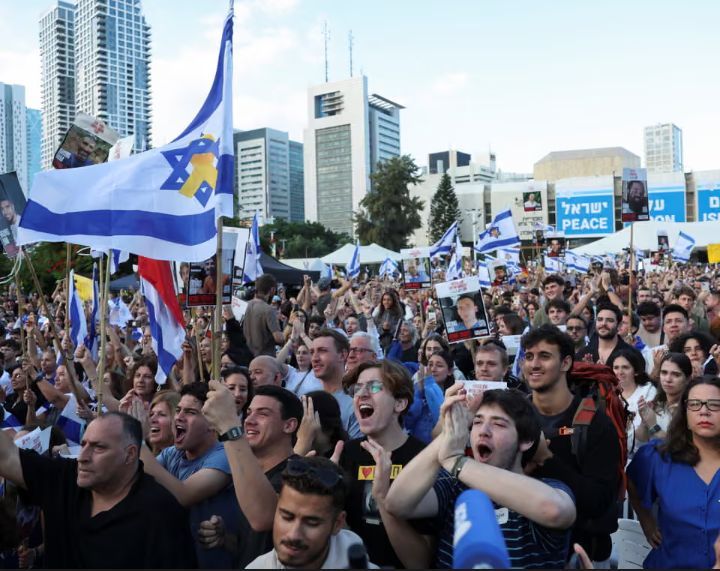
Celebrations erupted across Israel on Monday night as crowds filled Tel Aviv’s Hostages Square, waving flags and singing songs of freedom under the bright city lights.
Families hugged strangers, and several hostages appeared live via hospital video calls, their faces tired but smiling after the ordeal that lasted nearly seven hundred days.
President Donald Trump, arriving earlier in the day, addressed the Knesset, describing the hostage release as “a great and beautiful day for humanity.”
He declared, “What we are witnessing today is not just peace, it’s proof that determination and faith can overcome the longest darkness.”
Trump urged Hamas to fully commit to peace, stating that “disarmament is not surrender — it’s the first step toward freedom for the people of Gaza.”
But within hours, Hamas responded with a statement rejecting the call, calling disarmament “a foreign demand designed to weaken Palestinian dignity and self-determination.”
Despite the celebration, challenges remain. Medical experts reported that many freed captives suffer from malnutrition, trauma, and infections caused by inadequate living conditions in underground sites.
The Israeli Health Ministry confirmed that several of the hostages are undergoing long-term rehabilitation programs focusing on psychological support and reintegration into daily civilian life.
Meanwhile, search operations continue for the bodies of the deceased hostages, many believed buried under collapsed structures in northern Gaza’s destroyed neighborhoods.
A senior Red Cross official described the process as “slow, delicate, and deeply emotional,” emphasizing that complete recovery may take several weeks or months.
Analysts warn that despite this milestone, the ceasefire’s long-term stability is uncertain, given the volatile history of past truces between Israel and Hamas.
Previous agreements have crumbled amid renewed rocket exchanges, political mistrust, or disagreements over prisoner releases and humanitarian access to Gaza’s blockaded regions.
Within Israel, Prime Minister Benjamin Netanyahu praised the operation, calling it “a triumph of faith, courage, and diplomacy,” though his coalition partners remain divided on concessions.
Hardline ministers have criticized the decision to release so many Palestinian prisoners, arguing it could embolden militants and compromise future national security operations.
Opposition leaders, however, described the hostage release as “a moral victory,” saying the government had a duty to bring every Israeli citizen home alive.
In Gaza, residents cautiously welcomed the truce, emerging from shelters for the first time in weeks to buy food and reconnect with relatives across devastated neighborhoods.
Humanitarian convoys began entering Gaza through the Rafah crossing, delivering medical supplies, water, and fuel under supervision from international relief agencies and Egyptian observers.
Local journalists reported scenes of relief mixed with skepticism, as many Gazans questioned whether peace would truly hold or collapse under renewed military pressure.
The conflict traces back to Hamas’s October 7, 2023 attack, in which more than 1,200 Israelis were killed and 250 hostages seized, sparking a prolonged war.
Israel’s retaliatory campaign destroyed much of Gaza’s infrastructure, killing thousands and displacing nearly two million people, creating one of the region’s worst humanitarian crises.
Since then, smaller hostage exchanges occurred sporadically, but none matched the scale and coordination of Monday’s operation, hailed as a potential turning point.
Observers note that this agreement represents the most ambitious diplomatic engagement since the Oslo Accords, testing whether mutual concessions can lead to sustainable coexistence.
Egyptian, Qatari, and Turkish officials credited Trump’s personal diplomacy for breaking the stalemate, though some critics accuse him of using the crisis for political advantage.
At the Knesset, Trump dismissed such claims, saying, “Peace has no campaign season — it belongs to every parent who dreams of seeing their children home again.”
His remarks drew applause from Israeli lawmakers across party lines, many of whom expressed cautious optimism that his initiative could lead to a longer-term settlement.
Still, the central question remains whether Hamas’s leadership and Israel’s right-wing factions can coexist under the same framework without reigniting hostilities.
Experts believe the next few weeks will determine whether this moment becomes the beginning of reconciliation or another fleeting pause before violence returns.
Reconstruction in Gaza is expected to be the next major challenge, with international donors pledging billions of dollars to restore hospitals, schools, and housing.
United Nations officials say long-term peace will depend on political inclusion, respect for human rights, and the gradual demilitarization of all factions involved.
For many Israelis, however, Monday was a day of relief and release. “For two years we lived in fear,” said one mother, “but today, hope returned.”
As celebrations continued late into the night, prayers echoed across Jerusalem and Tel Aviv, symbolizing a nation’s gratitude and cautious anticipation of a fragile peace.
Whether this truce endures or falters, the Israeli hostage release has already reshaped the conversation, offering a rare glimpse of compassion amid decades of conflict.