Hamas hostages handovers are set to begin as the group confirms it is prepared to release 20 living Israeli captives, marking a critical stage in negotiations.
The declaration marks the most significant progress in months of fragile ceasefire talks, injecting new urgency into the ongoing Gaza truce efforts driven by regional and international mediators.
According to officials briefed on the negotiations, Hamas conveyed its readiness through both Qatari and Egyptian envoys, with Egypt mediation central to verifying security and transportation guarantees.
A senior Hamas representative, Osama Hamdan, told AFP: “The prisoner exchange is set to begin Monday morning as agreed, and there are no new developments.”
Hamdan emphasized that Hamas remains “committed to the terms signed under international witness,” and that both sides have “a moral obligation to honor this humanitarian phase.”
Israeli officials confirmed receiving notice of the Hamas hostages handover through secure communication channels, though some uncertainty persists over timing and logistics of the delicate cross-border transfer operation.
“The communication was verified, the intent appears genuine,” said one Israeli military spokesperson, cautioning that “logistical challenges and mutual distrust could still slow the handover process.”
The planned release will reportedly coincide with the next stage of Israeli troop withdrawals from central Gaza, a key condition for sustaining the temporary Gaza truce now in effect.
Under the emerging framework, Israel will release nearly 2,000 Palestinian prisoners in exchange for the Hamas hostages handover, many of them detained during the two-year-long Gaza campaign.
Humanitarian agencies, including the International Committee of the Red Cross, are expected to oversee verification and safe transit, ensuring no breach of the carefully negotiated ceasefire talks protocol.
Families of Israeli hostages have cautiously welcomed the announcement, calling it “a necessary step toward closure,” while demanding full transparency on the conditions and identities of returnees.
“We have waited for two years in agony,” said Yael Cohen, sister of one hostage. “We need truth, not more political theater or empty declarations.”
Hamas claims that twenty of the remaining forty-eight hostages are alive, while twenty-eight others are either dead or missing amid Gaza’s war-ravaged ruins and collapsed tunnel networks.
“The task of locating all remains is painful and complicated,” Hamdan admitted. “We will hand over the living and the dead as part of our responsibility.”
Israeli intelligence sources say that verifying the status of each captive has been hampered by limited access and fragmented Hamas command structures within northern and southern Gaza sectors.
An Israeli official told Channel 12 that “some hostages were moved between factions, creating uncertainty about who controls their custody at any given time.”
Analysts warn that even successful completion of the Hamas hostages handover will not guarantee the endurance of the Gaza truce, as both sides remain locked in political suspicion.
Le Monde reported that “no element of this agreement ensures an end to the war,” describing the truce as a “pause built on mistrust and exhaustion.”
Israeli hardliners argue that Hamas should not be rewarded with legitimacy or territorial reprieve, insisting that “victory requires total demilitarization, not staged humanitarian concessions.”
Hamas, conversely, sees the Hamas hostages handover as both a humanitarian act and a political statement asserting its continuing leverage in Gaza’s post-war governance debates.
Within Israel, internal divisions deepen as right-wing politicians accuse the government of “bending under foreign pressure” from Washington and Cairo to accelerate the exchange process.
Egyptian President Abdel Fattah el-Sisi personally intervened during the Egypt mediation, warning both parties that “the window for peace is narrow and must not be wasted again.”
A senior Egyptian diplomat said, “If either side sabotages this moment, rebuilding trust will take years. The world is watching how both act in these critical hours.”
Monday’s planned exchange coincides with a landmark peace summit in Sharm el-Sheikh, where U.S. President Donald Trump and Sisi will co-chair talks on stabilizing the Gaza truce.
Over twenty nations are expected to participate in the summit, seeking to institutionalize the ceasefire, coordinate reconstruction, and discuss the governance of Gaza after the hostilities.
U.S. negotiators have reportedly urged Israel to move quickly on the Hamas hostages handover, fearing delays could derail broader ceasefire talks and embarrass summit hosts.
Washington sources confirmed that Trump’s administration views the exchange as a “critical trust-building exercise” before deeper political discussions can take shape in Egypt.
Israeli officials privately complain that American pressure has been relentless, describing “a constant push to move faster than what’s operationally secure or politically feasible.”
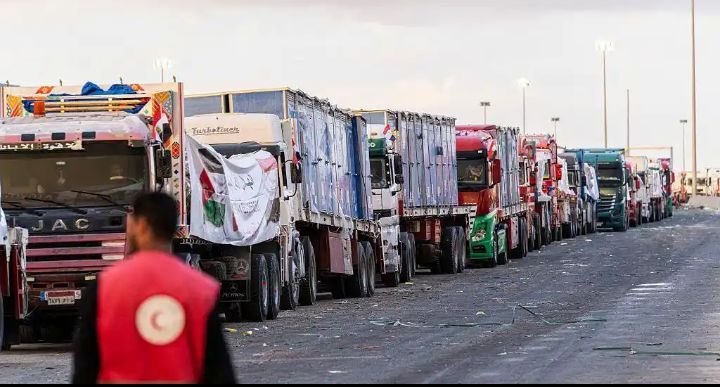
On the ground, Red Cross convoys are expected to cross into Gaza through Rafah Monday morning, with Israeli and Egyptian security units providing a coordinated protective corridor.
Aid trucks loaded with medical supplies and food are also queued for entry as part of the Gaza truce’s humanitarian clauses tied to the hostage and prisoner exchanges.
The United Nations Relief and Works Agency (UNRWA) confirmed preparations to deliver emergency aid to northern Gaza once safe passage is guaranteed by both Israeli and Hamas forces.
Despite the optimism surrounding the Hamas hostages handover, several Israeli defense analysts warn that the exchange could be exploited for propaganda or tactical repositioning.
“The symbolism of the handover carries power,” said Israeli analyst Amos Harel. “Hamas will seek to project resilience, not weakness, even in surrendering captives.”
In Gaza City, local witnesses report visible signs of tension as Hamas fighters tighten security perimeters around several undisclosed locations believed to house the remaining hostages.
Eyewitnesses described “nervous movement” and “increased patrols,” suggesting preparations are underway but also reflecting internal caution over Israeli drone surveillance in contested neighborhoods.
If all goes as planned, the Hamas hostages handover will begin Monday morning, followed by Israel’s release of Palestinian prisoners under Red Cross supervision in southern Israel.

Any delay or violation could immediately jeopardize the fragile ceasefire talks, reviving hostilities and collapsing the hard-won mediation effort that has taken months to orchestrate.
For families on both sides, the approaching exchange represents more than politics—it is a test of humanity after years of siege, grief, and relentless propaganda.
“The world will judge both sides by what happens in these next seventy-two hours,” said an EU envoy in Cairo. “Trust is built in moments like this.”
While the Hamas hostages handover offers hope, the broader question of Gaza’s political future remains unresolved, with rival factions vying for post-war influence under watchful global eyes.
For now, the region holds its breath, waiting to see if the exchange will mark the start of reconciliation or merely another brief pause in an endless cycle of conflict.
About The Author