

Thousands of aid trucks rolled through the Rafah crossing into Gaza this morning, marking the most significant humanitarian convoy since the Israel-Hamas truce took effect on Friday.
Long queues of aid trucks stretched across the desert border, engines idling under a grey dawn, as Egyptian officials coordinated the expanded delivery under the Gaza ceasefire deal.
The convoys carried food, water, fuel, and medicine—essentials desperately needed by civilians after months of siege—symbolising the first tangible promise of relief under the fragile Israel-Hamas truce.
Witnesses described an “unbroken chain” of aid trucks rumbling north towards Khan Younis, their progress closely monitored by UN teams and Egyptian military observers stationed along the route.
Under the Gaza ceasefire deal, the number of daily aid trucks entering the enclave is expected to multiply each day as both sides adhere to the terms negotiated this week.
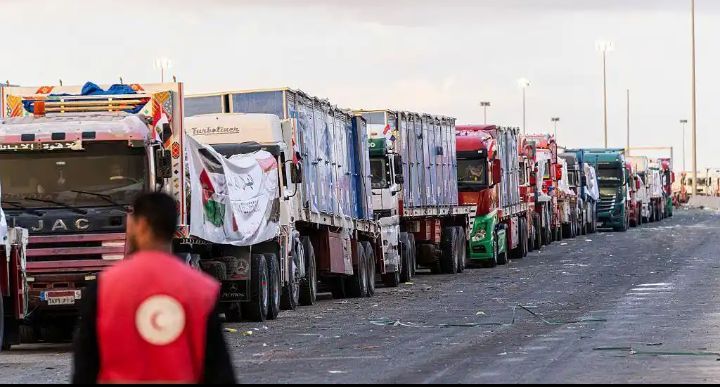
Humanitarian officials said the Rafah crossing has become the heartbeat of the fragile ceasefire, with hundreds of aid trucks waiting clearance amid complex Israeli security checks and fuel restrictions.
Crowds of displaced Palestinians gathered near the convoy routes, waving white flags and holding signs reading “We need water,” as aid trucks passed through devastated neighbourhoods reduced to rubble.
Video clips showed young men clambering onto aid trucks to toss down sacks of flour and canned goods to families who have not eaten properly for weeks.
One UN coordinator said the scale of the operation must “overwhelm Gaza with food” if famine and disease are to be averted, stressing that the aid trucks were only the beginning.
As the aid trucks moved deeper into Gaza, smoke still lingered over northern districts, a haunting reminder that the guns have only temporarily fallen silent under the Israel-Hamas truce.
Israeli officials confirmed that 1,700 detainees from Gaza and 250 Palestinian prisoners will be freed in the coming hours as part of the broader hostage release component of the deal.
The ceasefire plan stipulates that Hamas must release all remaining Israeli hostages by midday Monday, a deadline described by regional diplomats as the “ultimate test” of the truce’s credibility.
“We expect every hostage home by Monday,” said one senior official close to the talks, adding that no further aid trucks will be blocked if the process continues peacefully.
In Tel Aviv, crowds chanted “Bring them home” outside the defense ministry, holding photographs of loved ones still trapped in Gaza as news of the approaching hostage release spread.
Families of Israeli hostages said they were “waiting by the phone” for official calls confirming their relatives’ freedom, describing the next 24 hours as both hopeful and excruciating.
Israel’s prime minister declared the truce a “momentous development,” vowing that the temporary halt in fighting “does not end our mission but begins a new chapter of security and redemption.”

Yet inside Gaza, the devastation remains overwhelming. Drone footage revealed flattened residential blocks, sand-colored debris fields, and streets where only aid trucks now dare to move.
Returning residents picked their way through shattered neighbourhoods, some clutching plastic bags with whatever remained of their belongings, whispering, “It’s all gone,” as they faced the ruins of their homes.
A woman in Khan Younis, her face streaked with dust, said she only returned “to feel the ground again,” as aid trucks rumbled past toward northern camps filled with displaced families.
The Rafah crossing, once a symbol of Gaza’s isolation, has become the artery of survival, where aid trucks represent both mercy and the measure of international resolve.
Western and Arab diplomats have hailed the influx of aid trucks as a critical turning point, though many warned that the ceasefire’s success depends entirely on sustained humanitarian access.
At Sharm El-Sheikh, world leaders including Donald Trump and Keir Starmer are expected to meet Monday to sign the U.S.-brokered Gaza ceasefire deal, designed to transform the truce into a lasting accord.
The summit, attended by more than twenty heads of state, will focus on reconstruction pledges, hostage release guarantees, and mechanisms ensuring the continuous flow of aid trucks into Gaza.
Trump told reporters the world is witnessing “a moment of healing,” declaring that “on Monday, the hostages come back, and Gaza begins to rebuild.”
The remark drew applause from Israeli and U.S. officials, though critics warned that the humanitarian crisis cannot be fixed by diplomacy alone unless the aid trucks keep moving.
Starmer, speaking ahead of the summit, called the Gaza ceasefire deal “a test of collective conscience,” urging all parties to “safeguard every corridor of compassion, every route of relief.”
In Cairo, Egyptian authorities said border operations are running around the clock to process hundreds of aid trucks, though fuel shortages and inspection bottlenecks continue to slow the flow.
Military engineers are reportedly reinforcing sections of the Rafah crossing to handle the unprecedented convoy traffic, ensuring the aid trucks can pass unimpeded for the next critical phase.
Satellite imagery confirmed convoys stretching from the Sinai logistics hub to Gaza’s southern gate, forming what one diplomat described as “a living pipeline of survival.”
The humanitarian scale is immense. Officials estimate nearly half a million people rely on today’s incoming aid trucks for their next meal or dose of clean drinking water.
UN teams have begun coordinating distribution through schools and abandoned mosques, converting them into emergency centers while assessing areas safe enough for storage and onward delivery.
In northern Gaza, small groups of residents have defied warnings to travel back toward Gaza City, navigating broken roads where aid trucks can no longer safely drive.
Three-quarters of Gaza City’s structures are believed damaged or destroyed. Residents returning north find only heaps of concrete and twisted rebar where their apartments once stood.
Still, many said the sight of aid trucks rolling southward offered psychological comfort—a faint signal that the world has not forgotten them, even amid desolation.
Regional analysts warn that any disruption to the flow of aid trucks could reignite hostilities. The ceasefire’s sustainability rests on humanitarian consistency and visible, measurable progress.
Both sides remain on alert. Israeli surveillance drones continue to patrol the skies, while Hamas units reportedly regroup south of Gaza City under strict orders not to provoke confrontation.
International mediators are pressing for a second-stage framework linking the hostage release schedule with continued aid delivery, hoping that humanitarian interdependence will lock both sides into restraint.

As dusk settled, another wave of aid trucks crossed Rafah under floodlights, each carrying the weight of human desperation and diplomatic calculation in equal measure.
From the rubble of Gaza to the corridors of Sharm El-Sheikh, the question now is whether the rhythm of aid trucks can outlast the rhythm of war.
Officials describe the coming days as “fragile but vital,” a race between relief and relapse, between hunger’s return and humanity’s resilience under the uncertain peace of the Israel-Hamas truce.


