

Buratai dismisses terrorism-financing allegations as fabricated attacks on his integrity and demands Sahara Reporters retract the claims and apologise or face legal action.
Former Chief of Army Staff and immediate past Ambassador to the Republic of Benin, Lt.-General Tukur Yusuf Buratai (rtd), has strongly rejected the recent allegations suggesting he was involved—either directly or indirectly—in terrorism financing.
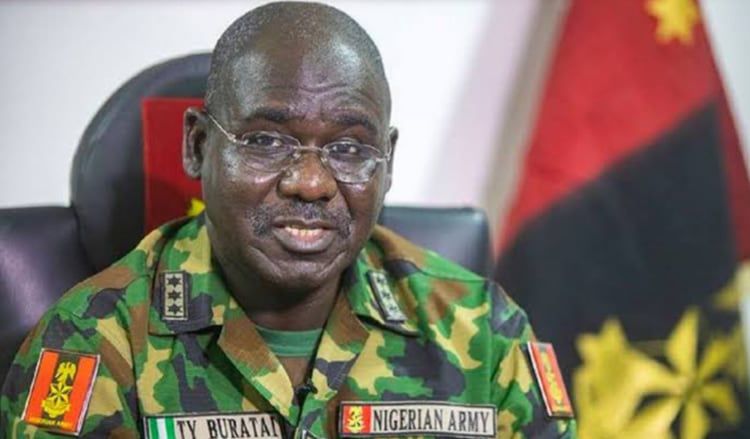
Buratai described the claims as a complete fabrication that contradicts both established facts and his lifelong dedication to protecting Nigeria from extremist violence.
The retired general made his position known through a detailed statement issued on Saturday by former Army spokesperson, Brigadier-General Sani Kukasheka Usman (rtd), in response to an online report that attempted to link him and several other high-profile Nigerians to terrorism sponsors.
According to him, the accusations represent another deliberate attempt to tarnish a name built over decades of disciplined military service.
The statement stressed that Buratai has never been interrogated, investigated, or implicated in any terrorism-related matter by any legal, security, or intelligence institution within or outside Nigeria.
It emphasized that no court, military panel, administrative board, or diplomatic body has ever associated him with terrorism financing, making the recent claims baseless and malicious.
According to the statement, the publication relied solely on unverified allegations credited to retired Major General Danjuma Ali-Keffi.
The claims, it said, lacked merit, lacked factual grounding, and were fueled by personal grievances rather than evidence.
It further stated that the online outlet, Sahara Reporters, has a long history of attempting to drag Buratai’s name into controversy, despite consistently failing to substantiate any claim against him.
The statement noted: “These allegations are false, unfounded, mischievous, and nothing short of a smear campaign orchestrated to harm his reputation. Not once in his distinguished career has General Buratai ever been linked to terrorism financing by any credible institution. This latest attempt is a continuation of baseless narratives meant to malign him.”
To provide historical context, the statement highlighted Buratai’s critical role in Nigeria’s fight against Boko Haram and ISWAP during his tenure as Chief of Army Staff.
Under his leadership, the Nigerian Army reclaimed numerous communities previously occupied by insurgents, reopened critical highways once deemed too dangerous for travel, restored civilian governance in several recovered towns, and facilitated the safe return of thousands of displaced citizens to their homes.
During the years when Nigeria faced some of its most intense security challenges, Buratai emerged as one of the frontline figures guiding counter-terrorism strategies, troop deployment, and military reforms aimed at strengthening operational effectiveness.
The statement pointed out that these achievements directly contradict the narrative that he could have been linked to the same terrorist groups he fought against.
“It defies logic, rationality, and basic conscience,” the statement added, “to suggest that the same General Buratai who championed decisive anti-terrorism campaigns, motivated troops under difficult conditions, and consistently advocated for strengthened national security, would somehow be collaborating with elements of terrorism. Such narratives collapse under the weight of their own falsehood.”
The statement further emphasized that Buratai’s record speaks for itself. Over forty years of military service, he held positions that required high-level security clearance, ethical leadership, and strategic decision-making.
Anyone in such a position would have undergone numerous background checks, intelligence audits, and diplomatic scrutiny, none of which ever found any connection between him and illicit financing.
Another section of the statement highlighted that while allegations are easy to manufacture, reputations built on decades of verifiable service cannot be easily damaged.
It recalled how previous attempts to unjustly implicate Buratai similarly fell apart due to lack of evidence.
The current claims, it stressed, follow a predictable pattern of sensationalism without substance.
Brig.-Gen. Usman also noted that resorting to publishing unverified claims reinforced the need for stricter accountability in media practice.
According to him, reputable journalism demands verification, evidence, and balanced reporting—qualities notably absent in the controversial publication.
In addition to defending his name, Buratai called on Sahara Reporters and Major General Ali-Keffi (rtd) to immediately retract the publication.
The statement demanded an unreserved public apology for what it described as a defamatory attack motivated by malice rather than journalistic or patriotic duty.
Failure to issue a retraction, the statement warned, will compel Buratai and his legal team to institute appropriate legal action to seek redress and protect his reputation.
It stressed that the retired general will not allow deliberate falsehoods to take root, especially when such claims have the potential to harm not only his image but also public trust in national institutions.
Beyond the personal angle, the statement also expressed concern about the broader consequences of circulating unverified claims about national security matters.
According to it, such publications could undermine public confidence, mislead citizens, and weaken collective efforts to combat terrorism.
It argued that Nigeria’s fight against extremist violence requires unity, professionalism, and adherence to truth—attributes endangered when false narratives are allowed to flourish.
The statement noted that fabricating accusations against individuals who spent decades defending the nation is not only unjust but also counterproductive to ongoing national security efforts.
His diplomatic role in Benin Republic required adherence to global counter-terrorism protocols, cooperation with regional security bodies, and constant engagement with intelligence systems—areas where integrity and trustworthiness are non-negotiable.
These responsibilities, it emphasized, would be impossible to discharge if he had even the slightest stain of terrorism association.
About The Author


