

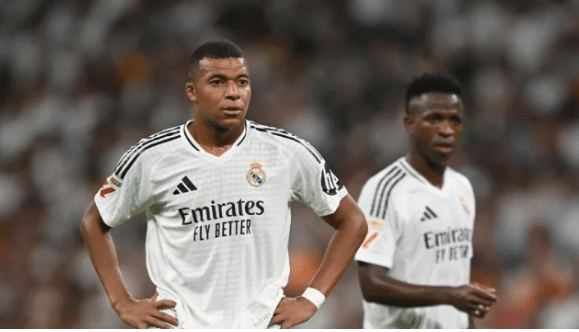
Former Real Madrid star Gareth Bale has criticised Kylian Mbappe and Vinicius Junior’s underwhelming performances in the Champions League defeat against Liverpool at Anfield on Tuesday night.
The Spanish giants suffered a 1-0 loss in a match where Liverpool’s intensity exposed Real Madrid’s lack of sharpness and offensive creativity throughout the ninety minutes of action.
Bale, speaking to CBS Sports, described the duo’s performance as “disappointing” and argued they lacked the spark and confidence required to influence the match’s decisive moments effectively.
The former Welsh international suggested both players were hesitant in attacking spaces and often made predictable movements, allowing Liverpool’s defence to control them with surprising ease and discipline.
He noted that Real Madrid’s famed pace on the flanks was ineffective, as neither Mbappe nor Vinicius consistently attempted to stretch defenders or exploit one-on-one opportunities effectively.
According to Bale, the pair “overcomplicated things” in the final third, choosing flashy dribbles over simpler, more direct options that could have unsettled Liverpool’s defensive structure completely.
Liverpool’s backline, led by Virgil van Dijk, remained compact, denying Real Madrid space and forcing their attackers into rushed decisions that lacked the precision required at this level.
The absence of a traditional striker, which Bale referred to as a “reference number nine,” left Madrid’s forwards without a central target for crosses or rebounds in attack.
Since Karim Benzema’s departure, Real Madrid have operated with fluid attacking rotations, but Bale believes the lack of a natural striker weakens their tactical balance and scoring potential.
Anfield’s fierce atmosphere amplified Madrid’s struggles. The home crowd’s unrelenting noise and pressure clearly unsettled the visiting players, particularly Vinicius, who often miscontrolled passes under heavy pressing.
Mbappe, meanwhile, appeared unusually subdued. The French forward, usually explosive in transition, struggled to break free from Liverpool’s pressing traps, spending long spells isolated on the left flank.
For a player of Mbappe’s calibre, Bale suggested, such a muted performance raises questions about his adaptation to Madrid’s tactical rhythm and understanding with new teammates.
Vinicius, whose flair has previously tormented Premier League defences, found himself contained by Trent Alexander-Arnold and Dominik Szoboszlai’s coordinated efforts to double-mark him effectively throughout the encounter.
The defeat also exposed Real Madrid’s overreliance on Thibaut Courtois, whose brilliance in goal prevented a potential three-goal margin that could have embarrassed Carlo Ancelotti’s men further.
Despite Courtois’ heroics, Bale asserted that elite clubs like Madrid must demand more from their attacking stars, especially when competing at iconic venues such as Anfield.
He emphasised that technical excellence must be matched with mental resilience, especially in environments where pressure, history, and intensity combine to test every player’s temperament deeply.
Bale’s comments have sparked debate among pundits and fans alike, with some agreeing that Real Madrid’s forwards lacked efficiency while others defended them against harsh criticism.
Supporters of the duo argue that Liverpool’s defensive organisation and tactical preparation made it difficult for any attacking player to find rhythm or consistent creative openings.
However, critics point to the fact that players of Mbappe’s and Vinicius’s quality are expected to rise above tactical constraints and deliver decisive moments under pressure.
Real Madrid’s midfield also faced scrutiny. Without Luka Modric’s control, Madrid’s transitions were slower, limiting the service to wide areas where Mbappe and Vinicius thrive best.
Federico Valverde and Jude Bellingham worked tirelessly, yet their passes lacked penetration, forcing the attackers to drop deeper and reducing Madrid’s attacking unpredictability significantly.
For Bale, the issue extends beyond individual performances; it represents a broader structural weakness in how Real Madrid approach big matches without a focal point striker.
He suggested that the team’s build-up becomes predictable, with defenders reading patterns easily because no forward stretches the defensive line or holds play centrally for others.
Liverpool capitalised on that predictability, breaking quickly whenever Madrid lost possession, using the energy of Darwin Núñez and Luis Díaz to keep Madrid defenders constantly unsettled.
Madrid’s defeat now complicates their qualification path in the Champions League group stage, leaving them needing victories in their remaining fixtures to secure top spot.
Ancelotti, known for his composure, admitted post-match that his side “lacked final-third clarity,” subtly echoing Bale’s analysis about the forwards’ indecisiveness under Liverpool’s relentless pressure.
Meanwhile, Spanish media outlets described Mbappe’s display as “invisible,” with some critics questioning whether the star forward has yet fully integrated into Real Madrid’s tactical identity.
Vinicius faced similar backlash, with journalists calling his performance “predictable” and urging him to rediscover the audacity that once defined his best games for Madrid.
Still, Bale’s remarks carry extra significance. As a player who once thrived under similar scrutiny, his insights highlight the standards expected at a club of Madrid’s stature.
He reminded viewers that Real Madrid’s legacy was built on players who delivered when the stakes were highest — referencing figures like Cristiano Ronaldo, Karim Benzema, and Sergio Ramos.
The Welshman insisted that for Mbappe and Vinicius to reach legendary status at Madrid, consistency in big matches is non-negotiable and defines a player’s true greatness.
Bale’s analysis also reignites discussion about Real Madrid’s recruitment strategy, particularly their decision to invest heavily in wingers while neglecting a proven centre-forward replacement.
Some fans believe the club’s reliance on youthful dynamism over positional balance leaves them vulnerable in tight European fixtures where tactical adaptability becomes essential.
Others defend Ancelotti’s approach, citing his past success in adapting attacking roles to maximise individual brilliance, trusting Mbappe and Vinicius to eventually refine their chemistry.
Yet, the Liverpool defeat demonstrates how thin Madrid’s margin for error has become in Europe’s elite competitions, where every misstep draws scrutiny from legends and fans alike.
Bale concluded by urging the pair to learn from this setback, improve decision-making, and rediscover the ruthless simplicity that once defined Real Madrid’s attacking dominance.
His assessment underscores the expectations of a club built on excellence — a reminder that wearing the white shirt demands not only talent but consistent, world-class execution.

As Real Madrid prepare for their next Champions League fixture, all eyes will be on Mbappe and Vinicius to respond decisively, proving Bale’s doubts either right or wrong.


