

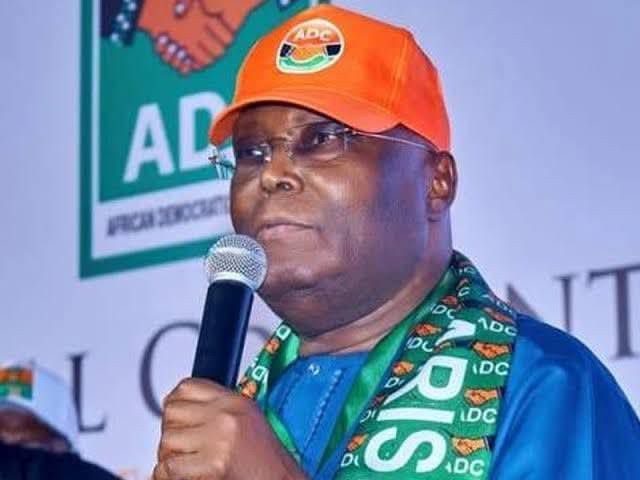
Atiku Abubakar has reaffirmed his plan to restore targeted fuel subsidy if elected president in 2027, saying Nigerians need relief from rising costs.
Former Vice President Atiku Abubakar has moved to clear the air over his position on fuel subsidy, insisting that Nigerians should expect the policy to return if he wins the 2027 presidential election.
The presidential candidate of the African Democratic Congress (ADC) said his position should not be confused with comments recently made by one of his media aides, Paul Ibe.
Atiku addressed the issue on Tuesday in Abuja when he received members of the ADC leadership from Osun State.
His intervention followed an interview in which Ibe reportedly said an Atiku administration would bring back petrol subsidy but could gradually discontinue it after the country’s economy had recovered.
The former vice president rejected that explanation, saying the media aide did not speak for him on the matter.
Rather than suggesting a temporary return of the subsidy, Atiku said his intention was to use a targeted intervention to ease the financial pressure currently being experienced by Nigerians.
He maintained that the country had enough resources to provide relief for its citizens and insisted that his position on the matter remained firm.
“Earlier, one of my press aides contradicted me in a policy statement as far as subsidy is concerned.
“I want to repeat categorically that when I said I would return to subsidy, I will! Nigeria is rich enough to look after the welfare of its citizens. Let it be clearly stated that he was not speaking on my own authority,” Atiku said.
The ADC candidate later returned to the subject in a post on his X account, where he explained the economic reasoning behind his proposal.
According to him, the issue should not be viewed simply as a question of how much money the government would spend on subsidy.
He said the more important consideration should be whether Nigerians can still afford food, transportation and other necessities with the income available to them.
Related news:
- 2027 Presidency: Peter Obi rejects Atiku’s fuel subsidy comeback plan
- Fuel Subsidy: Mohammed Idris explains why Tinubu government won’t reverse reform
- Atiku 2027: Okonkwo reveals how his fuel plan will reduce petrol prices
- 2027 Presidency: Peter Obi reveals plans to rebuild Nigeria, tackle insecurity, create jobs
For Atiku, an economy cannot be described as prosperous merely because government revenue is increasing if ordinary citizens are becoming poorer and losing the ability to purchase basic goods.
“I believe the wealth of a nation is not measured by how much government collects, but by how much the money in the pockets of its people can buy,” he said.
He argued that the removal of petrol subsidy has consequences that extend far beyond the price displayed at filling stations.
Petrol is closely connected to transportation, agriculture, distribution and several other areas of economic activity. When the cost of fuel increases, transport operators generally face higher operating expenses, while businesses also spend more moving goods from one location to another.
Those additional expenses, Atiku said, eventually affect consumers.
“When fuel rises, transport rises. When transport rises, food rises. When food rises, families suffer,” he said.
The former vice president said his proposed intervention would therefore be aimed at reducing the burden on households while improving the purchasing power of Nigerians.
He said workers should be able to receive wages that retain meaningful value instead of seeing their earnings rapidly eroded by rising prices.
Farmers, he added, should not have their profits swallowed by the cost of transporting agricultural produce to markets.
The ADC candidate also promised to create conditions that would enable businesses to increase production, employ more people and expand their operations.
His argument is that reducing the cost pressures faced by producers could have wider benefits for the economy by encouraging local production and helping to moderate the prices of goods.
Atiku said this approach would form part of a wider economic strategy rather than being limited to the issue of petrol.
He promised to concentrate on reducing energy costs, encouraging domestic production and putting more purchasing power in the hands of citizens.
“That is why I will restore targeted subsidy and put purchasing power back in the hands of Nigerians,” he said.
Atiku also sought to address concerns about the nature of the subsidy he intends to introduce.
He said his plan should not be interpreted as an attempt to return to a system that allegedly encouraged dependence on imported petroleum products.
His focus, he said, would be on providing relief to citizens while simultaneously strengthening the productive capacity of the Nigerian economy.
“I will not restore the import racket; I will restore relief,” he stated.
The former vice president also criticised the rising cost of living, linking the difficulties faced by households to the wider increase in the prices of transportation and essential commodities.
He said his administration, if elected, would seek to reverse what he described as a damaging pattern of rising costs that has affected Nigerians during the years of the Tinubu administration.
“I will break that wretched chain that has defined our national life in the nearly four years of Tinubu’s presidency,” Atiku said.
His remarks signal that fuel subsidy is likely to remain an important part of his economic message ahead of the 2027 presidential election.
The issue has continued to generate intense debate in Nigeria, particularly over whether government should subsidise petrol prices to protect consumers or allow market forces to determine the price.
For Atiku, however, the immediate concern is the effect of high energy and transportation costs on the average Nigerian.
He said government must look beyond its own revenue figures and pay greater attention to what citizens can actually afford.
The ADC presidential candidate also connected economic wellbeing with security, saying Nigerians need an environment where they can work, conduct business and live without fear.
He described his broader agenda as one that would combine economic security with physical security and improved living standards.
Atiku said his ultimate objective was to strengthen the value of the naira in the hands of ordinary citizens and make everyday life less financially difficult.
“I will make the naira in your pocket worth more, make daily living affordable again, and secure our people.
“Economic security. Physical security. A better life for every Nigerian. That is the Nigeria I intend to build,” he said.
About The Author
