The Artemis II moon mission is approaching a decisive moment as Nasa targets 6 February for launch, marking the first crewed lunar flight in over five decades.
Nasa officials say the Artemis II moon mission will proceed only if all systems meet strict safety thresholds, emphasising that astronaut protection remains the agency’s overriding priority.
“The entire process must go smoothly for us to launch,” said Nasa exploration systems development chief Jim Honeycutt, stressing that readiness will dictate the final decision.
If technical faults or adverse weather disrupt the schedule, Nasa has identified 14 alternative launch dates extending through mid-April to preserve mission objectives.
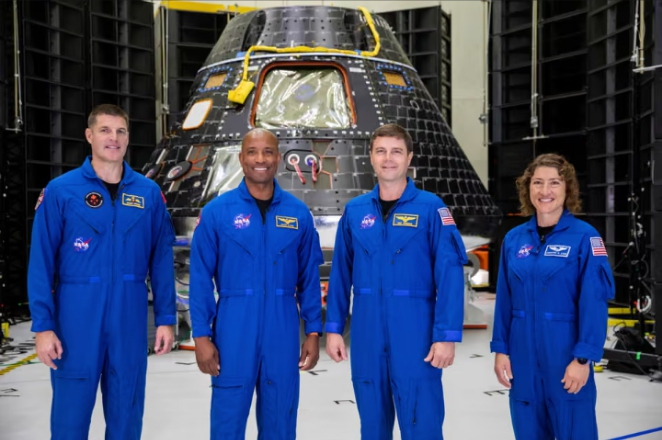
“We’re going to fly when we are ready,” Honeycutt said. “From launch through the mission days to follow, crew safety is our number one priority.”
The Artemis II moon mission will lift off aboard the Space Launch System rocket from Kennedy Space Center, carrying four astronauts inside the Orion spacecraft.
Moments after liftoff, the rocket will push Orion into space, beginning a carefully sequenced test designed to validate systems for future lunar exploration missions.
Following launch, the crew will loop twice around Earth, allowing engineers to assess spacecraft performance before committing to the long journey toward the moon.
During this phase, Orion will separate from the rocket’s upper stage, a critical maneuver that sets the stage for hands-on astronaut operations.
Astronauts will manually fly Orion using onboard cameras and external visual cues, approaching and retreating from the jettisoned upper stage in space.
This exercise will help Nasa understand how Orion handles under real conditions, particularly for future docking and undocking procedures in lunar orbit.
“These are skills crews will need later,” a Nasa official explained, describing the manoeuvres as essential learning steps rather than routine operations.
The Artemis II moon mission remains a test flight, despite carrying humans, and engineers acknowledge that unexpected challenges remain possible.
“This is a test flight, and there are things that are going to be unexpected,” said Jeff Radigan, Artemis II’s lead flight director.
Nasa planners have built flexibility into mission timelines, allowing teams to respond quickly if anomalies emerge during early flight stages.
After completing Earth-orbit operations, Orion’s European-built service module will provide a final propulsion burn toward the moon.
The spacecraft will then travel more than 230,000 miles from Earth, venturing farther than any crewed spacecraft in more than 50 years.
As Orion approaches the moon, it will swing around the far side, an area permanently hidden from Earth-based communications.
The spacecraft’s trajectory will trace a giant figure-of-eight path, allowing gravity to guide Orion safely back toward Earth.
Throughout the journey, astronauts will conduct system checks, scientific observations, and operational tests essential to future missions.
Emergency procedures will be rehearsed repeatedly, ensuring the crew can respond to pressure loss, power failures, or navigation anomalies.
One key focus will be Orion’s radiation shelter, designed to shield astronauts from dangerous solar flares during deep-space travel.
Nasa engineers consider radiation protection critical as missions move beyond low-Earth orbit and toward sustained lunar operations.
“The farther we go, the more we learn,” a mission specialist said, noting that Artemis II bridges past Apollo lessons and future ambitions.
The Artemis II moon mission also serves as a confidence-building exercise for hardware and human performance alike.
Unlike Apollo missions, Artemis spacecraft rely heavily on automation, though manual control remains vital during contingency scenarios.
Astronauts have trained extensively for both automated and hands-on flight, simulating hundreds of potential emergency situations.
Despite that preparation, mission leaders accept that spaceflight always carries uncertainty and inherent risk.
“Every rocket launch is a nail-biter,” said Nasa astronaut Christina Koch, who is part of the Artemis II crew.
“We’re putting astronauts on a rocket that has flown only once before,” she added.
“Of course it’s nerve-wracking.”
Koch stressed, however, that Nasa’s cautious approach gives her confidence in the agency’s decision-making process.
“I’m confident Nasa will only launch when they are ready,” she said, echoing leadership assurances.
The mission marks humanity’s first crewed lunar voyage since Apollo 17 in 1972, a gap spanning more than half a century.
For Nasa, Artemis II represents a turning point toward sustained exploration rather than short, symbolic visits.
Future Artemis missions aim to establish a long-term human presence near the moon’s south pole.
That region is believed to contain water ice, a resource that could support life and fuel production.
The Artemis II moon mission will not land, but it lays essential groundwork for Artemis III and beyond.
Public interest is building as launch day approaches, blending excitement with understandable tension.
Space historians note that every major leap forward has carried moments of anxiety alongside hope.

More than 50 years after the last lunar footsteps, anticipation is once again rising around human spaceflight.
As launch windows approach, Nasa teams continue round-the-clock checks, simulations, and reviews.
Whether on 6 February or a later backup date, the mission will only fly when all conditions align.
For now, Artemis II stands as a powerful reminder that returning to the moon is both an engineering challenge and a human endeavour.
Read more: Ireport247news
About The Author