Former Stoke City legend Rory Delap has revealed that Arsenal wanted throw-ins replaced because of Stoke’s long throw-ins, highlighting how set-pieces influenced Premier League football matches.
Delap, famous for one of football’s most feared throws, regularly launched the ball 30–40 metres at speeds up to 60 km/h, consistently creating scoring chances for Stoke City.
He explained that Arsenal, under Arsene Wenger, often faced difficulties defending Stoke City’s long throw-ins, which demonstrates why Arsenal wanted throw-ins replaced to minimize their vulnerability.
“So many people used to complain about the way we played,” Delap told Ladbrokes, highlighting that Arsenal wanted throw-ins replaced due to Stoke City’s unusually powerful long throws.
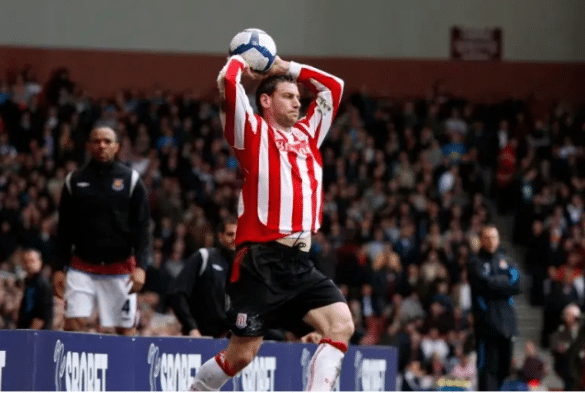
Delap added that replacing throw-ins with kick-ins, as Arsenal reportedly suggested, would likely have made matters worse, allowing Stoke City to launch long throws from anywhere on the pitch.
He noted that Stoke City’s throws were most effective because teammates understood positioning and movement, ensuring long throw-ins consistently led directly to goal-scoring opportunities during matches.
Delap compared Stoke City’s approach to Wimbledon’s Crazy Gang of the late 1980s and early 1990s, who also used long balls, set-pieces, and tactical ingenuity to achieve results.
“I’ve said it before, but football comes full circle. Formations, tactics, and style of play always repeat, like fashion trends, making throw-ins and set-pieces timeless strategic tools,” Delap explained.
He emphasized that modern set-piece coaches may appear revolutionary, but the basic principles are longstanding, previously handled by managers or assistants analyzing throw-ins and corners meticulously.
Delap underlined the importance of adapting to tactical trends, noting that analysts now focus exclusively on set-plays, whereas Stoke City managers incorporated long throw-ins into standard training sessions.
He stated that neglecting set-piece preparation is risky, as matches can be won or lost depending on how teams exploit or defend long throw-ins, corners, and free-kicks effectively.
Arsenal, once critical of Stoke City’s long throws, now excel at set-piece execution, which Delap finds ironic, showing that strategies once criticized are now essential in top-flight football.
He recalled how opponents frequently became frustrated by Stoke City’s throws, making Arsenal want throw-ins replaced, and illustrating the disruptive power of Delap’s long throws in Premier League contests.
Delap noted that football constantly evolves, yet long throw-ins remain a crucial tactical weapon, essential in both offensive and defensive planning across different leagues and competitive matches worldwide.
He credited Stoke City’s success partly to his throw-ins, suggesting that Arsenal wanted throw-ins replaced because teams consistently struggled against the distance, speed, and unpredictability of his deliveries.
Delap highlighted the importance of preparation and practice, explaining that Stoke City’s repeated set-play routines ensured players were positioned correctly to exploit long throw-ins in every match scenario.
He remarked that although critics often disliked Stoke City’s style, results proved the effectiveness of long throws, showing that unconventional tactics could heavily influence match outcomes in the Premier League.
Delap added that Arsenal’s current set-piece proficiency demonstrates football’s cyclical nature, where methods once criticized, such as long throw-ins, now form key elements of elite teams’ tactical arsenals.
He reflected on how Stoke City used throw-ins strategically, turning a simple restart into a high-threat scenario, and how Arsenal wanted throw-ins replaced to limit his influence on matches.
Delap stressed that football trends come and go, but set-pieces remain central, and Arsenal wanting throw-ins replaced underscores how vital tactical innovation can be for gaining a competitive edge.
He noted that long throw-ins, while simple in concept, require precise execution, teamwork, and understanding of opponents, which Stoke City mastered, forcing Arsenal and other teams to adjust defensive strategies.
Delap emphasized that his throws created scoring chances almost every match, proving why Arsenal wanted throw-ins replaced, as defenders struggled to anticipate or block Stoke City’s high-speed deliveries.
He reflected that long throw-ins are not a novelty but part of football’s DNA, forming a significant portion of goals, and teams ignoring them risk being outplayed by skilled practitioners.
Delap recalled how Arsenal’s repeated complaints about Stoke City’s long throws were ironic, considering the same club now thrives on set-pieces, illustrating football’s changing tactical priorities over time.
He concluded that Arsenal wanted throw-ins replaced because Stoke City’s long throws gave smaller teams an unusual advantage, turning ordinary restarts into powerful attacking tools shaping match results.
Delap emphasized that his throws were more than gimmicks; they were calculated strategies involving movement, timing, and placement, proving why Arsenal wanted throw-ins replaced during his playing days.
He stated that Stoke City’s long throw-ins showed how attention to detail and tactical intelligence can transform ordinary game elements into decisive advantages, frustrating even elite teams like Arsenal.
Delap reflected that Arsenal now embracing set-pieces demonstrates football’s evolving strategies, while Stoke City’s pioneering long throws remain a model for tactical innovation and preparation in matches.
He said that long throw-ins can be just as decisive as free-kicks and corners, and Arsenal wanted throw-ins replaced because they disrupted defensive plans and created numerous scoring chances.
Delap noted that modern football emphasizes set-piece specialists, but Stoke City’s era proved that with teamwork and timing, long throw-ins could single-handedly change match outcomes and league standings.
He emphasized that Arsenal wanted throw-ins replaced due to the continuous threat of Stoke City’s high-speed, long-distance throws, making them a formidable opponent in the Premier League during his career.
Delap added that strategic long throw-ins demand precision, awareness, and timing, and Arsenal wanting throw-ins replaced reflected their recognition of Stoke City’s superior execution and effective game planning.
He reflected that long throw-ins remain relevant today, and clubs continue to adapt tactics, showing that Arsenal wanting throw-ins replaced was a natural response to Stoke City’s innovative approach.
Delap concluded that football’s tactical evolution rewards innovation, and his throws illustrate how effective planning, positioning, and execution can make Arsenal want throw-ins replaced during competitive Premier League seasons.
He stated that Stoke City’s long throw-ins were more than a gimmick—they were a tactical weapon, explaining why Arsenal wanted throw-ins replaced to counter their unpredictable, high-impact attacks.
Delap emphasized that as football evolves, long throw-ins remain a valuable weapon, and Arsenal wanting throw-ins replaced shows how disruptive and influential Stoke City’s unique playing style truly was.
He noted that preparation, timing, and coordination were crucial, and Arsenal wanting throw-ins replaced reflected the genuine competitive challenge posed by Stoke City’s long throw-ins in top-flight football.

Delap remarked that Arsenal wanted throw-ins replaced because their defenders struggled against high-speed deliveries, proving Stoke City’s tactical innovation made a lasting impact on Premier League defensive strategies.
He reflected that long throw-ins can shape match outcomes, and Arsenal wanting throw-ins replaced highlights the ongoing influence of strategic set-pieces in modern football, even decades after their use.
Delap concluded by stating that football constantly adapts, but Stoke City’s long throw-ins remain a model of effective tactical execution, explaining why Arsenal wanted throw-ins replaced during his playing career.
About The Author