Jose Antonio Kast wins Chile presidential election, marking a dramatic political shift as voters hand power to a hardline conservative promising order, security, and sweeping national change.
Jose Antonio Kast wins Chile presidential election after a polarising runoff that exposed deep anxieties over crime, migration, and economic uncertainty gripping the South American nation.
With nearly all ballots counted, Jose Antonio Kast wins Chile presidential election decisively, securing 58 percent of votes and defeating Communist-backed former labour minister Jeannette Jara.
Election authorities confirmed the outcome late Sunday, triggering celebrations among Kast supporters and uneasy reflection across Chile’s centre-left political establishment.
Speaking shortly after victory was confirmed, Kast framed the result as a mandate to restore stability and confront what he called a climate of national fear.
“This is not about one man or one party,” Kast told cheering supporters. “Chile chose hope, security, and the courage to reclaim our future.”
Jeannette Jara conceded defeat swiftly, signalling an orderly democratic transition despite the bruising campaign that sharply divided Chilean society.
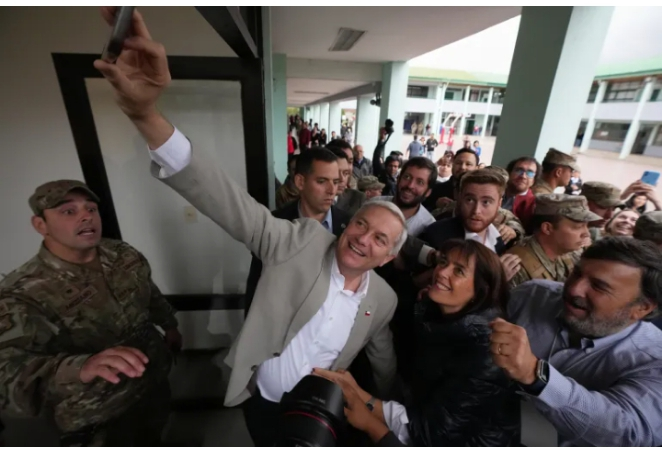
“Democracy has spoken clearly,” Jara wrote online. “I have congratulated President-elect Kast and wish him success for the good of Chile.”
She urged supporters to remain engaged, promising continued advocacy for social justice from outside the presidential palace.
Jose Antonio Kast wins Chile presidential election amid widespread frustration over rising violent crime, organised drug trafficking, and growing public unease around irregular migration.
Voter surveys throughout the campaign showed security overtaking inequality as the dominant concern shaping electoral choices nationwide.
Chile, once regarded as one of Latin America’s safest countries, has seen homicide rates and gang activity rise steadily in recent years.
Kast capitalised on that anxiety by offering a hardline security platform branded the “Implacable Plan.”
The proposal calls for mass deportations, expanded prisons, harsher sentencing laws, and total isolation of cartel leaders.
“While criminals roam freely, honest citizens are prisoners in their own homes,” Kast wrote in his campaign security blueprint.
Critics warned the proposals risked human rights violations, but supporters argued decisive action was long overdue.
Jose Antonio Kast wins Chile presidential election on his third attempt, completing a remarkable political comeback after losing heavily in 2021.
That earlier defeat came against outgoing president Gabriel Boric, whose approval ratings slumped sharply during his single constitutionally permitted term.
By the end of Boric’s presidency, public approval hovered near 30 percent amid inflation, crime fears, and stalled reforms.
Analysts say voter fatigue with progressive governance created fertile ground for Kast’s conservative message.
“People voted less out of love for Kast than exhaustion with the status quo,” one Santiago-based political analyst observed.
Jose Antonio Kast wins Chile presidential election as part of a broader right-wing surge across Latin America.
Recent conservative victories in Argentina and Ecuador suggest shifting regional attitudes driven by economic pressures and security fears.
Argentina’s libertarian president Javier Milei celebrated Kast’s victory enthusiastically.
“FREEDOM IS ADVANCING,” Milei wrote, praising what he called a continental defense of liberty and private property.
In Washington, US Secretary of State Marco Rubio congratulated Kast and pledged cooperation on security and trade.
“A new era is beginning for Chile and the region,” Ecuadorian President Daniel Noboa declared.
Despite international congratulations, Kast’s past continues to shadow his presidency.
Opponents frequently cite his sympathetic remarks about former military dictator Augusto Pinochet.
Pinochet ruled Chile from 1973 to 1990 following a coup that toppled socialist president Salvador Allende.
His regime became infamous for widespread torture, executions, and forced disappearances.
Kast has rejected the “far-right” label but once remarked that Pinochet, if alive, would vote for him.
During the campaign, Kast attempted to soften his image, emphasising democratic institutions and economic growth.
Al Jazeera correspondent Lucia Newman described the victory as historically significant.
“This is the first time since Chile’s return to democracy that such a conservative government will govern,” she said.
“But how conservative it ultimately becomes remains uncertain,” Newman added.
Jose Antonio Kast wins Chile presidential election while facing a fragmented National Congress.
Lawmakers are expected to resist some of his most radical proposals, forcing compromise.
Political observers predict intense negotiations over security legislation and migration reforms.
Kast is scheduled to be sworn in on March 11, inheriting a deeply polarised country.
Compulsory voting returned for this election, drawing more than 15 million eligible voters to the polls.
In the first round, Kast finished second before consolidating right-wing support in the runoff.
That unity proved decisive, transforming earlier fragmentation into an overwhelming victory.
For supporters, the result represents a long-awaited correction.
For critics, it raises fears of authoritarian tendencies resurfacing decades after dictatorship.
Read more: Andy Burnham dismisses reports linking him to Labour leadership challenge
Jose Antonio Kast wins Chile presidential election at a crossroads moment, with expectations high and patience limited.
Whether his presidency delivers security without sacrificing democratic values may define Chile’s next political era.
About The Author