
Andy Burnham defence spending faces tax dilemma
Andy Burnham defence spending plans face a major financial challenge after the Resolution Foundation warned that higher taxes on middle earners may be unavoidable if Britain is to meet its military commitments.
The warning comes as the prime minister prepares for his first Prime Minister’s Questions since taking office, with Conservative leader Kemi Badenoch expected to challenge him over taxation, defence and government spending.
The government has pledged to increase defence spending significantly, including a target of 3.5 per cent of GDP by 2035, while also pursuing ambitious plans for public services, regional development and economic growth.

However, the Resolution Foundation estimates that reaching the 3.5 per cent target could require an additional £28 billion annually by 2035 compared with current plans.
The think tank has therefore warned that the government cannot realistically promise substantially higher spending while simultaneously guaranteeing that middle earners will not face increased taxation.
Resolution Foundation warns of higher taxes
The Resolution Foundation’s latest analysis argues that Britain’s financial position makes the question of who pays for a larger state increasingly difficult to avoid.
James Smith, the foundation’s chief economist, said: “Despite recent increases, the UK still taxes average earners less than most of our international peers.”
He added: “No other OECD rich country has a bigger state and a lower burden on average workers, so any politician promising both is not being realistic.”
The organisation says the tax burden on British workers remains relatively low by international standards despite substantial increases in taxation since Labour came to power.
Its analysis found that taxes on an average UK worker rose sharply in 2025, but the overall tax wedge remained below the OECD average and below levels recorded in several comparable wealthy nations.
Smith argued that the benefits of increased defence expenditure would be shared broadly across society and therefore believed the financial burden should also be distributed widely.
“There is a strong case that any benefits of increased defence spending will be broadly shared,” he said, arguing that “the tax rises needed to find this should be too, including higher rates on middle earners.”
Labour faces difficult defence spending choices
The warning places Chancellor John Healey under growing pressure as he prepares to determine how Labour will finance its defence commitments.
Healey has previously argued strongly for greater defence investment and is expected to present a detailed plan during the next spending review.
The government’s long-term objective is to devote 3.5 per cent of GDP to defence by 2035, while Burnham has also confirmed a pathway towards spending three per cent of economic output on defence by 2030.
That ambition comes alongside promises to reduce household costs, regenerate struggling communities and increase public control over essential services.
The competing priorities could make the upcoming Budget and spending review crucial moments for the Burnham administration.
The government must demonstrate that its plans are financially credible while avoiding measures that could increase pressure on households already dealing with high living costs.
Government insists on fiscal discipline
Ministers have rejected suggestions that Burnham’s plans represent uncontrolled government spending.
Cabinet Office minister Sally Jameson defended the prime minister’s economic approach and insisted that the government remains committed to its fiscal rules.
“I think it’s important we don’t over-read into individual comments people make,” she said, adding that Burnham had been clear that the government would “stick to those fiscal rules rigidly.”
Jameson also stressed that “fiscal responsibility is absolutely imperative”, while arguing that stronger economic growth could help the government deliver its programme.
“We’ve got to have controls on spending,” she said. “But I think the key thing is having growth and bringing optimism back into this country.”
Her comments came after Lord Jim O’Neill, an ally of Burnham, expressed concern about how international investors might interpret the prime minister’s emphasis on greater government spending.
The dispute illustrates the tension between Burnham’s desire to pursue major structural reforms and the need to reassure financial markets that public finances will remain under control.
Andy Burnham faces first PMQs showdown
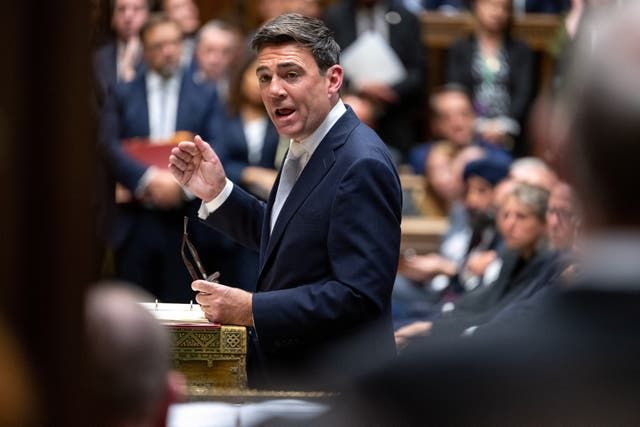
The debate over Andy Burnham defence spending comes as the prime minister prepares to face Badenoch at the Commons despatch box.
His first PMQs will provide an early test of his authority over Labour backbenchers and an opportunity for the Conservatives to challenge the government over its economic strategy.
Read also:
US-Iran airstrikes intensify as fears of wider war grow
Badenoch is expected to focus on the possibility of tax increases, defence expenditure and the financial implications of Burnham’s programme.
The prime minister’s appearance follows his first major Commons address, during which he criticised decades of economic policy and outlined plans to devolve more power from Westminster to Britain’s regions.
Burnham blamed the legacy of Margaret Thatcher, austerity and Brexit for what he described as years of economic stagnation.
He said Brexit had “ushered in a decade of low growth” and argued that Britain needed to confront the decisions that had contributed to its economic difficulties.
The prime minister described the existing system as a “failed economic model” and said his government would seek to replace it with a strategy focused on growth, regional empowerment and greater public control.
Public control rather than full nationalisation
Burnham’s plans for essential services have also attracted considerable attention, particularly proposals involving water, energy, housing and transport.
However, ministers have sought to clarify that greater public control does not necessarily mean complete nationalisation.
Housing minister Sally Jameson said: “I don’t think it’s about renationalisation as such, it’s about public control and what’s in the interests of people.”
She pointed to bus franchising as an example of the model the government could use in other sectors.
Under such arrangements, local authorities can influence prices and routes while private companies continue providing services.
Jameson said the objective was to “put the public back in the driving seat again” and ensure essential services operate in the interests of consumers rather than simply shareholders.
The approach could allow Burnham to pursue his promise of greater public influence without immediately committing the government to the enormous cost of completely nationalising major utilities.
Brexit becomes central to Burnham’s economic argument
During his first Commons statement, Burnham directly connected Britain’s economic difficulties with the consequences of Brexit.
He argued that Brexit had compounded problems created by over-centralisation, deindustrialisation and privatisation.
The prime minister said Britain needed to be “blunt” about what had gone wrong and insisted that power must be transferred away from Westminster to communities across the country.
His argument represents a significant political shift in the government’s economic narrative, particularly because Brexit remains one of the most divisive political issues in Britain.
Burnham has also signalled his intention to continue improving relations with the European Union.
That approach will be highlighted by his planned meeting with French President Emmanuel Macron at Downing Street.
Macron visit highlights UK-EU reset
Macron is expected to become the first European leader to visit Britain since Burnham became prime minister.
The meeting is expected to reinforce the government’s attempt to reset relations between Britain and the European Union.
Migration cooperation with France is likely to feature prominently, particularly following government claims that summer small-boat crossings were at their lowest level since 2020.
Burnham’s spokesperson said closer cooperation with France was producing results but stressed that the government remained vigilant.
The Macron visit therefore offers Burnham an opportunity to demonstrate his European strategy while facing mounting domestic pressure over defence spending and taxation.
Defence spending could shape Burnham’s premiership
The controversy surrounding Andy Burnham defence spending highlights one of the biggest challenges facing the new government.
Burnham wants to increase military expenditure, reform essential services, devolve power and stimulate economic growth while maintaining strict fiscal rules.
The Resolution Foundation, however, believes the government will struggle to finance those ambitions without broader taxation.
Its analysis argues that Britain cannot simultaneously maintain a larger state, significantly increase defence spending and guarantee that average workers will not contribute more through taxation.
The government insists that economic growth and fiscal discipline can help reconcile its competing commitments.
But if ministers ultimately raise taxes on middle earners, the Conservatives are likely to argue that Labour failed to properly account for the cost of its promises.
For Burnham, the immediate task will be convincing voters that stronger defence, improved public services and economic renewal can be achieved without placing an excessive financial burden on working families.
His first PMQs and the forthcoming spending review could therefore provide early indications of how his government intends to resolve that difficult equation.
The debate over UK defence spending is unlikely to disappear soon, particularly as Britain faces growing geopolitical pressures and the government remains committed to increasing military expenditure.
Ultimately, the question confronting Burnham is straightforward but politically difficult: how much should Britain spend on defence, and who should pay for it?
The answer could determine not only the future of the government’s economic programme but also the political direction of Burnham’s premiership.
About The Author