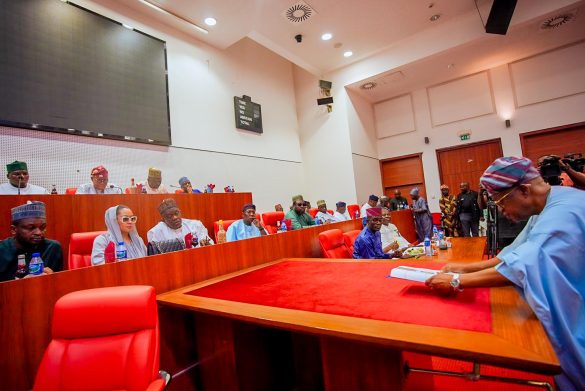
Rotimi Amaechi joins Abuja protesters opposing Senate rejection of electronic transmission, urging opposition unity and warning against threats to electoral credibility.
Former Rivers State Governor and ex-Minister of Transportation, Rotimi Amaechi, on Tuesday made a notable public appearance at a protest in Abuja opposing the Senate’s decision to reject mandatory real-time transfer of election results.

The demonstration, which began a day earlier, has continued to draw political actors, civil society groups, and concerned citizens who fear the decision could weaken public confidence in Nigeria’s electoral process.
Amaechi’s participation immediately drew attention, not only because of his political stature but also due to the symbolism surrounding his presence.
He arrived at the protest ground with his son, a medical doctor, a move he said was both practical and deliberate.
According to him, protests in Nigeria have historically faced risks, and having medical expertise on hand was a precaution.
Beyond that, he explained that leadership demands visibility, especially in moments where democratic principles are being contested.
The protest was convened by the African Democratic Congress (ADC) in collaboration with multiple civil society organisations.
Organisers described the Senate’s stance as a step backward, arguing that transparency remains a critical pillar of credible elections.
For them, rejecting electronic transmission sends the wrong signal at a time when public trust in institutions is fragile and electoral reforms are widely expected.
Addressing protesters, Amaechi challenged the ruling All Progressives Congress (APC), accusing it of resisting reform out of political insecurity. He argued that a party confident in its popularity would have nothing to fear from transparent electoral mechanisms.
According to him, credible elections should not be viewed as a threat but as a validation of performance in office.
He further called on opposition parties to put aside partisan rivalries and present a united front. In his view, electoral integrity transcends party lines and directly affects the legitimacy of governance.
Amaechi insisted that when citizens lose faith in the process that produces leaders, the consequences often extend beyond politics into social instability.
The former minister also reacted to claims that the protest could be hijacked by opposition interests.
He dismissed such concerns, questioning why similar accusations are rarely raised when ruling parties mobilise supporters for political causes.
Amaechi maintained that peaceful protest is a constitutional right and a vital tool for democratic engagement.
Despite boasting of political dominance and control of several state governments, Amaechi questioned why the ruling party would resist reforms such as electronic transmission if it truly enjoyed widespread support.
He stressed that modern democracies are increasingly embracing technology to minimise manipulation and human interference in elections.
According to him, electronic transmission would not replace voters’ choices but would simply ensure that votes cast are accurately reflected in final results.
He warned that resisting such reforms could deepen suspicion among citizens and fuel apathy, especially among young voters who already feel disconnected from the political system.
Amaechi acknowledged that Senate President Godswill Akpabio and President Bola Tinubu might choose to ignore the demands of protesters.
However, he said sustained civic pressure often forces political leaders to reconsider unpopular decisions.
He added that democracy thrives not only through elections but through continuous engagement between the government and the governed.
As the protest progressed, security agencies increased their presence around the National Assembly. Major access roads were barricaded by operatives of the Nigeria Police Force ahead of an emergency plenary session convened by the Senate.
While authorities cited security concerns, protesters interpreted the move as an attempt to discourage public participation.
The demonstration is being coordinated by human rights activist Aisha Yusuf, alongside several civil society organisations.
She emphasised that the protest remains peaceful and issue-driven, insisting that the goal is not to destabilise government but to defend election credibility and democratic accountability.
Yusuf noted that the rejection of electronic transmission could undermine years of advocacy for electoral reform. She urged lawmakers to listen to citizens’ concerns and prioritise long-term democratic stability over short-term political advantage.
As debates continue, the Abuja demonstration reflects a broader national conversation about trust, transparency, and the future of elections in Nigeria.
About The Author