

Nigeria’s ambition to unlock the full economic potential of its marine and blue economy faces renewed uncertainty following the presentation of a ₦10.5bn budget proposal for the 2026 fiscal year, which the Minister of Marine and Blue Economy, Adegboyega Oyetola, has described as grossly inadequate to drive meaningful reforms across the sector.
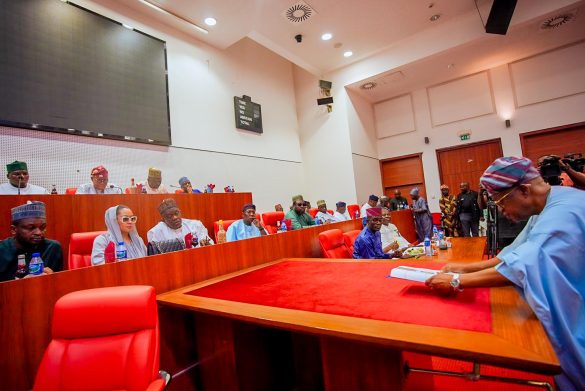
Oyetola raised the concern on Tuesday while defending his ministry’s 2026 estimates before a joint session of the Senate Committee on Marine Transport and multiple House of Representatives committees overseeing ports, harbours, maritime safety, shipping services, inland waterways, and fisheries.
In a statement issued by the ministry, the minister said the proposed allocation would barely sustain basic operations, warning that it falls far short of what is required to modernise infrastructure, improve safety, and expand Nigeria’s competitiveness in global trade.
Breakdown of the proposed allocation
According to the minister, the ₦10,499,984,667.10 proposal is made up of ₦8.24bn for capital expenditure, ₦453.86m for overhead costs, and ₦1.81bn for personnel expenses.
Oyetola stressed that while the figures may appear substantial on paper, they are insufficient when measured against the scale and strategic importance of the sector.
“The proposed budget would only sustain minimal operational continuity rather than deliver meaningful reforms or sectoral growth,” he told lawmakers, adding that the marine and blue economy remains one of Nigeria’s most underfunded economic frontiers despite its enormous potential.
Oyetola decries inadequate funding in 2026 marine budget
At the centre of the minister’s submission was a broader warning that the 2026 marine budget, in its current form, could slow Nigeria’s efforts to reposition maritime transport, fisheries, and inland waterways as engines of economic diversification.
Oyetola explained that the ministry oversees a network of interconnected subsectors—ports, shipping, inland waterways, fisheries, and aquaculture—which collectively handle over 90 per cent of Nigeria’s international trade by volume.
“These sectors are not only critical to trade but also to food security, job creation, and Nigeria’s overall economic competitiveness,” he said.
He argued that chronic underfunding limits the ministry’s ability to coordinate reforms, improve safety standards, and attract private investment into maritime infrastructure.
Strain on self-funded maritime agencies
The minister also highlighted structural challenges facing key maritime agencies such as the Nigerian Ports Authority (NPA), Nigerian Maritime Administration and Safety Agency (NIMASA), and the Nigerian Shippers’ Council.
Although these agencies are largely self-funding and remit substantial revenues to the Consolidated Revenue Fund, Oyetola said deductions at source have significantly weakened their liquidity.
According to him, these deductions have reduced operational flexibility and constrained the agencies’ ability to invest in safety, port efficiency, and regulatory oversight.
“What appears to be an accounting issue has become a national economic concern,” the minister said, warning that the consequences include port congestion, higher logistics costs, delayed cargo movement, revenue leakages, and inflationary pressure on consumer goods.
Budget misalignment raises oversight concerns
Oyetola further drew lawmakers’ attention to what he described as a budgetary misalignment involving the Council for the Regulation of Freight Forwarding in Nigeria (CRFFN).
He said the council’s 2026 budget was wrongly placed under the Federal Ministry of Transportation by the Budget Office, despite the agency falling under the Ministry of Marine and Blue Economy.
According to him, the misplacement undermines clarity in oversight and weakens policy coordination across the maritime logistics value chain.
“This misalignment creates confusion and weakens institutional coherence at a time when efficiency and coordination are critical,” he said.
Inland waterways safety under threat
On inland waterways, the minister appealed for increased funding to tackle frequent accidents and fatalities, noting that water transport remains one of the most cost-effective modes of transportation globally.
He lamented Nigeria’s heavy reliance on road haulage, which accounts for over 80 per cent of freight movement, stressing that this dependence has accelerated road deterioration and driven up logistics costs.
“A safer and more efficient inland waterways system would ease pressure on our roads and significantly reduce the cost of moving goods,” Oyetola said, adding that inadequate funding continues to slow progress in dredging, navigation aids, and enforcement of safety standards.

Fisheries and aquaculture funding gaps
The minister also painted a troubling picture of Nigeria’s fisheries and aquaculture subsector, revealing a significant gap between domestic demand and local production.
According to him, Nigeria’s annual fish demand exceeds 3.6 million metric tonnes, while domestic production stands at about 1.4 million metric tonnes, forcing the country to rely on imports valued at over $1bn annually.
He added that post-harvest losses of up to 30 per cent further reduce supply, despite fish being one of the most affordable sources of animal protein for Nigerian households.
Oyetola assured lawmakers that the ministry is working to boost local production, improve cold-chain infrastructure, and reduce dependence on imports, but warned that sustained underfunding could derail these efforts.
Poor releases undermine budget execution
Revealing the scale of past funding challenges, Oyetola disclosed that in 2025, the ministry’s revised capital budget of ₦3.53bn received an actual cash release of just ₦202.47m, representing about 1.7 per cent.
He added that overhead releases stood at 35 per cent, a situation he said severely limited implementation capacity.
The minister said engagements were ongoing with the Ministry of Budget and Economic Planning to address the funding gaps in line with the Federal Government’s strategy to diversify the economy through the marine and blue economy.
Stakeholders express growing concern
Industry stakeholders have continued to raise alarms over inadequate funding, heavy remittance requirements, and deductions affecting maritime agencies, warning that these constraints limit investment in port infrastructure and efficiency.
Frequent boat mishaps and Nigeria’s continued dependence on fish imports have further underscored the urgency of increased funding and coordinated reforms.
As lawmakers review the proposal, analysts say the fate of the 2026 marine budget could determine whether Nigeria’s marine and blue economy becomes a true growth pillar—or remains a missed opportunity.
About The Author


