

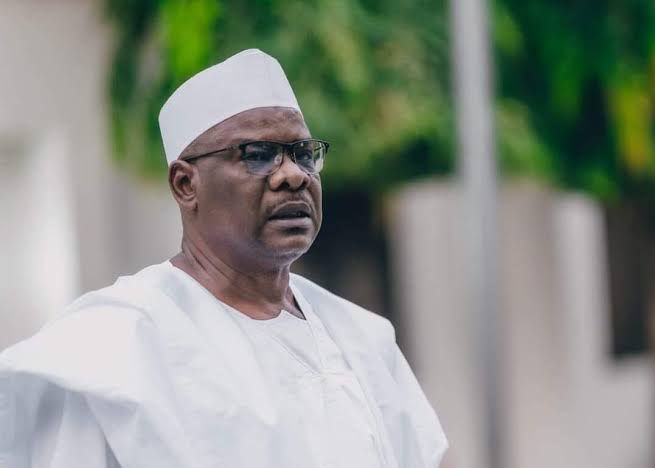
Senator Ali Ndume, representing Borno South in the National Assembly, has challenged Nigerians to look beyond politicians when discussing the country’s leadership problems, arguing that citizens also bear responsibility for the people who emerge as leaders.
Ali Ndume made the submission on Wednesday, September 16, while speaking at the public presentation of Military Transformational Leadership in Action: The Buratai Era at the Nigerian Army Conference Centre and Suites in Asokoro, Abuja.
The senator’s intervention followed comments by Muhammadu Sanusi II, the Emir of Kano, who had raised concerns about the conduct of the political class and the growing use of ethnicity and religion in Nigerian politics.
Sanusi’s remarks touched on the connection between political behaviour, governance and the security challenges confronting the country.
However, Ndume said the conversation should not be limited to the actions of politicians because citizens are also central to the democratic system that produces political leaders.
According to the senator, Nigerians frequently direct their frustrations towards politicians while overlooking the role they themselves play in determining who occupies positions of authority.
“Every blame is on the politician. And I’m a politician, though accidental, or maybe, forced or recruited into it. But I’m a realist. I live with the situation I find myself, and I’m proud of it,” Ndume said.
He explained that politics is fundamentally about people and that democracy gives citizens the responsibility to participate in choosing those who govern them.
Ndume said political leaders should therefore be viewed within the context of the society and electoral process from which they emerge.
He maintained that citizens cannot demand a different outcome from a political system without also examining their own contributions to that system.
“Politics is people; politics is one way to run democracy, and what is democracy? It’s the government of the people, for the people, and by the people. From all discussions, now the blame goes down to us, and we are your product,” he said.
The senator’s argument was that leadership is not entirely disconnected from the choices and actions of the electorate.
He urged Nigerians to pay greater attention to the candidates they support and the circumstances surrounding their emergence.
He also extended his argument to situations involving electoral malpractice, saying citizens should not assume that politicians alone are responsible for manipulating the political process.
Ndume said that even when allegations of rigging arise, Nigerians are often involved in one way or another, stressing that those who manipulate elections are members of the same society.
“And by the way, you are to be blamed because even if it is through rigging, it is you people that do the rigging to bring us in. So, if you put us here, we are doing your bidding,” he said.
The lawmaker’s comments therefore placed considerable emphasis on citizen participation as an important component of democratic governance.
He suggested that Nigerians seeking improved leadership must become more deliberate about their involvement in politics and elections.
Rather than waiting until after elections to complain about the performance of elected officials, Ndume urged citizens to scrutinise the people seeking public office and understand the political processes through which they emerge.
He also called for greater reflection on the relationship between followers and their leaders.
According to him, Nigerians should consider whether the quality of leadership they experience is partly connected to the choices and values present within the wider society.
“And God says that he does not bring leaders different from the followers. I think part of this is something that we look at very well, so that you make sure that we have democracy, and when we have democracy, we would have good governance,” Ndume said.
His comments came against the backdrop of continuing public discussions about Nigeria’s democratic development and the country’s struggle to translate political participation into effective governance.
The senator’s position was that achieving good governance requires more than holding politicians accountable after they assume office.
Citizens, he argued, must also take an active interest in the process from the beginning, including the selection of candidates, electoral participation and the broader political environment.
Ndume further used a simple analogy to illustrate his point, suggesting that the outcome of a system is influenced by what is introduced into it.
“You put garbage in, you expect something good out of it? It’s not possible,” he said.
The statement reinforced his call for Nigerians to examine the choices they make during the political process and the standards they apply when deciding who deserves their support.
The senator’s remarks also added another dimension to the debate sparked by Sanusi’s criticism of the political class.
While Sanusi’s intervention focused attention on the conduct of politicians and the use of ethnic and religious identities in politics, Ndume broadened the discussion to include the responsibilities of citizens.
He maintained that politicians are products of the same democratic environment in which Nigerians participate, making citizen involvement an important part of any conversation about leadership and governance.
Ndume consequently urged Nigerians to become more engaged in the political process if they want to see improvements in the quality of governance.
His position was that citizens should not only demand accountability from elected officials but should also consider their own role in producing and sustaining the political leadership they later criticise.
The senator’s comments ultimately centred on the idea that democracy involves shared responsibility.
In his view, stronger participation by citizens, greater scrutiny of political candidates and more conscious engagement with electoral processes are necessary parts of the effort to achieve good governance in Nigeria.