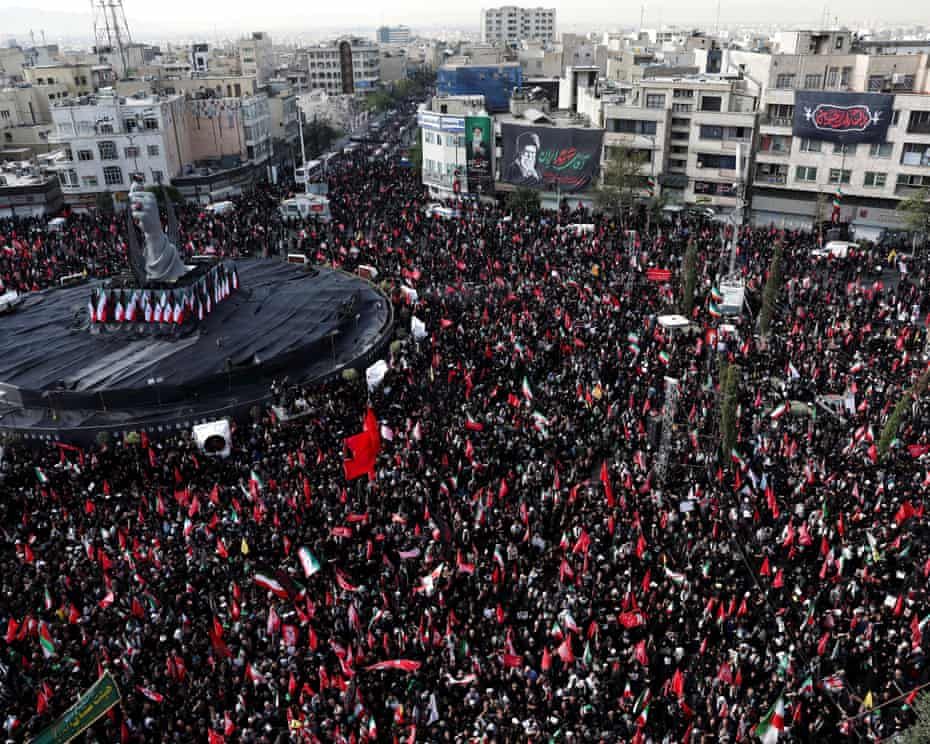
Ali Khamenei funeral procession moved across Tehran on Monday as millions in black joined the march from Revolution Square to Azadi Square. The Iran supreme leader funeral followed two days of rites at the Grand Masalla mosque and became one of the largest gatherings in the capital in years.
President Masoud Pezeshkian of Iran addressed the crowds and said the turnout was a covenant to continue the country’s path, while rejecting claims that the grief was staged amid the wider US Israel war Iran context.
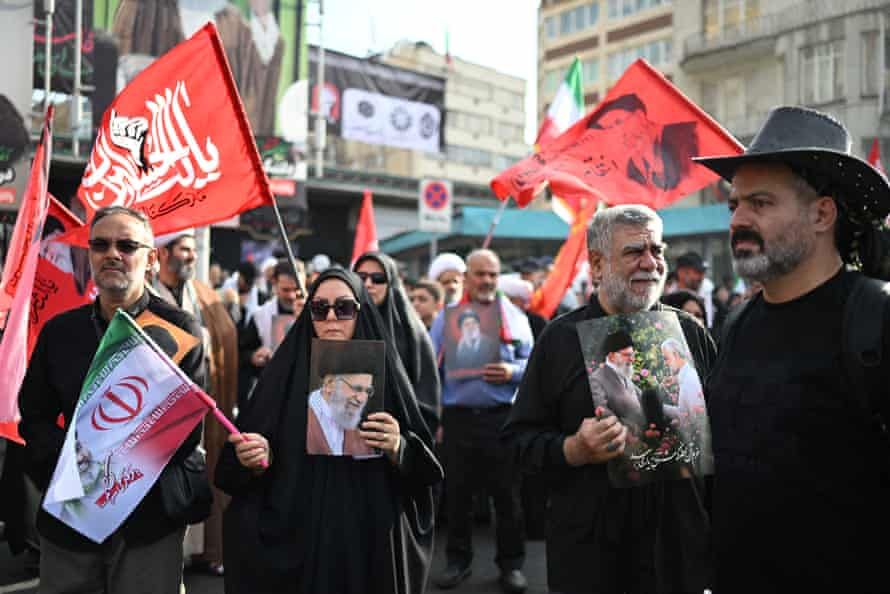
The procession began after the bodies of Khamenei and members of his slain family were received at the mosque. Mourners carried Iranian flags, portraits of the leader, and banners with the slogan “we will rise”.
The Tehran metro was packed as people tried to reach the route. Chants filled the streets, including “Mourning is mourning today, mourning day is today / Martyr Khamenei is before God today”.
Scale of the Tehran Mourning March
The Tehran mourning march stretched for hours and was expected to last between ten and twelve hours depending on numbers. Only limited crowds could enter the Masalla mosque at any one time, so the street procession carried the weight of public participation. By mid-morning, Ferdowsi Square was filled with people waiting to join.
Organizers and state services deployed a large volunteer civic effort to feed and house mourners. Officials said no one was killed during the march, a contrast with previous state-linked funerals that lost control. President Pezeshkian praised the behavior of the crowds and said the images should force the West to reflect on attempts to change Iran from without.
Public Mood and Symbols on the Route
Black clothing dominated, but the visual language was layered. Alongside national flags, many carried images of Khamenei and signs reading “we will rise”. At Sunday’s prayers, mourners had chalked “Kill Trump” on the stage, linking personal grief to a demand for revenge. The crowd’s tone mixed sorrow with defiance, and officials framed the turnout as national cohesion after months of regional conflict.
Security and Logistics
Authorities limited access to the mosque to manage flow, then guided people onto a westward route through central Tehran. Metro stations near the line were congested, and volunteers distributed water and food along the path. The state’s ability to move millions without major incident was presented as a measure of organizational capacity.
Leadership Presence and Succession Questions
Most of the depleted Iranian leadership attended Sunday’s morning prayer, the exception being Mojtaba Khamenei, the slain leader’s son and appointed successor. Officials said his absence was not due to injuries from an earlier strike on the presidential building, but to security concerns. His three brothers were present.
The presence of the political elite was meant to signal continuity. Pezeshkian, a reformist elected two years ago, used the moment to stress consensus inside the establishment. He said this was not a farewell but a pact to continue the path, and that the war had strengthened unity among Muslims and broadened global awareness of the region’s claims.
Masoud Pezeshkian Iran Response to US Claims
Pezeshkian directly addressed US President Donald Trump’s suggestion that the tears at the funeral could be fake. He said the grief seen on the faces of girls, men, and children could not be manufactured by order. Tears, he argued, come from pain that the world can see.
He also linked the funeral to foreign policy. Pezeshkian said the United States and Israel had shown in the war that their talk of freedom and human rights was a lie. He described the Zionists as the perpetrators of regional crimes, with support from Washington and European capitals. The speech framed the mourning as both domestic solidarity and international messaging.
Foreign Press Access
More than 300 foreign journalists received rare visas to cover the events, in addition to correspondents already based in Iran. The access was intended to show the scale of participation to an international audience. The coverage focused on the size of the march, the slogans, and the leadership’s statements.
Context of the US Israel War Iran
Khamenei was killed by Israeli bombs at the start of the war in February, in what officials described as an effort to destabilize and topple the government. The funeral was cast as a response to that strike. The article notes that many Iranians view the assembly as a turn after months of internal protest and repression, now redirected toward external confrontation.
Pezeshkian argued that the war disrupted regional geography but strengthened cohesion. He said the conflict had made more people aware of human rights arguments raised by Iran’s side. The narrative tied the Iran supreme leader funeral to a broader claim that external pressure had produced internal unity.
What the Funeral Signals Next
The procession was engineered to project scale, but it also revealed how the state wants the moment understood. First, as continuity. The leadership appeared together, and Pezeshkian spoke of a covenant rather than an ending. Second, as legitimacy.
The crowds, the slogans, and the international press were used to argue that grief was genuine and widespread. Third, as resolve. References to revenge, to Trump, and to Israel positioned the funeral inside a wartime frame.
The absence of Mojtaba Khamenei will remain a point of speculation. Officials cited safety, yet succession questions are now more visible. How the establishment manages that transition, while maintaining cohesion, will shape policy after the mourning period.
International Reading of the Images
For outside observers, the images from Azadi Square and Ferdowsi Square will be weighed against recent history. Seven months ago, Iran faced large street protests with heavy casualties.
The state now presented a different picture: orderly millions, volunteer support, and leadership alignment. Pezeshkian’s line that the world understands behavior and presence, even when Persian is not understood, was aimed at that contrast.
Whether the turnout changes Western calculations is uncertain. The funeral’s size alone will not resolve disputes over nuclear policy, regional alliances, or sanctions. But it does give Tehran a visual argument that internal support remains broad, and that external pressure has not fractured the political core.
Read also: Cassava Flour Pasta vs Semovita vs Wheat vs Yam Flour Pasta vs Eba: Which Is the Best Swallow for Diabetics Nigeria?
The Ali Khamenei funeral procession closed with the same message that opened it: continuity. From the Grand Masalla to Azadi Square, the march turned loss into a public statement. With Masoud Pezeshkian Iran framing the moment as a pact, and with the US Israel war Iran still shaping rhetoric, the Tehran mourning march will be read as both a funeral and a signal of where Iran intends to go next.
About The Author