
The US state of Alabama has carried out another nitrogen gas execution, killing a man convicted of a 1993 murder amid growing controversy over this lethal method.
Anthony Boyd, aged 54, was executed on Thursday evening after decades on death row for his role in a killing allegedly linked to a $200 drug dispute.
Boyd’s nitrogen gas execution marks the seventh instance since January 2024 that Alabama has used the method, despite repeated appeals and mounting criticism from rights advocates and legal experts.
Witnesses said Boyd’s death appeared drawn-out and distressing, intensifying questions about whether nitrogen gas execution violates constitutional protections against “cruel and unusual punishment” under the Eighth Amendment.
According to local reporters, the process lasted nearly 40 minutes, with Boyd visibly struggling and spasming for over 20 minutes before being declared dead at 6:33pm.
“The state turned on nitrogen at 5:57pm, but he kept breathing,” reported journalist Sarah Clifton of the Montgomery Advertiser, who observed the execution firsthand.
Boyd’s case reignited national debate over the Alabama death penalty, already under scrutiny for errors in lethal injection procedures and racial disparities in capital sentencing.
The nitrogen gas execution was chosen as an alternative to lethal injection after several botched procedures and a nationwide shortage of the drug cocktail used for traditional executions.
The gas method involves replacing breathable air with pure nitrogen, causing oxygen deprivation that leads to death by hypoxia. Officials claim it is quick and painless.
Critics, however, dispute that claim, calling the nitrogen gas execution an “unproven, experimental procedure” that risks extreme suffering and violates basic human rights norms.
Boyd’s attorneys argued the method breached the Eighth Amendment and requested that he be executed by firing squad instead, a request repeatedly denied by Alabama courts.
The US Supreme Court rejected Boyd’s emergency appeal, allowing the execution to proceed despite dissent from the court’s three liberal justices.
Justice Sonia Sotomayor described the nitrogen gas execution as a “torturous suffocation,” contrasting it with the relative immediacy of a firing squad death.
“Boyd asks for the barest form of mercy — to die by firing squad, which would kill him in seconds,” Sotomayor wrote in her impassioned dissent.
“The Constitution would grant him that grace. My colleagues do not. This Court turns its back on the Eighth Amendment’s guarantee against cruel punishment.”
Boyd, maintaining his innocence until the end, used his final moments to proclaim: “I didn’t kill anybody. I didn’t participate in killing anybody.”
“There can be no justice until we change this system,” Boyd said, echoing calls from activists who argue the Alabama death penalty disproportionately targets poor and Black defendants.
The Anthony Boyd case dates back to 1993, when prosecutors alleged that he and three others abducted and burned a man named Gregory “New York” Huguley to death.
Boyd was sentenced to death in 1995 by a 10-2 jury vote — a practice later outlawed by the US Supreme Court but still applicable retroactively in Alabama.
The Death Penalty Information Center (DPIC) reported that Boyd’s conviction relied solely on witness testimony, without any physical evidence linking him to the murder.
DPIC also noted that his trial took place in a county with the “highest per capita rate of death sentences in the nation” at the time.
Civil rights groups argue the nitrogen gas execution reflects deeper systemic failures in the US justice system, where legal representation and race still heavily influence capital outcomes.
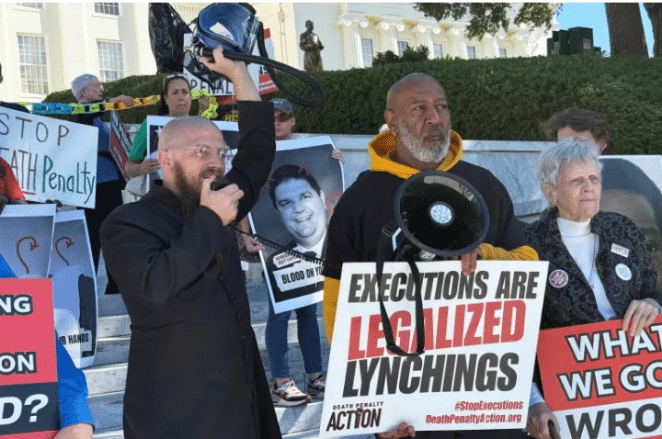
Reverend Jeff Hood, a long-time opponent of executions, led vigils outside the Alabama Capitol, calling the practice “a moral and spiritual crisis for this state.”
“This was not justice; this was state-sanctioned torture,” Hood told reporters after Boyd’s death, condemning Alabama’s insistence on continuing nitrogen gas execution procedures.
The state government defended its actions, arguing that the gas method complies with federal law and represents a humane, efficient alternative amid drug shortages for lethal injection.
In a statement, Alabama Attorney General Steve Marshall said the nitrogen gas execution “fulfilled the sentence lawfully imposed by a jury” and demonstrated the state’s commitment to justice.
Marshall criticized opponents for “politicizing the process,” saying families of victims deserve closure after decades of appeals and procedural delays in capital punishment cases.
International human rights organizations disagreed, urging Washington to pressure Alabama to suspend further executions involving nitrogen gas until independent medical reviews are completed.
Amnesty International condemned the nitrogen gas execution, calling it “an untested and barbaric procedure that places the United States alongside nations known for regressive penal policies.”
The United Nations Human Rights Office expressed concern that nitrogen gas execution might amount to torture under international law, violating multiple human rights treaties the US has ratified.
The Anthony Boyd case comes at a time when several US states have paused or reconsidered capital punishment, while others, like Alabama, have expanded execution options.
Oklahoma and Mississippi have already approved nitrogen as a secondary method, though neither has yet conducted an execution using it, pending further legal and ethical reviews.
Legal analysts say the nitrogen gas execution debate could shape the future of the death penalty nationwide, testing constitutional limits on evolving standards of decency.
Robert Dunham, former executive director of DPIC, said, “What Alabama calls innovation is, in truth, an experiment with human lives — one shrouded in secrecy and political expediency.”
Boyd’s execution followed two other controversial deaths by nitrogen gas this year, both of which drew complaints about visible distress and prolonged suffering.
Doctors who reviewed witness accounts said the convulsions described were consistent with hypoxia, suggesting the nitrogen gas execution is far from instantaneous or painless.
For many Alabamians, though, opposition to the death penalty remains a minority stance, as polls show steady support for capital punishment despite mounting ethical challenges.
Governor Kay Ivey, a staunch supporter of the Alabama death penalty, said the state would “continue to carry out lawful sentences” and “stand firm against violent offenders.”
Human rights advocates countered that the nitrogen gas execution represents a dangerous step backward for a country that claims to uphold human dignity and due process.
Boyd’s family, who had long pleaded for clemency, said they would continue to fight for justice and an end to executions they describe as “cruel and un-American.”
“This is not closure,” one family member told Reuters. “This is another tragedy built on decades of injustice and denial of truth.”

As Alabama presses forward, global scrutiny of the nitrogen gas execution method is likely to intensify, raising profound questions about morality, legality, and the future of capital punishment.
Whether Boyd’s death marks progress or regression depends on how the nation defines justice — and how much cruelty it is willing to accept in its name.
About The Author





