

The AFCON 2025 game against Uganda served as a defining moment for Nigeria’s Super Eagles, revealing tactical depth, squad flexibility, and evolving ambition under head coach Eric Chelle.
Having already secured qualification for the round of sixteen, Nigeria approached the fixture without desperation, instead viewing it as a strategic opportunity for controlled experimentation.
Chelle’s selection choices made it clear that the match was not about resting players, but about testing readiness, mentality, and adaptability across the entire squad.
The Super Eagles responded with authority, delivering a convincing 3–1 victory that balanced attacking efficiency with instructive lessons ahead of knockout football.
In tournament settings, such matches often determine how prepared a team truly is, especially when results matter less than performance standards and internal competition.
Nigeria’s coaching staff understood this reality, using the AFCON 2025 game against Uganda as a laboratory for tactical refinement under competitive pressure.
Eight changes were made to the starting lineup, signalling Chelle’s confidence in his depth and his refusal to rely solely on familiar combinations.
Only Victor Osimhen, Calvin Bassey, and Bruno Onyemaechi retained their places, providing leadership continuity amid widespread rotation across defence, midfield, and attack.
Osimhen captained the side, setting the tone with intensity, pressing leadership, and selfless movement rather than chasing personal scoring milestones.
Francis Uzoho returned in goal, eager to reassert his credentials, while the defensive unit showcased composure despite limited collective minutes together.

Ryan Alebiosu and Igoh Ogbu justified their inclusion, maintaining positional discipline and contributing positively to Nigeria’s build-up play from deep areas.
The midfield was where experimentation truly flourished, with Raphael Onyedika delivering a standout performance that defined the rhythm of Nigeria’s approach.
Onyedika’s two goals were the highlight, but his positional intelligence, ball recovery, and distribution underscored his growing influence within the squad.
Alongside him, Fisayo Dele-Bashiru injected power and verticality, repeatedly carrying the ball forward and unsettling Uganda’s compact defensive structure.
Their partnership reflected Eric Chelle tactics focused on balance, combining control with forward momentum rather than static possession.
Nigeria’s attacking structure remained fluid, with wide players interchanging roles and central forwards rotating intelligently to stretch Uganda’s defensive lines.
Paul Onuachu seized his chance emphatically, scoring with confidence while contributing defensively and demonstrating improved mobility throughout the contest.
Samuel Chukwueze and Moses Simon provided creativity, with incisive passing, dribbling, and off-ball movement opening channels for sustained pressure.
The Super Eagles’ three goals were products of teamwork, patience, and well-timed runs rather than individual brilliance alone.
This collective approach is increasingly defining Super Eagles AFCON 2025 performances, reinforcing Chelle’s emphasis on structure over star dependence.
Uganda offered resistance and physicality, yet Nigeria controlled the tempo, limiting transitions and forcing play into less dangerous wide areas.
However, the concession of a late goal again raised concerns about game management during closing stages of matches.
Such lapses have become noticeable, prompting discussions about concentration, defensive discipline, and situational awareness as matches wear on.
In knockout football, these moments can be decisive, where a single lapse may outweigh extended periods of dominance.
Chelle acknowledged these shortcomings post-match, stressing that ambition must be supported by continuous improvement and sharper decision-making.
The coach expressed satisfaction with the overall performance while maintaining realism about the demands of the tournament’s later stages.
One of the strongest takeaways from the AFCON 2025 game against Uganda was confirmation that Nigeria’s strength extends beyond its first eleven.
Players rotated into the side demonstrated readiness, hunger, and tactical understanding, intensifying internal competition for starting positions.
Chelle openly admitted that selection decisions are becoming increasingly difficult, describing the situation as a positive headache for the coaching staff.
Such competition elevates training intensity, sharpens focus, and ensures standards remain high regardless of individual status or reputation.
Nigeria vs Uganda AFCON encounters have historically tested discipline, making this performance particularly valuable from a psychological perspective.
The Super Eagles showed maturity, resisting complacency despite qualification already secured, and maintaining respect for the opposition throughout the match.
Tactical flexibility was evident as Nigeria shifted shapes seamlessly, adjusting midfield spacing and attacking patterns without disrupting overall cohesion.
This adaptability reflects extensive preparation and trust between players and coaching staff, crucial ingredients for tournament success.
Eric Chelle tactics appear increasingly embedded, with players executing instructions instinctively rather than reactively under pressure.
Such understanding reduces reliance on sideline interventions and allows in-game leadership to flourish organically on the pitch.
Nigeria’s ability to rotate without sacrificing identity highlights genuine Super Eagles squad depth, a rarity in African tournament football.
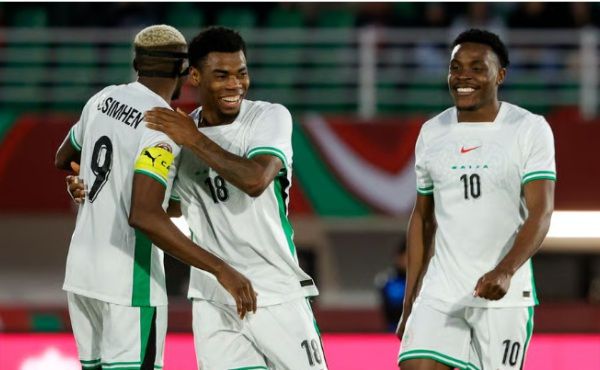
As fatigue accumulates and suspensions emerge, this depth could become Nigeria’s most decisive advantage in knockout scenarios.
Opponents will study Nigeria closely, particularly their tendency to concede late, adjusting strategies to exploit perceived vulnerabilities.
Addressing these issues through improved game management and composure will be critical as margins narrow.
Despite these concerns, confidence within the squad is visibly growing, fuelled by belief in the collective rather than isolated stars.
Read more: Nigeria vs Uganda: Super Eagles Soar to 3-1 AFCON 2025 Victory
The AFCON 2025 game against Uganda reinforced unity, accountability, and tactical clarity at an important juncture in the competition.
Nigeria enters the knockout phase not merely as favourites, but as a side evolving steadily under structured leadership.
Chelle’s measured approach contrasts with reactive tournament management, prioritising long-term success over short-term optics.
This philosophy may ultimately define Nigeria’s AFCON 2025 journey as pressure intensifies and expectations rise.
If refinement matches ambition, the Super Eagles possess the tools required to challenge decisively for continental supremacy.
About The Author


