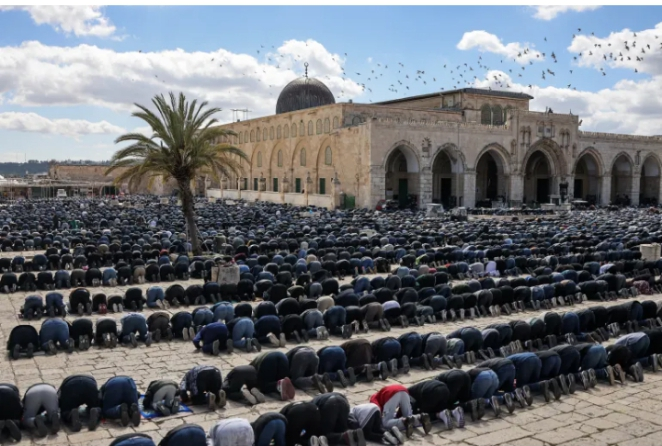
Around 100,000 Palestinian worshippers gathered at Al-Aqsa Mosque in occupied East Jerusalem on Friday for prayers marking the second Friday of the Muslim holy month of Ramadan, despite strict access restrictions imposed by Israel.
The large turnout far exceeded Israeli-announced limits that capped attendance at 10,000 worshippers per Friday. Thousands of Palestinians travelled from across the occupied West Bank, passing through military checkpoints amid heavy Israeli security deployments surrounding Jerusalem and the Old City.
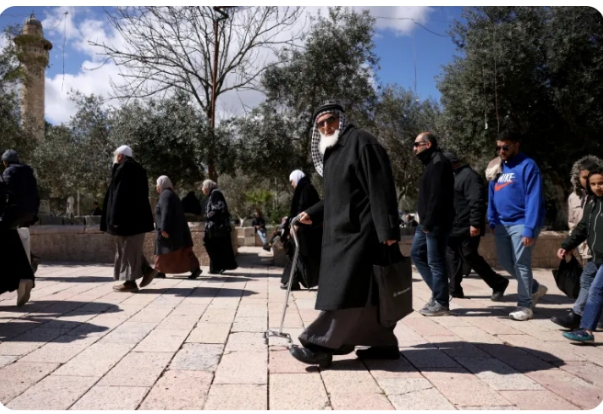
Israeli authorities had announced at the start of Ramadan that entry permits would be restricted to men over the age of 55, women aged 50 and above, and children under 12 accompanied by a family member.
Worshippers were also required to undergo digital verification procedures when crossing back into the West Bank after prayers.
Despite these rules, crowds streamed into the Al-Aqsa compound from the early morning hours. Long queues formed at checkpoints, particularly at Qalandiya checkpoint, where worshippers were subjected to prolonged searches and identity checks.
Many Palestinians reported being denied access even though they carried valid permits. Najati Oweida, who travelled from Hebron, said Israeli soldiers turned him back without explanation.
“The occupation claims it has provided facilitation, but the procedures are strict,” he said. “I only want to pray at Al-Aqsa. Why am I being prevented?”
Another worshipper, Ali Nawas, 58, said he and his wife travelled for more than an hour from Nablus, only for his wife to be stopped at the checkpoint despite holding a permit. “I was forced to return with her. How could she go back to Nablus alone?” he said.
In addition to entry restrictions, Israeli authorities recently announced bans on 280 Jerusalem residents — including religious figures, journalists, and formerly imprisoned Palestinians — preventing them from accessing the mosque during Ramadan.
Palestinian officials and rights groups say the measures are part of a broader policy aimed at limiting Palestinian presence in the Old City and undermining Palestinian cultural and religious life in occupied East Jerusalem.
Jerusalem’s Islamic Waqf, the body responsible for administering the Al-Aqsa compound, said attendance numbers once again demonstrated Palestinians’ determination to pray at the site despite mounting restrictions.
Last week, the Waqf reported that about 80,000 worshippers attended the first Friday prayers of Ramadan, also surpassing Israeli-imposed limits.
Tensions around Al-Aqsa have increased sharply since the outbreak of the war on Gaza in October 2023. Palestinians view the mosque as a central religious and national symbol, while repeated restrictions during Ramadan are widely seen as particularly provocative.
Al-Aqsa Mosque, Islam’s third-holiest site, has long been a flashpoint in the Israeli-Palestinian conflict. Palestinians regard East Jerusalem, including the Old City and Al-Aqsa compound, as the capital of a future Palestinian state — a claim rejected by Israel, which occupies and has unilaterally annexed the area, a move not recognised by most of the international community.
Human rights groups have condemned the restrictions, saying they constitute a violation of Palestinians’ freedom of worship.
Al-Haq described the Israeli measures as “systematic attempts to control religious practices and restrict Palestinian presence in the Old City,” adding that such policies exacerbate tensions in Jerusalem during the holy month of Ramadan.
International observers have also expressed concern over reports of worshippers being turned away despite holding valid permits, calling for Israel to ensure safe and equitable access to holy sites.
Meanwhile, local Palestinian authorities have urged worshippers to remain peaceful and continue observing Ramadan traditions despite the challenges. The Islamic Waqf emphasized the spiritual significance of Al-Aqsa and called on the international community to monitor the situation.
“Our people’s devotion to Al-Aqsa reflects their resilience,” a Waqf official said. “Even in the face of restrictions and obstacles, they will not abandon their sacred duty to pray at this blessed site.”
About The Author