Volodymyr Zelenskyy’s upcoming visit to the White House highlights the growing urgency of supplying Ukraine with long-range Tomahawk missiles, a move that could reshape the conflict.
The main focus of discussion is the potential transfer of US Tomahawk cruise missiles to Kyiv, a development that would mark the longest-range weaponry ever provided.
Donald Trump recently confirmed plans to meet Vladimir Putin in Budapest, following what he described as a “very productive” call, raising questions over immediate missile support for Ukraine.
Some European officials fear Trump’s conciliatory approach toward Moscow could signal a weakening of US commitment, leaving Kyiv to manage the war without decisive American Tomahawk missiles long-range support.
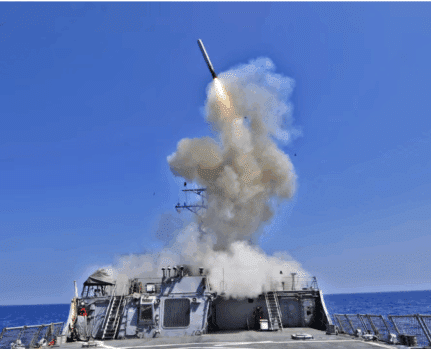
“Tomahawks missiles would give Ukraine a strategic advantage, but the numbers are extremely limited,” explained Rob Lee, senior fellow at the Foreign Policy Research Institute, emphasizing supply constraints.
The US currently has only small numbers of land-launched Typhon systems capable of deploying Tomahawks, and mobile X-Mav launchers remain scarce, complicating practical delivery to Ukrainian forces.
Pavel Luzin, a Russian military analyst, noted, “The Typhon system includes vehicles, transport, and command posts. Its deployment is not as simple as just sending a missile.”
The political dimension is equally complex, with Trump hinting at Tomahawk supplies to pressure Putin, while Moscow views the move as a potential escalation in the ongoing war.
Kremlin spokesperson Dmitry Peskov warned, “The delivery of Tomahawks could lead to a qualitatively new level of escalation in the conflict,” signaling Russian sensitivity to US involvement.
Ukraine’s reliance on US intelligence and training to operate the missiles underscores the risk of American personnel becoming more directly involved in the war’s operational side.
As Zelenskyy arrived in Washington, he noted, “Moscow reacts quickly whenever the topic of Tomahawks arises, demonstrating the psychological impact of long-range American weapons.”
Despite the high-profile diplomacy, experts caution that the symbolic effect may exceed the tactical utility, given the limited number of missiles available for immediate deployment.
“Even a few Tomahawks launched in salvoes could have strategic consequences,” said Radek Sikorski, Polish foreign minister, highlighting the difficulty of covering Russia’s vast territory with air defense systems.
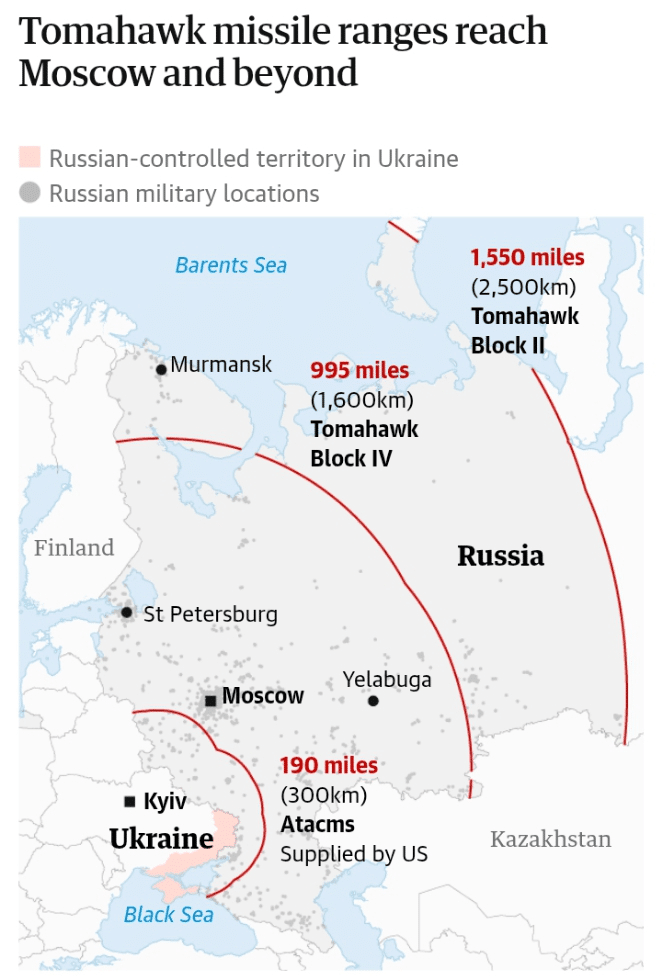
The Institute for the Study of War identifies nearly 1,900 potential Russian targets within reach of Tomahawks, ranging from infrastructure to strategic energy facilities.
Trump’s dual strategy involves simultaneously hinting at weapons support for Ukraine while arranging a personal summit with Putin, demonstrating a mix of diplomacy and negotiation tactics.
Critics argue that such maneuvers risk undermining credibility, as Moscow may interpret threats as bluff, diminishing the perceived deterrent effect of Tomahawk missile discussions.
Vladimir Frolov, a former Russian diplomat, commented, “Russia sees these threats as a bluff from a bullshit artist in chief; the practical threat is negligible without numbers or logistics.”
Even so, delivery of Tomahawks would carry symbolic weight, demonstrating that US arms support for Ukraine is both tangible and politically significant.
Trump’s approach contrasts with previous administrations, reflecting a willingness to negotiate directly with Putin while using weapons transfers as leverage in high-stakes diplomacy.
A former senior Russian defense official observed, “The battlefield effect may be limited, but signaling that Putin is losing Trump is deeply concerning for Moscow.”
The administration’s broader strategy includes providing US intelligence for drone and missile strikes on Russian oil facilities, intensifying fuel shortages and economic pressure inside Russia.
Tomahawk missiles would complement these efforts, potentially increasing the precision and impact of Ukrainian operations against Russian infrastructure, though their scarcity remains a limiting factor.
The cost of Tomahawks, approximately $1.3 million each, emphasizes the financial as well as strategic investment the US would be making in Ukraine’s defense capabilities.
Launching the missiles poses technical challenges since Ukraine lacks the ships or submarines typically required, leaving reliance on the limited Typhon and X-Mav systems.
“Operational constraints mean these missiles are more a political tool than a battlefield game-changer,” said Rob Lee, underscoring the symbolic rather than purely military effect.
Tomahawk missiles first saw combat in 1991, providing unparalleled range and destructive capacity, a capability that Ukraine currently cannot match with domestic weapons.
The timing of Zelenskyy’s visit coincides with Trump’s efforts to consolidate diplomatic momentum following his Gaza ceasefire negotiations, linking Middle East diplomacy with Eastern European strategy.
Trump’s engagement with Putin in Budapest aims to explore a potential settlement to the conflict while maintaining pressure on Moscow through the prospect of advanced missile deliveries.
Analysts note the delicate balance between deterring aggression and escalating hostilities, with the US weighing whether missile transfers could inadvertently widen the war.
Russian officials have repeatedly emphasized that missile deliveries would constitute a “red line,” framing the issue in terms of strategic escalation rather than immediate military impact.
The international community remains divided, with NATO allies cautiously supportive but concerned about the operational limitations and geopolitical repercussions of providing Tomahawks to Ukraine.
Zelenskyy’s arguments in Washington focus on both the psychological and tactical advantages, stressing that long-range strike capability could alter Russian strategic calculations.
“The mere discussion of Tomahawks forces Moscow to reconsider moves in Ukraine, even if practical deployment is constrained,” an EU official familiar with deliberations said.
Critics warn that partial supply, or symbolic gestures, could embolden Russian narratives about US inconsistency, potentially undermining Western credibility in the conflict.
Observers also point out the risks of operational misfires, logistical bottlenecks, and the challenge of integrating advanced systems into Ukrainian command and control networks.
Still, proponents maintain that limited missile support demonstrates tangible US commitment, signaling to both Kyiv and Moscow that America remains actively engaged.
Trump’s negotiations with Putin in Budapest, coupled with discussions over Tomahawks, illustrate the intertwined nature of diplomacy, deterrence, and military assistance in high-stakes international conflict.
Zelenskyy’s visit underlines the broader narrative of Ukraine’s reliance on American political will and military technology, framing the conversation around both survival and strategic leverage.
Ultimately, the debate over Tomahawk missiles encapsulates a broader struggle between diplomacy and escalation, illustrating how weapons, politics, and perception intersect in modern warfare.
As Zelenskyy presses for missile transfers, the world watches whether Trump’s approach will secure strategic advantage for Ukraine or provoke heightened tensions with Moscow.
The ongoing discussions about Tomahawk missiles deployment will shape not only Ukraine’s immediate capabilities but also the geopolitical balance between the US, Russia, and European allies in the coming months.
About The Author