The sudden Yermak resignation has sent shockwaves through Kyiv after anti-corruption investigators executed early-morning searches at the former presidential chief of staff’s apartment, intensifying Ukraine’s political turbulence.
A dramatic political rupture unfolded when Andriy Yermak, long viewed as President Zelenskyy’s most influential confidant, stepped down following widening raids connected to a nuclear energy kickback probe engulfing Kyiv’s elite.
The development marks a profound shift in Ukraine’s wartime decision-making structure, with insiders describing the moment as “a political earthquake” that could reshape internal power balances dramatically.
President Zelenskyy released a late-afternoon address praising Yermak’s service, yet stressing that “defence priorities must remain undistracted,” an unmistakable signal acknowledging escalating scrutiny.
The Yermak resignation has swiftly become a rallying point for domestic critics who argue that lingering corruption networks threaten Ukraine’s international standing amid heightened geopolitical stakes.
Zelenskyy confirmed Yermak offered his resignation voluntarily, emphasising the move was necessary to “avoid speculation and preserve institutional credibility,” hinting at concerns about public trust erosion.
Journalists recorded roughly ten investigators entering the government district early Friday, a scene prompting renewed public debate regarding high-level transparency commitments in a country fighting existential war.
Officials from the National Anti-Corruption Bureau, NABU, stated they were “conducting investigative actions” at Yermak’s residence, deepening public awareness of the massive probe into Energoatom dealings.
Yermak acknowledged the ongoing searches, asserting, “Investigators face no obstacles,” and pledged “full cooperation,” portraying himself as compliant amid growing public unease and political pressure.
The Yermak resignation coincides with a critical diplomatic moment, as he previously spearheaded Kyiv’s negotiations with Washington on counterproposals to competing peace frameworks that unsettled Ukraine’s allies.
Recent weeks saw tensions spike after the revelation of a complex bribery mechanism allegedly involving Energoatom partners, where insiders purportedly gathered 10–15% kickbacks from state-linked transactions.
Investigators suggest the alleged scheme had tentacles across ministries, reshaping Ukraine’s political narrative as citizens grapple with widespread electricity blackouts caused by Russian attacks on infrastructure.
Analysts argue the corruption revelations arriving simultaneously with high-stakes diplomacy have amplified fears that domestic scandals could undermine Kyiv’s ability to secure strategic US guarantees.
A source within the anti-corruption apparatus said the scandal’s re-emergence “could not be worse timed,” especially with Washington evaluating Ukraine’s newly proposed 19-point negotiation outline.
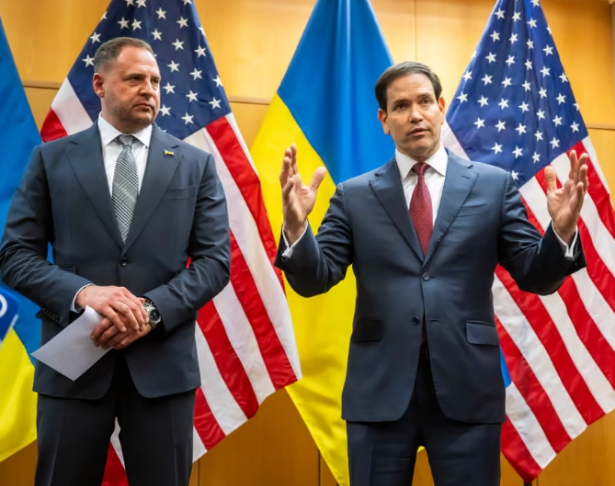
Yermak had been central in presenting Ukraine’s vision to US Secretary of State Marco Rubio during recent Geneva talks, becoming the face of Kyiv’s diplomatic push.
Photos from Geneva showed Yermak standing alongside Rubio as the two addressed journalists, signalling his pivotal role within Ukraine’s strategic messaging architecture abroad.
However, the Yermak resignation raises questions regarding the continuity of Ukraine’s diplomatic strategy, potentially complicating hard-won relationships cultivated during three years of intense wartime lobbying.
Yermak’s journey from entertainment lawyer and film producer to top political strategist mirrors Zelenskyy’s own transition from celebrity to wartime leader, forging a partnership many saw as unbreakable.
Insiders say Yermak’s influence permeated every administrative layer, from foreign policy direction to personnel appointments, making his exit “one of the most consequential resignations since 2020.”
The two men were notably inseparable during early invasion months, when Kyiv faced imminent capture, reinforcing public perception of Yermak as Zelenskyy’s indispensable wartime stabiliser.
The ongoing investigation traces its roots to discoveries made earlier in November, when NABU reportedly uncovered evidence implicating high-profile officials in Energoatom’s clandestine financial network.
Accusations centre on veteran producer and presidential associate Timur Mindich, who allegedly orchestrated the scheme before fleeing abroad hours before investigators reached his Kyiv flat.
Zelenskyy condemned the corruption scheme forcefully, yet questions linger about how individuals close to him became intertwined with illicit activity during wartime governance.
Two ministers were dismissed earlier this month, adding fuel to public frustration during a period when citizens endure hours-long power outages caused by relentless Russian bombardment.
Oleksiy Chernyshov, a former deputy prime minister, now faces charges of receiving $1.2bn in illicit payments and allegedly funding several luxury mansions south of Kyiv with the proceeds.
NABU claims to possess over 1,000 hours of secretly recorded conversations, including instances where suspects prioritised personal profit over essential defence infrastructure protections.
One intercepted conversation captured an accused official lamenting that protective structures for power stations were “a pity” because “the money could be stolen instead.”
International partners responded cautiously but positively. A European Commission spokesperson praised Ukraine’s investigative bodies, asserting the actions demonstrate “functioning, independent anti-corruption institutions.”
The Yermak resignation, however, threatens to overshadow these encouraging signals by fuelling narratives that governance fractures may hamper wartime resilience.
Political analysts warn Ukraine’s opponents might seize upon the crisis to argue Kyiv lacks the coherence required to negotiate or resist escalating Russian territorial demands.
Domestic reaction has been fierce, with some commentators saying the departure represents “a necessary cleansing,” while others view it as destabilising at a pivotal historical juncture.
For many Ukrainians, the scandal revives painful memories of past corruption cycles that previous administrations failed to dismantle despite reformist promises.
Yet supporters of the government say Zelenskyy’s acceptance of the resignation proves his commitment to transparency, even when it involves his closest circle.
Others speculate that internal restructuring of the presidential office could empower reformist figures seeking to streamline decision-making and enhance accountability frameworks.
Zelenskyy announced the search for Yermak’s replacement will commence immediately, revealing plans to “reorganise” the powerful presidential office into a more “efficient and resilient” structure.
Names of potential successors circulated online within hours, though officials declined to confirm any frontrunners amid heightened sensitivity to political optics.
The Yermak resignation also prompts renewed scrutiny of the presidential administration’s crisis-management culture, with critics accusing top officials of centralising authority excessively.
Supporters counter that such centralisation was indispensable during critical invasion phases, ensuring cohesive decision-making and operational continuity under severe duress.
Some analysts fear the scandal’s political aftershocks could undermine Ukraine’s public morale, already strained by winter hardships and battlefield challenges.
Citizens expressed mixed feelings on social platforms. One Kyiv resident wrote, “We deserve leaders who serve the people, not private interests.” Another cautioned, “Enemies will exploit this chaos.”
International observers insist Ukraine’s democratic institutions will be judged by how effectively the anti-corruption processes continue, rather than by individual scandals alone.
The White House has not commented on the Yermak resignation, but officials privately indicated the expectation that Kyiv must maintain “political stability” amid diplomatic engagements.
Energy experts warn the scandal could disrupt future projects if public confidence drops further, complicating efforts to secure investment for critical infrastructure reconstruction.
Ukraine’s transparency advocates argue the case exemplifies both the country’s long-standing vulnerabilities and the growing prowess of investigative bodies empowered by post-2014 reforms.
In Kyiv’s political corridors, many expect more high-profile figures to face questioning as investigators tighten their net around Energoatom-linked networks.
The resignation marks not just the loss of a political strategist but the symbolic end of an era defined by Zelenskyy’s tight-knit advisory circle.
Despite the turbulence, Zelenskyy vowed Ukraine would continue “defending our values and our independence,” insisting the crisis would not derail national priorities.

For now, the country braces for further revelations from the sweeping anti-corruption probe, aware that its political landscape could shift again in the coming days.
As Ukraine endures war’s relentless pressures, the Yermak resignation stands as a defining moment—testing leadership, institutions, and the country’s long-term democratic resilience.
About the Author