Bangladesh election concerns are mounting among women’s rights activists as Jamaat e-Islami, long repressed under Sheikh Hasina’s rule, looks set to secure an unprecedented share of the vote in Thursday’s national poll.
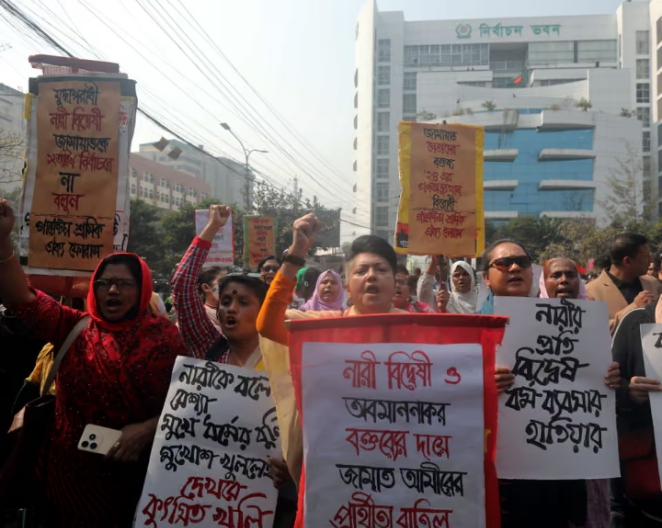
As midnight struck in Dhaka, women carrying flaming torches marched through the capital, chanting: “The people have given their blood, now we want equality.”
The protest reflected growing anxiety that the Bangladesh election, billed as the first free and fair vote in 17 years, could usher in a resurgence of conservative Islamist politics that threatens women’s freedoms.
The vote follows the dramatic fall of Sheikh Hasina in August 2024 after a bloody student-led uprising that left more than 1,000 people dead. Hasina is now in exile in India and faces a death sentence in Bangladesh for crimes against humanity.
Her Awami League party has been banned from contesting the Bangladesh election.
While opposition figures once jailed and persecuted are now campaigning openly, many women who were central to the uprising say they feel sidelined.
“This was meant to be an election representing change and reform. Instead, we are seeing women being systematically erased and their rights threatened,” said Sabiha Sharmin, 25, during the midnight march. “We worry this election will throw the country back 100 years.”
Jamaat e-Islami, an Islamist party that advocates introducing sharia law, was banned and heavily suppressed under Hasina. Its leaders were jailed, disappeared or sentenced to death.
Since her removal, the party has mobilised rapidly, emerging as a serious challenger to the long-dominant Bangladesh Nationalist party (BNP).
Although polling suggests the BNP is likely to win the Bangladesh election, analysts say Jamaat e-Islami could secure a historic share of the vote and become a powerful force in parliament.
“Whether it’s as a sizeable opposition or a government in power, the future of Bangladesh’s politics looks like a heavily Islamist party will be at its centre,” said Thomas Kean, a senior consultant on Bangladesh.
Critics argue that conservative Islamist rhetoric is already influencing social norms. In some rural areas, religious leaders have reportedly prevented girls from playing football, calling it indecent. Women have described increased harassment over dress and pressure to cover their hair.
Jamaat e-Islami’s manifesto focuses on reform, anti-corruption and women’s safety. However, the party is fielding no female candidates in the Bangladesh election. Its leader, Shafiqur Rahman, has said a woman could never lead the party because it would be un-Islamic.
Previous comments in which he denied the existence of marital rape and described rape as “immoral women and men coming together outside marriage” have resurfaced, drawing sharp criticism.
“These are the kinds of views and policies you hear in Iran and Afghanistan,” said Zayba Tahzeeb, 21, a physics student. “Women’s sovereignty, our freedoms, our independence: all are at stake in this election.”
Among Jamaat’s proposals is reducing women’s working hours from eight to five per day, with the state subsidising lost income so women can spend more time at home.
Women make up 44% of Bangladesh’s workforce — the highest proportion in south Asia — and many see paid employment as a hard-won right.
Frustration has also been directed at the National Citizen party (NCP), formed by student leaders who helped topple Hasina.
The NCP joined an alliance with Jamaat e-Islami, a move some members say was decided by a small group of male leaders without broader consultation. The party is fielding just two female candidates.
“It was such a clear betrayal,” said Tajnuva Jabeen, a doctor and NCP founder who left after the alliance was announced. “This was a historic opportunity to create a third political force, to represent the change that so many people died for. Instead, they failed the people and silenced the women who led this movement.”
Women remain underrepresented across the political spectrum in the Bangladesh election, with fewer than 5% of BNP candidates being female.
Read also: Indonesia prepares to send troops to Gaza in Trump Peace Plan
Bangladesh, a Muslim-majority country, has oscillated between secular and religion-based politics since independence in 1971.
While religion-based parties were initially banned, they gained influence during periods of military rule before secularism was reinstated in the constitution in 2011.
Analysts say disillusionment with decades of dynastic politics and corruption under both the Awami League and BNP has made some voters more receptive to Islamist alternatives.
Jamaat e-Islami has attracted support from young, first-time voters, who make up 42% of the electorate. Mir Ahmad Bin Quasem Arman, a barrister and candidate in Dhaka, said fears about women’s rights were exaggerated and politically motivated.
“When you talk to urban elites, their talking points are whether women can be in the top position of the government, whether women can wear whatever they want,” Arman said.
“These are – I’m sorry to use the word – feminist demands. The ground level is very different. The primary requirement of the women on the ground, the working class, is safety and that’s our prime concern.”
He added that women might run on the party’s ticket in the future.
In a show of support, thousands of female Jamaat e-Islami backers marched in Dhaka, rejecting claims that the party would curtail their freedoms.
“The policies they are proposing will improve women’s lives and their safety,” said Sirajim Munira, 27. “I think it will be good for the country to bring in Islamic law because it will make us honest and corruption-free.”
Ainum Nahar, 58, said women were central to Jamaat’s grassroots strength but agreed that women should not lead the party. “As an Islamic party, it is prohibited for women to be leaders,” she said. “But we will stand behind, to inspire them, to encourage them and to move the country forward.”
As voters prepare to cast their ballots, the Bangladesh election has become a defining moment not only for the country’s political future, but also for the trajectory of women’s rights in a nation still grappling with the legacy of revolution.
About The Author