Exiled former Bangladeshi leader Sheikh Hasina warns of voter boycott, saying the exclusion of her Awami League party from the Bangladesh 2026 elections will leave millions of citizens without representation.
From her exile in India, Hasina expressed outrage over the government’s decision to uphold the Awami League ban, calling it an assault on democracy and a betrayal of the country’s founding ideals. She insisted that millions of loyal supporters would refuse to vote if her party remains outlawed.
The former prime minister, aged 78, said the Muhammad Yunus interim government is setting the stage for a one-sided poll that will further divide the nation.
Her remarks came after Bangladesh’s electoral commission confirmed plans to hold the general election in February 2026 without lifting the restrictions on the Awami League.
In her message to the media, Sheikh Hasina warns of voter boycott if authorities continue to label her party a threat to national security. She argued that the allegations of terrorism and war crimes against her associates were politically motivated.

The Awami League ban was enacted under recent amendments to Bangladesh’s anti-terrorism laws, a move widely criticized by human rights groups. The government claims the decision is necessary to maintain peace following years of violent unrest during Hasina’s rule.
Hasina insists the accusations are false and part of a wider effort to eliminate political opposition. She stated that her administration’s record in economic growth, infrastructure, and women’s empowerment is being distorted for political gain.
In a written statement, Sheikh Hasina warns of voter boycott, emphasizing that Bangladesh’s democratic image is under threat. She noted that boycotting elections is not an act of defiance but a protest against injustice and silencing of voices.
Political analysts say the Bangladesh 2026 elections could be among the most controversial in the country’s history. With the Awami League sidelined, the opposition Bangladesh Nationalist Party (BNP) and the Islamist Jamaat-e-Islami have emerged as the leading contenders.
However, critics warn that without the participation of Hasina’s party, the legitimacy of the Muhammad Yunus interim government may come into question.
Yunus, the Nobel Peace Prize laureate and founder of Grameen Bank, was appointed to lead the caretaker administration following last year’s student uprising that forced Hasina from office.
Hasina has since been tried in absentia for alleged crimes against humanity. She maintains her innocence, claiming the trial is a politically motivated charade intended to tarnish her legacy. Her lawyers say the process lacks transparency and violates her right to a fair defense.
Meanwhile, government prosecutors have accused her of ordering violent crackdowns during the 2024 protests that led to hundreds of deaths. Evidence presented at the tribunal allegedly includes recorded orders instructing security forces to “use lethal weapons” against demonstrators.
In response, Sheikh Hasina warns of voter boycott, calling the trial a “kangaroo court” spectacle designed to intimidate her supporters. She declared that she will not participate in any legal proceedings orchestrated to ensure her conviction.
The Bangladesh voter boycott campaign is already gaining traction on social media, with millions of Awami League followers pledging to abstain from voting if the party is excluded. Civil society groups warn that such a boycott could result in historically low turnout and weaken faith in democratic institutions.
Observers fear unrest could erupt if authorities proceed with the elections under current conditions. The Awami League ban has triggered protests in Dhaka and other major cities, with demonstrators demanding inclusive elections and the withdrawal of charges against Hasina.
The Muhammad Yunus interim government, however, insists that it remains committed to free and fair polls. Spokespersons for the administration claim that security measures are necessary to prevent extremist influence and ensure stability during the transition period.
Despite that assurance, Hasina’s loyalists argue that the interim leadership lacks the popular mandate to dictate the country’s political future.
The former leader said, “You cannot disenfranchise millions and still call it democracy.” Her message has resonated strongly among rural supporters who credit her with expanding access to education, healthcare, and electricity.
International organizations have expressed concern about the deteriorating political environment. Human Rights Watch described the Awami League ban as “draconian” and urged the government to allow all major parties to participate in the upcoming vote.
Meanwhile, diplomatic sources say India is monitoring developments closely given Hasina’s long-standing ties with New Delhi. Analysts suggest that Bangladesh’s internal divisions could have regional repercussions, potentially affecting trade, migration, and cross-border security cooperation.
As Sheikh Hasina warns of voter boycott, she continues to position herself as a champion of democracy, despite her controversial past. Political observers note that her resilience and strong personality still command significant influence among grassroots voters.
The Bangladesh voter boycott movement underscores the deep polarization in the nation’s politics. Supporters see Hasina as a victim of a power grab, while critics argue her downfall was inevitable due to years of authoritarian governance.
With less than four months before the Bangladesh 2026 elections, uncertainty looms over whether the poll can be considered legitimate without participation from one of the country’s most dominant political forces.
The Muhammad Yunus interim government has repeatedly stated that it will not delay the vote, insisting that “national healing” will come through a new chapter of governance. Yet the growing calls for boycott threaten to undermine that message and cast a shadow over the democratic process.
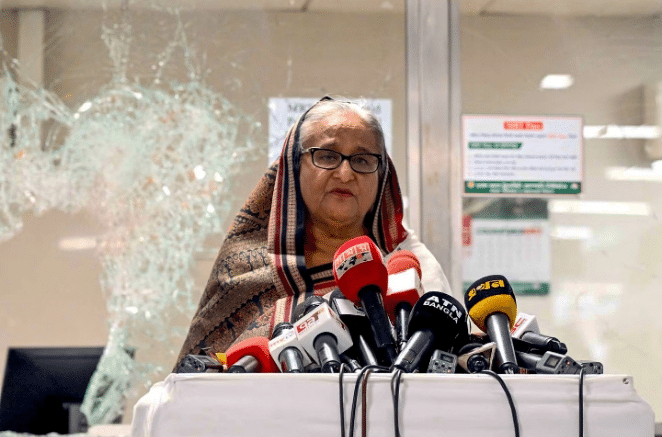
In her closing appeal, Sheikh Hasina warns of voter boycott, urging Bangladeshis to “stand on the right side of history” and demand fair representation.
Whether her words ignite renewed resistance or further division remains to be seen, but one thing is clear — Bangladesh stands at a pivotal crossroads as the 2026 elections draw near.
About The Author