

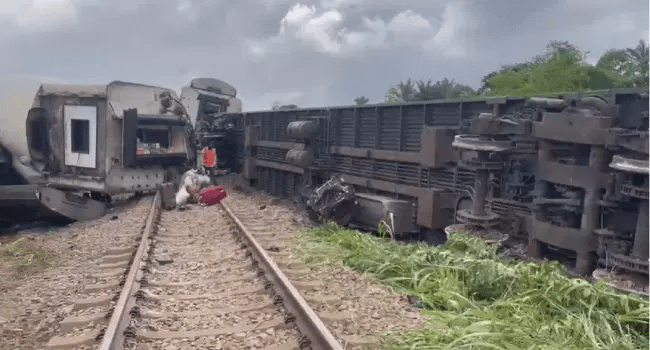
NRC confirms four deaths and 64 injuries in the June 8 Warri-Itakpe train derailment as investigations point to a possible wheel or bogie defect.
The Nigerian Railway Corporation (NRC) has confirmed that four people died and 64 others were injured when the Warri-Itakpe Train Service derailed in Delta State on June 8, 2026.
The corporation released its preliminary findings on Monday, several weeks after the accident, while making it clear that investigators have not yet reached a final conclusion on what caused the train to leave the tracks.
The incident happened at about 4:17 p.m. around kilometre 177, close to the Goodluck Jonathan Railway Station in Owa-Oyibu, Delta State.
The train had departed Itakpe at noon and was carrying 482 people at the time of the accident. The passengers accounted for 442 of those on board, while the remaining 40 were operational personnel working on the train.
Five coaches, a locomotive and a power car were involved in the derailment. Three coaches and the power car overturned, while the other affected rolling stock came off the tracks but remained upright.
The scale of the incident prompted an immediate emergency response involving several agencies and authorities.
The Delta State Government, Nigeria Police Force, Federal Road Safety Corps, National Emergency Management Agency and local emergency responders joined railway officials and medical teams in the rescue operation.
NRC Managing Director, Kayode Opeifa, said all passengers were successfully evacuated within two hours of the accident.
64 people injured
The corporation said 64 people sustained injuries in the crash and were taken to different medical facilities for treatment.
Twenty-eight passengers were treated at the Railway Hospital in Owa-Oyibu and later discharged. Another 36 injured persons were transferred to hospitals in Owa-Oyibu, Owa-Alero and the Central Hospital in Agbor.
The NRC said most of those who were admitted had recovered sufficiently to leave the hospitals within 72 hours.
However, three people required further specialist attention. Among them was an NRC employee who needed surgical intervention. The corporation also disclosed that two other patients later underwent surgery.
The railway authority further corrected the initial information on the number of people killed.
An earlier account had indicated that five people died. Following verification carried out with the Delta State medical team, the figure was revised downward to four fatalities.
The NRC expressed condolences to the families of those who died and said arrangements under its victim and medical support procedures were used to assist affected families.
Mechanical fault under investigation
While the preliminary report has ruled out some possible explanations, the NRC said it was not yet in a position to announce a definitive cause of the derailment.
An internal investigation team was set up after the accident to examine the circumstances surrounding the crash.
Investigators visited the scene, gathered physical evidence, examined railway records and inspected the locomotive and other rolling stock involved in the incident.
Members of the train crew, railway workers and emergency responders were also interviewed as part of the inquiry.
One of the possibilities identified by the investigators was the sudden development of a defect involving a bogie or wheel while the train was travelling.
A bogie is a major assembly beneath a railway coach that supports the vehicle and allows it to move along the rails. A serious fault involving the wheels or bogie can affect the stability of a train and its interaction with the track.
According to the NRC, a defect of this nature could have produced abnormal wheel-and-rail contact, increased impact forces and a loss of stability.
Investigators are also examining whether the manner in which the train’s brakes were applied contributed to the severity of the accident.
The corporation, however, warned that neither explanation should be regarded as conclusive at this stage.
It described the mechanical defect and braking issue as working hypotheses that require further technical analysis.
The final cause of the accident will be determined after the relevant evidence has been fully examined.
Investigators find no track vandalism
The preliminary inquiry also looked into the possibility of deliberate damage to the railway infrastructure.
The NRC said investigators found no evidence that the track had been vandalised before the derailment.
An examination of the affected area reportedly showed that the railway points were intact.
The finding is significant because the same route experienced derailment incidents on November 1 and November 8, 2025, which had raised concerns about the safety of railway infrastructure along the corridor.
For the June 8 accident, however, the NRC said there was no indication from its site inspection that vandalism was responsible.
The Nigerian Safety Investigation Bureau (NSIB) has separately commenced an independent investigation into the accident.
The NRC said it would cooperate fully with the NSIB and would take account of the bureau’s findings and recommendations.
NRC lists safety measures
Beyond investigating the immediate cause of the accident, the NRC said its internal review identified areas requiring further improvement across the railway system.
The corporation listed six major recommendations covering rolling stock, infrastructure, operational procedures, emergency response, staff capacity and funding.
It recommended more detailed inspections and technical audits of railway equipment and infrastructure, as well as faster replacement of components found to be defective.
The NRC also called for stronger enforcement of operational safety rules and updates to standard operating procedures.
Emergency preparedness was another area highlighted in the report. The corporation said regular emergency exercises and better coordination between railway officials, security agencies, medical personnel and other responders would improve the response to future incidents.
Continuous training and competency assessments for railway workers were also recommended.
The corporation further stressed the need for sustainable funding to support railway modernisation, infrastructure upgrades and proper management of railway assets.
Passenger and staff protection also featured in the recommendations, with the NRC proposing a review of insurance and compensation arrangements.
Train services await safety clearance
The NRC confirmed that the affected portion of the railway track has been repaired and restored following the derailment.
The locomotives involved have also been recovered and are currently undergoing reconditioning.
However, the restoration work does not mean passenger services will immediately resume on the route.
According to the corporation, train operations will restart only after a comprehensive safety audit of the track and railway equipment has been completed.
The NRC said the additional checks are necessary to establish that the corridor and rolling stock meet the required safety standards before services return.
The corporation also explained the delay in publishing its preliminary findings.
It said more time was needed to ensure that relatives of passengers and other people affected by the accident were properly informed through established medical and victim-support channels.
The NRC said its broader objective following the incident is to improve railway safety, strengthen the system’s ability to withstand operational challenges and restore confidence among Nigerians who depend on rail transportation.
About The Author
