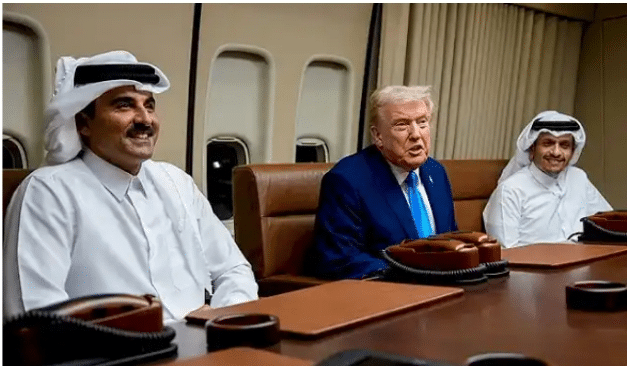
US President Donald Trump opened his first overseas mission since re-election by attending the ASEAN summit in Malaysia, signaling renewed American engagement with an increasingly strategic Asian region.
Speaking before assembled leaders, Trump declared, “America is back in the Pacific to defend fair trade and lasting peace.” His statement underscored a calculated return to assertive global diplomacy.
The ASEAN summit in Malaysia gathered heads of Southeast Asian nations amid tensions rooted in the US-China trade war, tariff disputes, and growing competition over technological and resource influence.
Trump arrived in Kuala Lumpur insisting Washington sought “mutual prosperity through fairness,” arguing the summit would strengthen alliances and open alternative trade corridors against China’s tightening regional economic dominance.
His six-day Asia Pacific tour includes visits to Japan and South Korea, with a planned face-to-face meeting with Chinese President Xi Jinping expected to dominate the diplomatic calendar.
Trump’s arrival coincided with mounting debates over rare earth minerals and strategic maritime routes. American officials said such resources were central to new trade discussions shaping regional alliances and independence.
The ASEAN summit in Malaysia thus became a test of Trump’s foreign policy credibility. Analysts say he aims to reestablish Washington as Southeast Asia’s indispensable security and economic partner.
“Trump wants to remind everyone that America’s presence here is not negotiable,” said Dr. Laila Chen of Singapore’s ISEAS Institute. “It’s a bid for regional trust.”
In his address, Trump accused “certain powers” of debt manipulation, hinting at Beijing’s influence over smaller economies. “We will not stand for economic coercion disguised as partnership,” he asserted firmly.
The summit’s agenda focused on restoring supply chains disrupted by trade wars and the pandemic. Trump proposed creating an “ASEAN-American Economic Corridor” to strengthen transparent, rules-based trade.
His comments were met with cautious approval. Malaysian Prime Minister Anwar Ibrahim noted that “a stable and predictable America is vital for global growth,” calling the summit “a turning point for cooperation.”
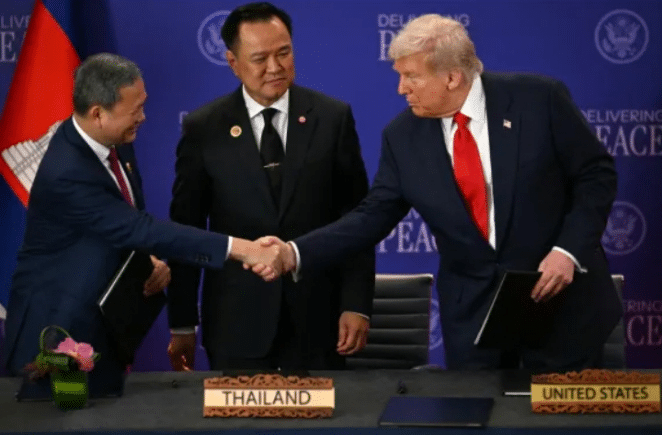
Trump, meanwhile, used the ASEAN summit in Malaysia to showcase his self-styled “deal-making” persona. He brokered a peace agreement between Thailand and Cambodia, resolving long-standing territorial disputes peacefully.
The signing, attended by ASEAN representatives, drew applause as Trump called it “a model for diplomatic solutions worldwide.” Regional leaders praised the accord as evidence of pragmatic leadership in volatile times.
Behind the smiles, however, Trump’s team pressed regional partners to lessen dependence on China for technology components and rare earth minerals crucial to defense and manufacturing industries.
“Control over minerals means control over futures,” said Trump, emphasizing his intent to develop cooperative mining networks among ASEAN nations free from monopolistic practices undermining economic sovereignty.
Analysts see this push as both economic and strategic, part of a larger effort to limit China’s leverage in the Indo-Pacific and restore balance in global trade.
“Trump’s rare earth strategy is also geopolitical,” said Malaysian economist Nur Khalid. “It challenges Beijing’s dominance in a critical sector while giving ASEAN nations new leverage.”
The ASEAN summit in Malaysia also reignited discussions on maritime defense cooperation, especially in the South China Sea, where overlapping claims have long strained regional diplomacy.
Trump pledged additional U.S. naval support to ensure “freedom of navigation and regional stability.” He framed this as “a shared responsibility among free nations determined to protect open waters.”
Such language pleased U.S. allies but raised eyebrows in Beijing. China’s foreign ministry urged “constructive dialogue rather than confrontation,” warning against “Cold War thinking” and external interference in regional matters.
Yet Trump remained undeterred. “We will meet power with partnership, not passivity,” he declared, reinforcing his stance that U.S. engagement in Southeast Asia is both moral and strategic necessity.
Observers noted the contrast between Trump’s new diplomatic tone and the unpredictability of his earlier presidency. His rhetoric now mixed firmness with overt appeals for regional trust.
“This is a more disciplined Trump,” said Tokyo-based analyst Hiroshi Tanaka. “He’s learned that confrontation without cooperation yields isolation. His new approach feels deliberately calculated and sustained.”
At the ASEAN summit in Malaysia, trade dominated every corridor conversation. Delegates debated tariff realignments, renewable energy investments, and measures to counter inflation triggered by global market instability.
U.S. officials proposed incentives for nations diversifying supply chains away from China. “We’re not asking partners to choose sides,” said a senior American envoy, “but to choose transparency.”
Meanwhile, Chinese delegates remained diplomatically silent. Beijing’s representatives listened attentively yet avoided sharp exchanges, suggesting caution before Trump’s upcoming private meeting with President Xi in Tokyo.
Experts predict that conversation could define the next decade of the US-China trade war, potentially thawing tensions or igniting another round of tariff escalations.
“The world will watch how Trump and Xi behave,” remarked political scientist Arif Rahman. “Their chemistry—or lack of it—will shape future diplomatic and economic alignments across Asia.”
Before leaving Malaysia, Trump reiterated his commitment to long-term Southeast Asia diplomacy, promising infrastructure funding, joint defense programs, and educational exchange initiatives linking universities across ASEAN countries and America.
“We believe in bridges, not barriers,” Trump said, paraphrasing his campaign slogan while redefining it for foreign policy. “Our commitment here is about partnership, not dominance.”
Local media widely reported public enthusiasm for America’s renewed attention. Malaysian citizens interviewed in Kuala Lumpur expressed cautious optimism about trade benefits and investment opportunities arising from the summit.
Still, skepticism lingers. Many ASEAN leaders remember Trump’s earlier withdrawal from regional agreements and now seek concrete assurances that U.S. engagement will last beyond symbolic appearances.
“The question is continuity,” said Thai journalist Ratchanaporn Suda. “Southeast Asia welcomes America’s return, but consistency will determine whether this is a partnership or another political performance.”
As the ASEAN summit in Malaysia drew to a close, Trump described the gathering as “a cornerstone for a new era of regional confidence and strategic independence.”
His motorcade departed amid mixed applause and wary analysis. For some, his assertiveness marked a long-awaited revival of American diplomacy; for others, it revived memories of past unpredictability.
Next, Trump travels to Japan, where defense and trade will again dominate discussions. His meeting with Xi Jinping there could either stabilize global markets or deepen existing rivalries.
Tokyo is preparing a high-security environment for the encounter. Japanese Prime Minister Fumio Kishida praised Trump’s ASEAN performance, calling it “a decisive statement of commitment toward freedom and fair trade.”
South Korea, Trump’s final stop, expects renewed dialogue on denuclearization and security. Officials confirmed joint military drills and investment discussions aimed at balancing regional economic and defense priorities.
By week’s end, Trump’s Asia-Pacific journey will have tested his capacity to balance confrontation with cooperation—a balance essential for sustaining credibility amid escalating global polarization.
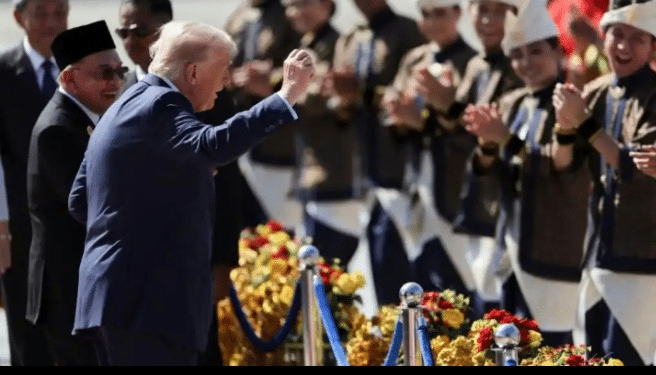
The ASEAN summit in Malaysia thus stands as both symbol and test: proof that diplomatic resurgence must be sustained through consistent engagement, not fleeting speeches or campaign slogans.
As one regional delegate summarized privately, “This was Trump’s chance to show that America still listens. The region will now wait to see if it still leads.”
Washington insiders hinted that follow-up visits and trade delegations will continue through 2026. The White House hopes to institutionalize this new phase of Southeast Asia diplomacy for long-term strategic gain.
Even Trump’s critics admit that the ASEAN summit in Malaysia reestablished U.S. relevance in a region long drifting toward China’s orbit, restoring equilibrium to a fractured geopolitical landscape.
Whether that momentum lasts remains uncertain, but for now, Trump’s renewed assertiveness has undeniably shifted the balance of influence, reviving old alliances and unsettling old hierarchies.
In the words of Dr. Chen, “History rewards consistency. If Washington stays committed this time, Southeast Asia might finally get the stability it has been waiting decades for.”
As Air Force One departed Kuala Lumpur, one truth lingered—this ASEAN summit in Malaysia was not merely ceremonial; it was an ideological re-entry, echoing with the sound of recalibrated power.
About The Author