The U.S. moves to impose visa bans and sanctions under new Nigeria religious freedom measures targeting groups accused of persecuting minorities.
The United States has intensified diplomatic pressure on Nigeria as President Donald Trump and members of the U.S. Congress advance new measures to impose Nigeria religious freedom sanctions.
The initiative aims to hold individuals and organisations accountable for severe violations of religious liberty and to end years of persecution targeting Christian and minority groups across the country.
The proposed bill, sponsored by Representative Chris Smith, introduces targeted sanctions that would include travel bans, visa restrictions, and asset freezes on groups or persons involved in religiously motivated attacks.
Specifically mentioned in the legislation are the Miyetti Allah Cattle Breeders Association of Nigeria (MACBAN) and Miyetti Allah Kautal Hore, both accused of being complicit in violent acts against farming communities in the Middle Belt region.

According to Smith, the purpose of the bill is to send a strong signal that religious persecution will no longer be ignored by the United States.
“America cannot turn a blind eye to suffering,” he said, urging Nigeria’s leaders to uphold their constitutional duty to protect every citizen regardless of faith.
Smith commended President Donald J. Trump for his leadership in redesignating Nigeria as a Country of Particular Concern (CPC) under the International Religious Freedom Act.
He explained that this classification obliges Washington to act against nations that fail to prevent gross violations of religious rights.
“President Donald J. Trump acted appropriately and decisively to redesignate Nigeria as a CPC and hold the Nigerian government accountable for its complicity in religious persecution by radical Islamists such as Boko Haram and Fulani terrorists,” Smith declared.
The bill also references the inclusion of Fulani Ethnic Militias operating in Benue and Plateau States on the U.S. Entities of Particular Concern (EPC) list, which applies to non-state actors responsible for grave abuses.
This classification aligns with the broader Nigeria religious freedom sanctions framework, which identifies perpetrators of violence against both Christians and moderate Muslims.
Beyond punitive actions, the legislation emphasizes humanitarian support. It urges the U.S. government to extend direct aid to faith-based organisations helping internally displaced persons in Nigeria’s conflict zones.
It also recommends conditioning all U.S. foreign assistance, including global health funding, on Nigeria’s tangible progress in addressing religious persecution and prosecuting offenders.
The proposed law outlines a comprehensive roadmap for restoring peace and rebuilding trust among diverse communities.
It calls for improved law enforcement training, enhanced intelligence-sharing with international partners, and reforms that guarantee fair trials for those accused of religiously motivated violence.
The bill further stresses the need for Nigeria to uphold constitutional protections for freedom of belief and expression.
Representative Smith stated that the purpose of the Nigeria religious freedom sanctions is not only to punish wrongdoers but also to motivate systemic reform.
He emphasized that promoting religious liberty is a cornerstone of American diplomacy and a moral duty.
“We stand with those suffering for their faith,” he said, reaffirming bipartisan support for the initiative.
In parallel, Senator Ted Cruz introduced the Nigeria Religious Freedom Accountability Act of 2025, a related bill aimed at strengthening mechanisms for justice and expanding international monitoring of human rights violations.
Cruz maintained that Washington has a responsibility to ensure global accountability where persecution thrives unchecked.
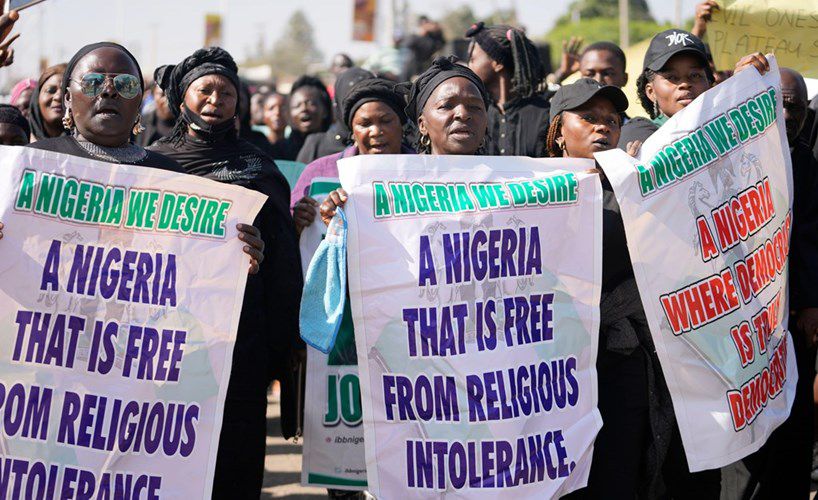
These legislative efforts coincide with rising international alarm over worsening attacks on religious minorities in Nigeria.
Over the past decade, extremist factions such as Boko Haram, the Islamic State West Africa Province (ISWAP), and militant Fulani groups have carried out brutal assaults that have displaced millions and destroyed hundreds of churches and mosques.
Analysts say the attacks have not only deepened social divisions but also crippled rural economies and heightened food insecurity.
The Nigeria religious freedom sanctions debate gained further urgency after President Trump warned that the U.S. might consider direct intervention if Nigerian authorities fail to curb ongoing killings of Christians and other vulnerable groups.
Trump’s firm stance reflects his administration’s broader foreign policy principle—linking aid and cooperation to measurable progress in human rights and religious freedom.
In Washington, human rights advocates have welcomed the proposed sanctions as a necessary corrective measure.
According to several religious liberty organisations, Nigeria has become one of the most dangerous countries in the world for Christians, with thousands killed each year in sectarian violence.
They argue that while past U.S. diplomatic efforts have focused on dialogue, the lack of accountability has emboldened perpetrators.
However, critics caution that imposing sweeping sanctions could strain U.S.–Nigeria relations or inadvertently impact humanitarian operations in conflict regions.
Some experts advocate for a balanced approach—one that combines accountability with capacity-building programs to strengthen Nigeria’s judicial and security systems.
Despite differing opinions, both lawmakers and rights groups agree that the ongoing crisis demands decisive action.
The persistence of unchecked violence has led to massive displacement, economic instability, and deep mistrust among religious communities. Without strong deterrence and judicial reform, observers warn, the cycle of persecution may continue.
The Nigeria religious freedom sanctions legislation thus represents a turning point in U.S. foreign policy toward Africa.
It reflects a growing willingness to couple diplomatic engagement with enforcement measures aimed at protecting fundamental human rights.
Should the bill pass, it would set a precedent for holding governments and organisations accountable for violations of religious liberty worldwide.
For Nigeria, the international spotlight presents both a challenge and an opportunity to rebuild confidence, strengthen interfaith dialogue, and reaffirm its constitutional commitment to equality before the law.
As debates continue in Washington, millions of Nigerians displaced by violence are watching, hoping the new measures will lead to lasting peace and justice.
More news at ireport247news
About the Author