

A massive 7.4 magnitude earthquake jolted southern Philippines, killing at least two people, injuring many, and triggering widespread tsunami warnings that prompted frantic evacuations before being lifted.
The earthquake struck offshore near Davao Oriental province at a shallow depth of 23 kilometers. The Philippine Institute of Volcanology and Seismology (Phivolcs) said the tremor was “extremely destructive.”
Residents across coastal towns fled their homes in panic. “The shaking was so strong, we thought buildings would collapse on top of us,” said survivor Maria Santos from Mati City.
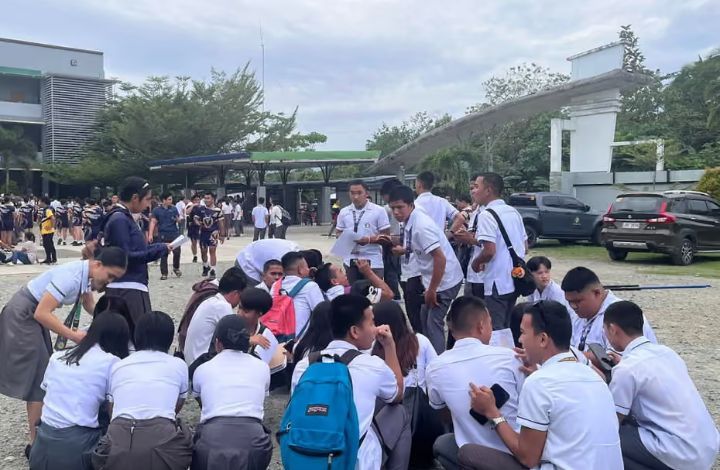
The Pacific Tsunami Warning Center (PTWC) warned of possible waves between one and three meters along the eastern coast. Authorities immediately ordered evacuations across six Mindanao provinces.
Crowds poured into the streets carrying children, pets, and small bags of belongings. “People were screaming and crying. Everyone just wanted to reach higher ground,” recalled farmer Ernesto Dela Cruz.
By midday, the PTWC confirmed the tsunami threat had passed. Minor sea level changes were recorded, but no destructive waves were observed. The nationwide evacuation order was lifted.
Despite relief, tragedy struck. Two fatalities were confirmed in Mati City after houses collapsed. “We mourn their loss while continuing search operations for survivors,” Governor Nelson Dayanghirang said.
Hospitals reported serious challenges. A major facility in Davao Oriental evacuated 250 patients outside after cracks appeared in its walls. “Our priority is safety,” a hospital director explained.
Government agencies rushed to deliver aid. President Ferdinand Marcos Jr. urged calm, saying, “The situation is under control. Let’s trust our responders and follow official safety instructions.”
Power outages affected several towns. Engineers shut down electricity grids to prevent fires. Classes and government operations were suspended pending inspection of buildings, bridges, and public facilities across Mindanao.
Phivolcs director Teresito Bacolcol warned: “Expect aftershocks for days, even weeks. Some may be powerful enough to further damage weakened buildings. Remain vigilant and prioritize safety always.”
The Philippines sits along the Pacific Ring of Fire, a seismically active zone. This vulnerability, experts warn, demands stricter building codes and expanded disaster-preparedness investment to safeguard communities.
Only days earlier, a 6.9 magnitude quake hit Cebu, killing more than 70. The back-to-back tremors underscored the archipelago’s exposure to frequent, deadly seismic events.
At evacuation centers, families huddled together. “We didn’t bring anything, just ourselves. I held my children and ran,” said housewife Liza Moreno, who took refuge in a school gym.
Aid workers distributed relief packs of food, water, and blankets. Volunteers offered psychological support to traumatized children. “The kids are crying, they’re scared to sleep indoors,” said social worker Ana Reyes.
Relief operations remain difficult. Collapsed roads and bridges blocked access to remote barangays. “We need helicopters to reach some villages,” said disaster officer Ramon Castro in Davao Oriental.

Local disaster offices kept monitoring sea levels. Fishing boats were grounded until safety was confirmed. “We cannot risk another sudden surge,” warned coast guard commander Captain Jose Antonio Marquez.
Many residents described the quake as the strongest they’d ever felt. “The ground roared like a monster. I thought it was the end,” said teacher Gerardo Villanueva.
Shops, churches, and schools were converted into emergency shelters. “We’re feeding evacuees with what little we have. Donations are urgently needed,” said parish priest Father Mark Legaspi in Davao.
Officials stressed the importance of resilient infrastructure. “Our survival depends on strict compliance with building codes. Negligence costs lives every time disasters like this strike,” Senator Grace Poe told reporters.
Social media was flooded with shaky videos showing panicked crowds, falling ceiling tiles, and supermarket shelves collapsing. Netizens urged prayers, while others demanded stronger government disaster policies.
The Philippine Red Cross deployed rapid response teams. Chairman Richard Gordon said: “We are sending water tankers, mobile kitchens, and medical units to worst-hit evacuation centers.”
Economic costs are still being counted. Cracked airport runways and damaged highways may disrupt business in Davao region. Agriculture could also suffer with irrigation systems at risk of collapse.
International support poured in. “Japan stands with the Philippines in this difficult time,” Japanese Ambassador Kazuhiko Koshikawa tweeted. The UN pledged logistical assistance to ensure timely delivery of relief.
Although tsunami warnings were lifted, experts cautioned against complacency. “Aftershocks could still spark landslides or destabilize the seafloor. Stay alert,” said volcanologist Dr. Maria Antonia Bornas from Phivolcs.
Rescue teams continue to search through rubble. “Every second counts,” said firefighter Arnel de Guzman. “We don’t stop until every missing person is accounted for, dead or alive.”
Families mourn quietly. “We lost everything—our house, our savings. Only our lives remain,” whispered survivor Joel Navarro, clutching his two children in an evacuation tent.
Government relief convoys continue to deliver aid. Yet for many, the trauma will last longer than physical damage. “The quake shook not just homes, but our souls,” said survivor Marites dela Rosa.
As night falls, fear remains palpable. Many refuse to return home, preferring open fields. “We don’t trust the buildings anymore,” said student James Lagon, shivering under a blanket.
The Philippines faces a long recovery. Officials vow stronger readiness, but earthquakes continue to remind this nation of its fragile geography and the power of nature’s fury.
About The Author


