Donald Trump has unveiled a sweeping revision of the White House “Presidential Walk of Fame,” installing plaques that mirror his personal opinions of former presidents.
The plaques, located outside the West Wing along the colonnade, reflect Trump’s assessments rather than neutral historical summaries, turning the display into a permanent record of his views.
Joe Biden’s plaque has drawn the sharpest criticism, declaring, “Sleepy Joe was, by far, the worst President in American History,” attributing his rise to a corrupt election.
Barack Obama’s portrait now features a description branding him “one of the most divisive political figures,” criticizing the Affordable Care Act and blaming him for congressional losses.
Bill Clinton’s plaque is similarly diminished, crediting Republicans for legislative successes during his presidency and highlighting Trump’s 2020 decision to end NAFTA, which Clinton originally enacted.
The plaques also underscore Trump’s personal rivalries, explicitly referencing Hillary Clinton’s loss in 2016, framing it as a direct triumph for Trump over the former first lady.
By contrast, presidents Trump favors receive effusive praise, notably Ronald Reagan, described as “The Great Communicator” who was “a fan of President Donald J. Trump long before his historic run.”
The “Wall of Fame” now features these plaques in chronological order, with the notable exception of Biden, whose portrait has been replaced by an autopen image amid ongoing Republican criticisms.
Trump’s adjustments to the White House environment appear part of a broader strategy to assert personal influence over historical interpretation and public perception of presidential legacies.
Observers note that rather than being educational, the plaques read like social media posts, mirroring the style and tone Trump popularized on TruthSocial throughout his presidency.
The changes arrive amid declining approval for Trump, whose base has soured on his handling of the economy and social issues, pushing his rating to 39%, near the lowest of his term.
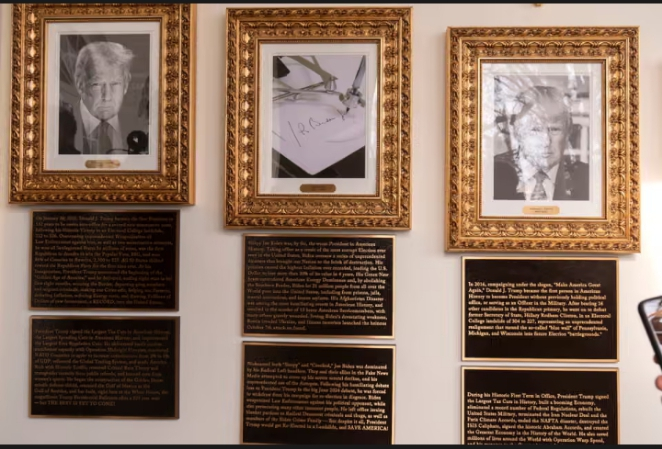
Critics argue the plaques undermine historical objectivity, portraying past presidents through the lens of partisanship, and risk politicizing the White House’s cultural and historical heritage.
The plaques emphasize negative achievements selectively, citing Obama’s healthcare law as “highly ineffective” and Clinton’s accomplishments as largely thanks to congressional Republicans, reinforcing Trump’s narrative of partisan struggle.
Even positive portrayals, such as Reagan’s, serve Trump’s self-promotion, stressing mutual admiration and historic alignment with a revered Republican figure to bolster his own presidential image.
The display coincides with broader controversies surrounding Trump, including his heavily criticized social media remarks on Rob Reiner’s death and the term “Trump Derangement Syndrome,” which drew widespread public backlash.
Healthcare experts also express concern, noting that ACA subsidies are set to expire, a critical issue linked in Trump’s plaques to Obama’s “failed” health policies, potentially impacting millions of Americans.
While the plaques focus on criticism, they also reinforce Trump’s victories, portraying electoral outcomes and policy changes as personal triumphs, including his administration’s legislative achievements and foreign policy moves.
Trump’s reevaluation of presidential history appears intended to solidify his narrative for visitors and staff, framing historical achievements and failures through his partisan, personal lens rather than balanced scholarship.
Several political analysts warn that such displays risk further polarizing public opinion, especially in a politically divided country, as Trump’s plaques explicitly disparage Democratic leaders while elevating Republican icons.
The plaques reportedly cost thousands to produce, featuring polished designs and explanatory texts in large, prominent lettering, signaling the administration’s commitment to cementing Trump’s interpretations in the White House.
Beyond Biden, Obama, and Clinton, other presidents receive varying treatments, with some plaques toned down and others highlighted, revealing Trump’s selective historical memory and strategic emphasis on praise or criticism.
The West Wing colonnade, historically a neutral space honoring presidents, is now transformed into a stage for Trump’s ideological and personal commentary, altering both tone and perception of presidential legacy.
Some historians describe the plaques as a form of “political graffiti,” permanently etched into the White House narrative, challenging conventions of nonpartisan historical acknowledgment in public spaces.
Trump’s interventions in historical memory extend beyond the plaques, influencing decorations, artwork, and ceremonial practices, reflecting a broader pattern of asserting control over presidential image and institutional narrative.
White House staff reportedly received directives to adopt Trump’s descriptions in tours and official documentation, reinforcing the display as a tool for shaping visitor perception and historical understanding.
Supporters argue the plaques simply reflect a former president’s perspective, asserting transparency about personal assessments and providing a candid, if controversial, account of presidential legacies for visitors.
Trump’s plaques have become a media spectacle, drawing widespread attention across television, social media, and online news platforms, amplifying the controversy and reinforcing his penchant for dominating the news cycle.
Even some Republican commentators question the approach, warning that the personal attacks could backfire politically, undermining Trump’s credibility among moderates and diminishing the gravitas of the White House itself.
Despite criticism, Trump’s office continues to defend the plaques as an “honest record,” portraying them as a corrective to what he calls historical revisionism by previous administrations or biased media narratives.
Observers note that these actions align with a broader pattern of reshaping public institutions for political messaging, a practice not widely seen in modern U.S. history at such a direct, visible level.
The plaques have prompted discussion about the balance between historical record and personal opinion, raising questions about how the White House commemorates past leaders while reflecting the views of current administrations.
Visitors encountering the colonnade now experience a blend of history and political commentary, with plaques emphasizing partisan assessments over factual neutrality, creating an environment that is as much ideological as historical.
The public response is divided, with Trump supporters praising candid assessments of Democratic leaders and critics decrying historical distortion and aggressive personalization of the nation’s most symbolic spaces.
White House communications emphasize the plaques as part of a broader “educational effort,” despite widespread skepticism, framing the display as a transparent presentation of presidential perspectives rather than conventional history.
Political analysts anticipate that the plaques will remain a point of contention, potentially influencing voter perceptions ahead of the next election cycle and continuing to fuel debates about Trump’s relationship with American history.
Historians caution that while presidential opinions have always colored public spaces, the scale and permanence of these plaques mark a unique moment in the politicization of historical commemoration within the executive branch.
The “Presidential Walk of Fame” is now a highly partisan display, blending biography, judgment, and opinion, illustrating how Trump’s administration seeks to embed personal interpretation into the nation’s symbolic heart.
The plaques will likely continue to attract attention from scholars, media, and political observers, who see them as emblematic of a broader effort to reshape memory, narrative, and institutional symbolism under Trump.
Read also: Winter storms worsen Gaza humanitarian crisis as aid remains blocked
About The Author