

Trump warns UK-China business ties are “very dangerous,” issuing a blunt caution to Britain just as Prime Minister Keir Starmer hailed progress in economic relations with Beijing during a high-profile visit to China.
The warning came hours after Starmer met President Xi Jinping and promoted a renewed UK-China engagement aimed at lowering tariffs, expanding market access, and restoring diplomatic momentum after years of strained relations.
Donald Trump has publicly cautioned the United Kingdom against strengthening economic relations with China, injecting fresh uncertainty into Britain’s diplomatic reset with Beijing.
Speaking in Washington, the US president described the UK’s pursuit of closer commercial ties with China as “very dangerous,” directly responding to Keir Starmer’s efforts to rebuild economic cooperation during his visit to Beijing.
Starmer, the first British prime minister to visit China in eight years, held extensive talks with President Xi Jinping at the Great Hall of the People, signalling what officials described as a thaw in relations.
The UK leader said discussions had produced “real progress,” pointing to improved market access, lower tariffs, and new investment opportunities for British firms.
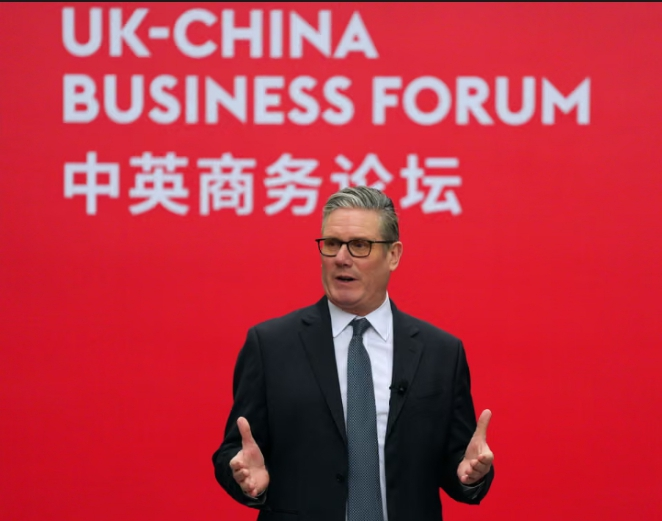
Addressing the UK-China Business Forum at the Bank of China headquarters in Beijing, Starmer emphasised that Britain had “a huge amount to offer” and committed to a “more sophisticated” relationship with China.
British business leaders present welcomed the renewed engagement, with the British Chamber of Commerce in China calling the visit successful and commercially pragmatic.
Trump’s remarks, however, risk complicating the diplomatic calculus for Downing Street. The US president, known for his confrontational stance on China, said Britain’s outreach to Beijing could carry significant risks, even as US-China trade remains deeply intertwined.

One UK official said Washington had been informed of the visit in advance and understood Britain’s objectives.
The warning followed Trump’s recent threats of tariffs against Canada over its own economic dealings with China, reinforcing concerns among US allies about Washington’s increasingly unpredictable trade posture.
Trump argued that China should not be viewed as a solution for Western economies under pressure, while simultaneously describing Xi Jinping as a personal friend and confirming plans to visit Beijing later in the year.
Starmer has sought to position Britain as capable of maintaining strong relations with both Washington and Beijing. In interviews before the trip, he insisted the UK would not be forced to choose between the US and China, stressing that economic engagement with Beijing would not undermine security cooperation with Washington.
US commerce secretary Howard Lutnick echoed scepticism about the UK’s China strategy, suggesting British exporters would struggle to gain meaningful access to the Chinese market.
He nevertheless downplayed the likelihood of the US imposing tariffs on Britain, unless relations deteriorated significantly.
After Beijing, Starmer was scheduled to travel to Shanghai before heading to Tokyo for talks with Japan’s prime minister, underscoring the UK government’s broader push to rebalance its global economic relationships amid growing geopolitical uncertainty.
Trump’s warning added a sharper geopolitical edge to what British officials had framed as a pragmatic economic re-engagement with Beijing.
His remark — “Well, it’s very dangerous for them to do that” — was delivered in response to questions about Starmer’s attempts at resetting relations with China, underscoring Washington’s unease with allies pursuing independent economic strategies involving its principal strategic rival.
The timing of the intervention was particularly sensitive. Starmer’s three-hour meeting with Xi Jinping had been presented by both sides as a signal of stabilising relations after years of diplomatic chill, marked by disputes over human rights, security concerns, and trade imbalances.
British officials had hoped the visit would demonstrate that London could pursue economic pragmatism while maintaining its security alignment with the United States.
Speaking after his meeting with Xi, Starmer struck an optimistic tone, saying the UK-China relationship was in a “good, strong place” and that discussions had delivered “just the level of engagement that we hoped for.”
His language reflected a deliberate attempt to reset the narrative around China, moving away from confrontation toward managed cooperation, particularly in trade and investment.
At the UK-China Business Forum in Beijing, Starmer elaborated further, telling executives: “We warmly engaged and made some real progress, actually, because the UK has got a huge amount to offer.”
The forum, hosted at the Bank of China, was designed to reassure British companies operating in or trading with China that government-level support for commercial engagement had returned.
Business leaders echoed that assessment. Chris Torrens, chair of the British Chamber of Commerce in China, described the trip as “successful,” adding: “It makes sense for UK to be looking to China, it’s one of its larger trading partners.”
His remarks highlighted the commercial pressures facing the UK economy, particularly as growth remains sluggish and exporters seek access to large overseas markets.
Despite these reassurances, Trump’s comments threatened to reintroduce strategic uncertainty. His administration has repeatedly framed China as a systemic threat, and his unpredictable approach to trade — marked by abrupt tariff threats and diplomatic reversals — has unsettled allies attempting to plan long-term economic policy.
Downing Street officials sought to downplay the significance of Trump’s remarks, noting that Washington had been briefed on the Beijing visit in advance and was aware of the UK’s objectives.
However, privately, concerns remain that public criticism from the US president could complicate Britain’s attempt to position itself as a bridge between competing global powers.
Trump expanded his critique by drawing a contrast between the UK and Canada, arguing that engagement with China was “even more dangerous, I think, for Canada.” He added: “Canada is not doing well. They’re doing very poorly, and you can’t look at China as the answer.”
The comparison underscored Trump’s broader scepticism about Western economies turning to Beijing for relief amid global trade disruptions.
Yet the US president’s position appeared nuanced, if contradictory. While warning allies away from closer economic ties with China, he also said: “President Xi is a friend of mine, I know him very well.” Trump confirmed that he was expected to visit Beijing himself in April, even as the US remains China’s largest single trading partner.
Starmer has consistently argued that Britain should not be forced into binary choices between Washington and Beijing. In an interview with Bloomberg before his trip, he said the UK could strengthen economic relations with China without undermining its alliance with the United States. “We’ve got very close relations with the US – of course, we want to – and we will maintain that business, alongside security and defence,” he said.
That balancing act is becoming increasingly difficult. Trump’s on-off threats of tariffs and his pledges to “grab control of Greenland,” an autonomous territory of Denmark, have rattled traditional US allies, raising questions about the reliability of American leadership and the space available for independent foreign policy decisions.
Adding to the sceptical voices, US commerce secretary Howard Lutnick publicly questioned whether Britain’s China strategy would yield tangible benefits.
“The Chinese are the greatest exporters and they are very, very difficult when you’re trying to export to them,” he said. “So good luck if the British are trying to export to China … it’s just unlikely.”
Lutnick nevertheless sought to reassure London that it was unlikely to face the same treatment as Ottawa, stating: “Unless the prime minister of Britain sort of takes on the United States and says very difficult things, I doubt it.” His comments suggested that, for now, Britain may avoid direct economic retaliation despite Trump’s warnings.
Starmer’s itinerary reflected the broader strategic context of the visit. After Beijing, he travelled to Shanghai before heading to Tokyo for talks with Japanese prime minister Sanae Takaichi, signalling the UK’s intent to strengthen ties across the Asia-Pacific region while diversifying economic partnerships.
The visit also placed Britain among a growing list of Western nations seeking to hedge against US unpredictability by cautiously re-engaging with China. In recent weeks, several leaders have travelled to Beijing, attempting to balance economic necessity against strategic rivalry in an increasingly fragmented global order.
For the UK government, the challenge now lies in sustaining economic gains from China without triggering diplomatic or trade consequences from Washington.
Read also: Heavy security deployed at Niamey airport after overnight gunfire and explosions
Trump’s declaration that closer UK-China ties are “very dangerous” has sharpened that dilemma, forcing London to navigate an increasingly narrow path between its largest security ally and one of its most important potential markets.
About The Author


