US President Donald Trump announced Thursday that the United States will begin targeting Venezuelan drug trafficking by land, claiming recent operations have already cut sea shipments by 85 percent.
“We’re not stopping. We warned them. Stop sending poison to our country,” Trump said in a Thanksgiving holiday address to US forces stationed across the Caribbean.
Trump praised American troops as the “backbone of our airpower,” highlighting recent Caribbean operations involving aircraft carriers, stealth fighter jets, and thousands of troops deployed to deter Venezuelan narcotics networks. “You’ve been working tirelessly to disrupt these criminal networks, and it shows,” he added.
The announcement comes after Washington carried out more than 20 US military strikes on vessels in the Caribbean Sea and Pacific Ocean since September, killing at least 83 people.
Legal experts and Latin American governments have criticized the campaign as extrajudicial and potentially unlawful.
Despite the strikes, the United States has provided no publicly verified evidence connecting the targeted vessels to actual drug trafficking. Regional leaders argue the attacks have primarily affected innocent fishermen, raising tensions with several Latin American nations.
Trump emphasized that while sea-based shipments have declined, land-based smuggling remains a problem. “People aren’t wanting to deliver by sea anymore. Soon we’ll stop the land routes too. The land is easier. That’s going to start very soon,” the president said.
Officials in Caracas denounced Trump’s statements as pretext for regime change. Venezuelan President Nicolas Maduro called US claims of Venezuelan drug trafficking “false and extravagant,” accusing Washington of attempting to destabilize the region for political gain.
“For 17 weeks, imperialist forces have continuously threatened peace in our Caribbean and our homeland,” Maduro said in a nationally televised address.
Maduro vowed Venezuelans would not be intimidated. “No foreign threat frightens our people, nor takes us by surprise. Our nation is prepared to defend its soil, seas, sky, soul, and history,” he stated, projecting resilience and national unity against what he called US aggression.
The Trump administration’s designation of the Cartel de los Soles as a terrorist organization has provided legal cover for intensified military action.
Observers, however, note that the move may serve dual purposes: combating narcotics while pressuring Maduro to step down. “The designation creates a legal pretext, but the political goal is clear,” said a Latin American security analyst.
Washington’s anti-drug campaign has already involved coordinated operations with naval aircraft and surface vessels.
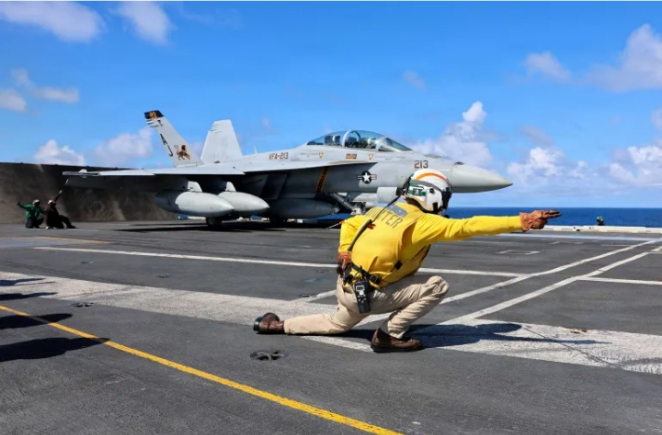
According to Pentagon sources, aircraft carriers including the USS Gerald R. Ford, alongside F/A-18F Super Hornets and stealth fighter jets, have conducted targeted strikes aimed at disrupting maritime trafficking routes.
The United States claims its Caribbean operations have killed dozens of traffickers while intercepting large quantities of narcotics. Trump, in his address, stated, “We’ve almost stopped it. It’s about 85 percent stopped by sea. But the land is next, and we’ll take care of that situation quickly.”
Regional leaders have condemned US strikes as disproportionate and reckless. “Civilians have been killed under the guise of anti-drug operations. These attacks are violating international norms,” said a senior Caribbean official familiar with maritime security in the region.
Trump’s remarks came as US military advisers toured the Caribbean, signaling possible escalation. Pentagon officials confirmed troop movements and intelligence-gathering missions are ongoing, heightening fears that Washington may attempt to expand US military strikes beyond maritime targets to Venezuelan soil.
The campaign has drawn criticism from multiple international actors. Cuba condemned the United States for “aggressive posturing,” warning that attacks on Venezuelan vessels risk destabilizing the entire region. The Cuban government called for restraint, emphasizing dialogue over force.
Trump has previously linked Maduro and senior Venezuelan officials to narcotics trafficking, asserting that the Venezuelan leadership is complicit in criminal networks.
“These people are responsible for sending poison into our communities. They must be stopped,” Trump said, reinforcing his hardline rhetoric.
The designation of the Cartel de los Soles follows a series of legal and political maneuvers intended to justify US military intervention. Analysts argue that the move strengthens Washington’s ability to conduct strikes while framing the narrative as anti-narcotics enforcement rather than political aggression.
Despite repeated warnings, Maduro continues to reject US claims. “We will not be intimidated or coerced by foreign powers. Venezuela is sovereign. Our people are united in defense of our nation,” he said, underscoring the potential for prolonged confrontation.
US strikes have reportedly killed fishermen and traffickers alike, blurring the line between lawful operations and extrajudicial killings. Legal experts argue that the lack of transparent evidence for drug involvement in the targeted vessels undermines US claims and risks international condemnation.
Trump’s military buildup in the region has included thousands of troops, air and naval assets, and logistical support for rapid deployment. Observers suggest the scale of preparations signals that the United States may be considering a wider campaign against Venezuelan drug trafficking networks.
The international community remains divided. Some Latin American countries urge de-escalation and diplomacy, while others tacitly support Washington’s anti-narcotics stance. The tension highlights a broader struggle over US influence and sovereignty in the region.
Trump framed the land-based campaign as the logical next step in his administration’s efforts. “Stopping the poison by sea has been effective. Now, we’ll ensure land routes are shut down completely. Our people deserve safety,” he said, reinforcing the narrative of protecting American communities.
Caracas officials argue that the US anti-drug narrative masks a broader strategic goal. Maduro’s government claims that Washington seeks regime change, using alleged narcotics operations as justification for US military strikes. “This is not about drugs. It is about politics,” said a Venezuelan foreign ministry spokesperson.
The ongoing escalation represents one of the most volatile periods in US-Venezuelan relations in decades. Analysts caution that missteps or miscalculations could trigger a wider conflict, further destabilizing the Caribbean and South America.
Trump’s rhetoric and military positioning also send signals to regional adversaries. By emphasizing American strength and readiness, Washington appears to be deterring potential challengers while asserting dominance in Latin American affairs.
As anti-drug operations expand, experts warn that civilian casualties and regional backlash could undermine US credibility. “Striking vessels without clear evidence risks alienating allies and strengthening anti-US sentiment,” said a former State Department official.
Despite the risks, Trump remains committed to his strategy. “We will stop Venezuelan drug trafficking by land. Our forces are ready, our intelligence is strong, and we will protect America,” the president said, concluding his Thanksgiving address with resolute determination.
The unfolding crisis underscores the complex intersection of Venezuelan drug trafficking, US military strikes, and geopolitical strategy. While Washington frames actions as anti-narcotics enforcement, Caracas portrays them as an existential threat to national sovereignty.
The designation of the Cartel de los Soles, paired with continued Caribbean operations, sets the stage for a prolonged confrontation. Analysts warn that both rhetoric and military posture increase the likelihood of accidental escalation.

For now, Venezuela appears steadfast. Maduro has rallied his population around national defense and sovereignty, emphasizing that foreign aggression will not succeed. The coming weeks may determine whether diplomatic pressure or military escalation shapes the next phase of this high-stakes confrontation.
About The Author