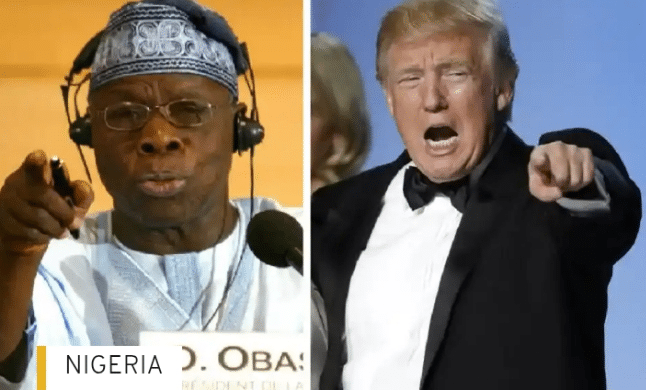
Donald Trump reignited debate Monday over an unconstitutional third term, explicitly ruling out a vice-presidential run while hinting at ambitions reminiscent of Obasanjo’s near-constitutional crisis in Nigeria.
“I’d be allowed to do that,” Trump told reporters aboard Air Force One, smiling, “but I wouldn’t do it. It’s too cute. People wouldn’t like it,” he said.
Critics immediately condemned the idea, warning, “This is what dictators do,” claiming that an unconstitutional third term would undermine democratic norms and erode institutional safeguards.
History shows Trump is not alone: former Nigerian President Olusegun Obasanjo’s third-term attempt in 2006 provoked national unrest, massive protests, and threats to the country’s democratic fabric.
Obasanjo was ultimately stopped by Nigeria’s political juggernauts: lawmakers, civil society leaders, and influential former presidents united to block constitutional manipulation. “We cannot allow a precedent like this,” they declared.
Trump praised Republican figures JD Vance and Marco Rubio, asserting, “They’re great people. If they formed a group, it’d be unstoppable,” signaling coalition-building as part of a Trump 2028 campaign.
Supporters see his comments as bold and visionary, arguing that enduring popularity and leadership experience justify exploring avenues for an unconstitutional third term while adhering to party strategies.
Some strategists floated a vice-presidential workaround: Trump could run as VP, then assume the presidency if a placeholder resigned, though legal scholars warn this exploits a dubious vice-presidential loophole.
Trump’s public flirtation with the unconstitutional third term includes “Trump 2028” merchandise and media appearances, keeping the idea alive while energizing his base and dominating political discourse.
When asked whether he might pursue a third term, Trump hedged: “Am I not ruling it out? You’ll have to tell me,” leaving both allies and opponents uncertain.
Democrats argue that an unconstitutional third term violates the 22nd Amendment, warning, “Any attempt to bypass legal limits would threaten democracy and undermine voter confidence in elections.”
Trump’s calculated ambiguity energizes supporters, dominates media cycles, and tests political boundaries while keeping the mechanics of a Trump 2028 campaign deliberately unclear.
Observers note repeated mentions of an unconstitutional third term build narrative momentum, ensuring Trump controls political discourse and frames the conversation about executive power before formal campaign announcements.
Even as Trump emphasizes foreign policy, his domestic messaging projects authority and political dominance, signaling that control of the White House is central to his strategy and legacy.
The potential constitutional controversy mirrors Obasanjo’s 2006 attempt, highlighting risks of extended terms: political polarization, civil unrest, and destabilization of democratic institutions in both contexts.
Obasanjo’s ambitions were curtailed by political juggernauts, including key Senate leaders, state governors, and opposition figures, proving that coordinated institutional resistance can check executive overreach.
Trump faces a U.S. parallel question: if he pursues an unconstitutional third term, will Congress, the courts, or the American electorate stop him, as Nigeria’s juggernauts stopped Obasanjo?

Critics argue that pursuit of extended power is dangerous, claiming presidents have no birthright to office beyond constitutional limits, while supporters frame ambition as a mandate from popular approval.
Trump praised loyalists, claiming, “All I can tell you is we have a great group of people, which they [the Democrats] don’t,” reinforcing party cohesion and planning for a Trump 2028 campaign.
The vice-presidential workaround, though legally dubious, continues circulating among strategists, keeping media attention high and feeding debates about constitutional limits on presidency and the unconstitutional third term.
Observers point out that leaders with enduring popularity often see office as entitlement, yet constitutions exist to curb ambition and maintain democratic stability, as Obasanjo’s near-crisis vividly illustrates.
Trump’s repeated teasing of an unconstitutional third term generates anticipation, media coverage, and base mobilization, ensuring dominance over political narratives while opponents scramble to respond strategically.
Legal scholars warn that any indirect path to power, including the vice-presidential loophole, could trigger judicial review, litigation, and a constitutional crisis unprecedented in modern U.S. history.
Trump’s references to loyal Republicans like JD Vance and Marco Rubio highlight coalition-building, framing a Trump 2028 campaign as a collective Republican endeavor rather than a personal ambition.
The African parallel underlines risks: Obasanjo’s third-term attempt nearly ignited nationwide unrest, parliamentary deadlock, and political polarization, illustrating consequences of executive overreach that Americans should heed.
Trump’s global diplomacy, public appearances, and media interactions collectively function as a prelude to 2028, blending foreign policy success with provocative discussion of an unconstitutional third term.
Despite ruling out a vice-presidential run, Trump’s statements keep the conversation alive, leaving uncertainty about the mechanics of an unconstitutional third term and maintaining strategic advantage.
Critics argue that such ambition is not a birthright but a dangerous impulse, yet history shows that leaders with charisma and loyalty networks often resist voluntary relinquishment of office.
Trump’s scenario echoes Obasanjo’s, demonstrating that attempts to extend presidential tenure can ignite political crises, provoke public unrest, and deepen partisan polarization, a cautionary tale for American voters.
Supporters maintain the unconstitutional third term concept is visionary, claiming Trump’s leadership experience, economic policies, and diplomatic achievements justify exploring unconventional avenues within political strategy.
Partisan divides intensify as Republicans rally behind Trump’s messaging while Democrats warn of dangerous precedent-setting, framing the Trump 2028 campaign as potentially destabilizing to democratic norms.
Trump’s media strategy, merchandise campaigns, and international appearances reinforce public perception of authority, blending diplomatic credibility with preparation for an unconstitutional third term bid.
Observers agree that repeated references to an unconstitutional third term dominate political conversation, shape narratives, and force both allies and opponents to consider future contingencies strategically.
Ultimately, both Trump’s ambitions and Obasanjo’s historical attempt highlight the tension between presidential ambition, legality, and democratic stability, reminding citizens that institutional safeguards exist to prevent overreach.
Trump’s global diplomacy, public rhetoric, and provocative hints function as a high-stakes prelude to 2028, blending foreign policy, domestic strategy, and relentless political theater.
The next three years will test Trump’s patience, the U.S. legal system, and public tolerance, as the possibility of an unconstitutional third term remains unresolved yet politically potent.
Power-hungry presidents often see office as personal entitlement, yet constitutions, courts, and civic institutions exist to curb excessive ambition and prevent national crises, as Obasanjo’s case demonstrates.
Trump’s consistent references to an unconstitutional third term ensure media attention, base mobilization, and public debate, making it a defining feature of the emerging political landscape leading to 2028.
The Obasanjo comparison underscores the consequences of unchecked ambition: political divisions, civil unrest, and near-constitutional breakdown, serving as a cautionary tale for Americans observing Trump’s maneuvers.
Even without pursuing a vice-presidential bid, Trump’s statements guarantee that discussion about an unconstitutional third term dominates the political discourse, forcing parties to plan for contingencies.

Ultimately, the unconstitutional third term debate demonstrates tension between ambition, legality, and democratic safeguards, reminding citizens that constitutional constraints exist to prevent executive overreach.
Trump’s global diplomacy, domestic messaging, and provocative rhetoric collectively set the stage for 2028, blending foreign policy, domestic strategy, and political spectacle, ensuring his presence dominates the Republican narrative.