
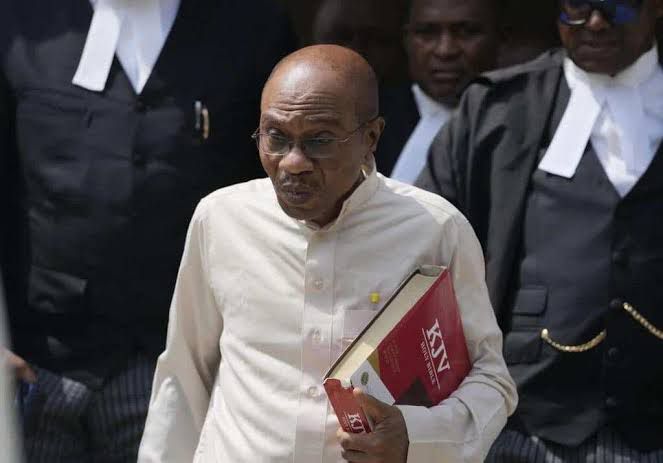
A High Court of the Federal Capital Territory (FCT) in Maitama has taken a firm stance against what it described as trial delay, imposing a monetary penalty on the country’s anti-corruption agency.
The court fined the Economic and Financial Crimes Commission (EFCC) N500,000 after it failed to present a key witness in the ongoing prosecution of former Central Bank of Nigeria (CBN) Governor, Godwin Emefiele.
The decision was delivered by Justice Hamza Muazu, who expressed dissatisfaction with the repeated requests for adjournments made by the prosecution.
According to the judge, the pattern of delays has hindered the smooth progress of the trial and raised concerns about the commitment to timely justice.
The ruling reflects growing judicial intolerance for procedural setbacks, particularly in high-profile cases.
At the resumed hearing, the prosecution, represented by Senior Advocate of Nigeria (SAN) Abba Mohammed, informed the court that its scheduled witness, Deputy Commissioner of Police Elohor Edwin Okpoziakeo, was unavailable.
The lawyer explained that the officer was attending to a personal legal issue at a High Court in Gwagwalada, involving a garnishee order placed on his bank account.
Despite acknowledging that the witness had been duly notified of the court date, the prosecution urged the court to grant another adjournment.
Mohammed further stated that he had taken additional steps to ensure the witness’s presence, including writing to the Inspector-General of Police and engaging the Assistant Inspector-General in charge of legal services. However, these efforts did not yield the desired result.
The request for adjournment was strongly opposed by the defence team, led by Matthew Burkaa (SAN).
The defence argued that the trial delay had already exceeded legal limits outlined in the Administration of Criminal Justice Act (ACJA) 2015.
Burkaa cited provisions of the law which restrict the number of adjournments a party can seek during a criminal trial, emphasizing that the prosecution had already surpassed the allowable threshold.
He further pointed out that the EFCC had earlier requested an accelerated hearing, a move intended to fast-track the case.
However, the defence argued that the agency failed to match its request with adequate preparation, noting that more than two years had passed without properly securing the attendance of its witnesses.
This, according to the defence, undermines both the spirit and letter of the law.
In delivering his ruling, Justice Muazu acknowledged the validity of the defence’s arguments regarding the statutory limits on adjournments.
However, he maintained that the court retains discretionary authority to ensure justice is served.
He stressed that completely shutting out a critical witness, particularly an investigating officer, could negatively affect the integrity of the trial.
Nevertheless, the judge did not ignore the implications of the trial delay.
He ruled that the prosecution’s inability to present its witness—despite prior assurances—amounted to unnecessary delay.
As a result, the court imposed a fine of N500,000 on the EFCC as a punitive measure. The sanction, he explained, serves both as a deterrent and a signal that the court will not tolerate avoidable setbacks.
Justice Muazu also granted what he described as a final adjournment, warning that the prosecution must ensure the presence of its witnesses at the next hearing.
The case was subsequently adjourned to April 27 and 28 for continuation.
The trial of Godwin Emefiele centres on a 20-count amended charge involving serious allegations, including criminal breach of trust, forgery, conspiracy, abuse of office, and obtaining money under false pretence.
One of the most notable accusations is that the former CBN governor allegedly obtained $6.23 million under the guise of funding international election observers during the 2023 general election.
Additionally, he is accused of granting undue financial benefits to private entities, specifically April 1616 Nigeria Limited and Architekon Nigeria Limited.
These allegations form a significant part of the prosecution’s case and are expected to be addressed through witness testimonies and documentary evidence as the trial progresses.
Legal analysts say the trial delay highlights broader concerns about the efficiency of criminal proceedings in Nigeria, especially in cases involving prominent figures.
While courts often strive to balance fairness with speed, delays caused by procedural lapses or lack of preparedness can erode public confidence in the justice system.
About The Author






