

Introduction
The phrase referee decision final has taken centre stage in the growing dispute between Senegal and the Confederation of African Football (CAF). What seemed like a dramatic on-field incident has now evolved into a potential legal battle that could be decided at the Court of Arbitration for Sport. At the heart of the issue lies a critical question: does a temporary walk-off invalidate a match if the referee allows play to resume?
This situation goes beyond emotion, fan reactions, or even match-day drama. It cuts into the core of football governance—where the authority of the referee meets the administrative power of competition organizers.
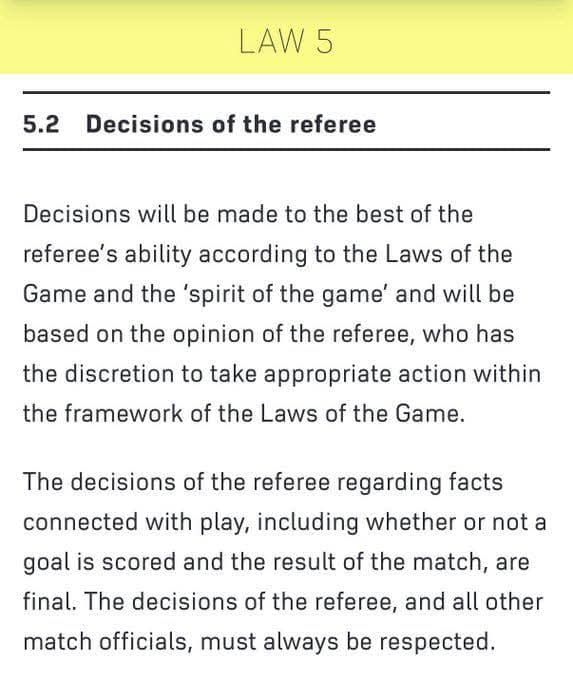
Referee authority under IFAB law
To understand the situation, we must start with the International Football Association Board (IFAB), the body responsible for the Laws of the Game.
Under Law 5, the referee has:
Full authority to enforce the rules
The discretion to stop, suspend, or continue play

The final say on all decisions related to the match
This is where the concept of referee decision final becomes crucial. Once a referee decides to restart a match, that decision carries significant weight. It implies that, from a gameplay perspective, the match is still valid and ongoing.
In the Senegal scenario, if the referee allowed play to continue after the players returned, then by IFAB standards, the match was not abandoned.
The complexity of match abandonment
However, football is not governed by IFAB laws alone. Tournament organizers like CAF operate under their own regulations, which introduce another layer of complexity.
CAF rules typically address:
Team misconduct
Refusal to continue play
Disciplinary consequences
This means that even if the referee decision final principle applies on the pitch, CAF can still evaluate actions off the ball—such as a team walking off—as a breach of competition rules.
So, the key distinction emerges:
IFAB governs the game itself
CAF governs the competition structure and discipline
This dual system is exactly why disputes like this escalate beyond the field.
Did Senegal abandon the match?
This is the central debate.
Argument supporting Senegal
Senegal’s strongest position is built around the idea that:
The referee did not officially abandon the match
Play was restarted
The game continued under the referee’s authority
From this perspective, the referee decision final principle clearly applies. If the referee did not declare abandonment, then retroactively labeling the situation as such becomes legally questionable.
Argument supporting CAF and Morocco
On the other hand, CAF and Morocco could argue:
The act of walking off constitutes misconduct
Intent to abandon is enough, even if play resumes
Tournament integrity must be protected
This shifts the focus away from the referee’s actions and onto the behavior of the team.
Why the referee’s decision matters so much
The importance of referee decision final cannot be overstated in this case. CAS has historically placed significant emphasis on:
Match officials’ reports
Decisions made during the game
Consistency between on-field actions and post-match rulings
If the referee:
Did not document abandonment
Allowed the match to continue
Treated the situation as a temporary interruption
Then CAF may struggle to justify a later claim that the match was abandoned.
This creates a legal contradiction, and CAS typically does not favor such inconsistencies.
The role of CAS in football disputes
The Court of Arbitration for Sport acts as the final authority in global sports disputes. Its role is not to replay matches but to assess whether rules were:
Properly applied
Fairly interpreted
Consistently enforced
CAS decisions often hinge on procedural fairness rather than emotional arguments.
In cases involving African football, there have been instances where CAF decisions were overturned due to:
Poor documentation
Misapplication of rules
Conflicts between referee actions and administrative rulings
This history gives Senegal a potentially strong footing.
Key factors that could decide the case
Several details will likely determine the outcome:
- Referee report
Did the referee explicitly mention abandonment or misconduct?
- Duration of the walk-off
A brief protest is very different from a prolonged refusal to play.
- Match restart procedure
Was the restart handled formally and within the rules?
- CAF disciplinary process
Did CAF follow its own regulations correctly?
If the referee decision final principle is supported by clear match documentation, Senegal’s argument becomes significantly stronger.
What this means for football governance
This situation highlights a broader issue in football:
The tension between on-field authority and off-field governance
If CAF overrides a referee’s decision without strong justification, it could:
Undermine referee authority
Create uncertainty in future matches
Open the door to more legal challenges
On the other hand, failing to punish misconduct could:
Encourage teams to exploit grey areas
Damage competition integrity
Striking the right balance is essential.
Final thoughts
At its core, this dispute revolves around one powerful principle: referee decision final. If the referee allowed the game to continue, that decision carries legal and sporting weight that cannot be ignored.
However, football is not just played on the pitch—it is regulated beyond it. CAF’s ability to sanction teams introduces a parallel layer of authority that could still influence the outcome.
If this case reaches CAS, the verdict will likely depend on consistency:
Did the referee’s actions align with CAF’s conclusions?
Or is there a contradiction that weakens the governing body’s case?
One thing is certain—this is more than just a match dispute. It is a defining moment that could reshape how authority is interpreted in African football and beyond.
Read more here: Afcon title overturned: Morocco crowned champions after CAF ruling
About The Author
