The train crash shocks Spanish town Adamuz after two trains collided near the small Andalusian municipality, killing at least 39 people and critically injuring more than a dozen others in Spain’s worst rail disaster in over a decade.
The collision, involving a high-speed Iryo service travelling from Málaga to Madrid and a Renfe train heading from Madrid to Huelva, occurred late on Sunday night just a few kilometres outside the town, leaving residents grappling with scenes they say they will never forget.
As dawn broke over the olive and oak groves surrounding Adamuz, the scale of the disaster became clearer. Twisted carriages lay strewn along the tracks, some overturned, others leaning at dangerous angles, as investigators and Guardia Civil officers combed the site.
Heavy machinery was brought in to begin the painstaking process of clearing wreckage from the line, while helicopters circled overhead and emergency vehicles continued to move between the crash site and the town.
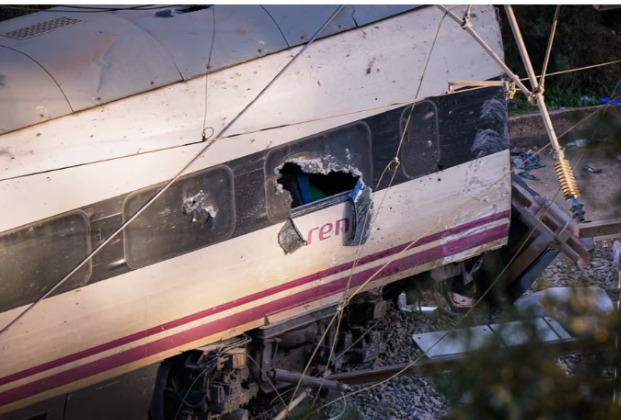
The train crash shocks Spanish town Adamuz, a community of just 4,000 people, many of whom rushed to help long before national emergency teams arrived.
Local residents described hearing sirens tear through the quiet streets late into the night as ambulances transported the injured to the town’s municipal events hall, which was rapidly transformed into an emergency response centre.
Spain’s prime minister, Pedro Sánchez, described the incident as “a night of deep pain for our country,” a sentiment echoed throughout the town as shock replaced the initial urgency of rescue efforts.
By Monday afternoon, Adamuz had become a focal point for national mourning, with journalists, emergency workers and officials converging on the normally quiet municipality.
Inside the municipal hall, the human response to the train crash shocks Spanish town Adamuz was visible everywhere.
Long tables were stacked high with blankets, food and water donated by residents who arrived carrying whatever they could find in their homes.
Local police, Guardia Civil officers and civil emergency workers worked side by side as injured passengers were treated and reassured.
Emergency responders spoke openly about the challenges they faced at the crash site. Francisco Carmona, Córdoba’s firefighting chief, said rescue teams were forced to make impossible decisions in the chaos.
He told local radio that there were moments when responders had to move the dead in order to reach survivors trapped inside the wreckage, underlining the severity of the Spain train collision.
Rafael Moreno, the mayor of Adamuz, said the images from the tracks would remain with him forever. He described hearing cries for help echoing through the darkness and watching injured passengers emerge from the mangled carriages in a state of shock. According to Moreno, the Adamuz train disaster has left emotional scars that will take years to heal.
The train crash shocks Spanish town Adamuz not only because of the number of lives lost, but also because of the way the community was drawn directly into the aftermath.
Residents spoke of organising themselves through WhatsApp groups within minutes of learning what had happened, coordinating donations and directing people to the municipal hall.
One local woman said she knew immediately something was wrong when she saw ambulances speeding through the streets late at night.
Fearing the worst, she sent her teenage son to the hall with blankets and warm clothing. Like many others, she spent the night unable to sleep as news of the southern Spain rail tragedy spread.
Older residents said they had never experienced anything comparable. A 75-year-old lifelong resident of Adamuz described the night as “terrible” but said the town responded with unity and compassion. Neighbours brought food, hot drinks and blankets, while others simply stood with survivors who were too shaken to speak.
As Monday progressed, attention slowly began to shift from rescue to investigation. Authorities confirmed that five information centres had been opened in cities including Córdoba, Málaga and Madrid to help relatives of missing passengers and to collect DNA samples for identification.
The process, officials said, would be slow and careful due to the condition of the wreckage.
The train crash shocks Spanish town Adamuz as questions mount over how two trains were able to collide on the same stretch of track.
Investigators are examining signalling systems, communication between drivers and previous safety reports, as Spain comes to terms with another high-speed train crash that has raised serious concerns about rail safety.
Pedro Sánchez visited Adamuz on Monday, meeting local officials and residents before travelling to the crash site. His presence underscored the national significance of the disaster and the government’s commitment to a full investigation. Spain later announced days of official mourning as tributes poured in from across the country and beyond.
For many in Adamuz, however, the focus remains on the human cost. Builders, shopkeepers and retirees alike described spending hours ferrying supplies to the municipal hall or trying to reach the crash site before it was sealed off. Several said the emotional impact of seeing their town associated with such a tragedy was overwhelming.
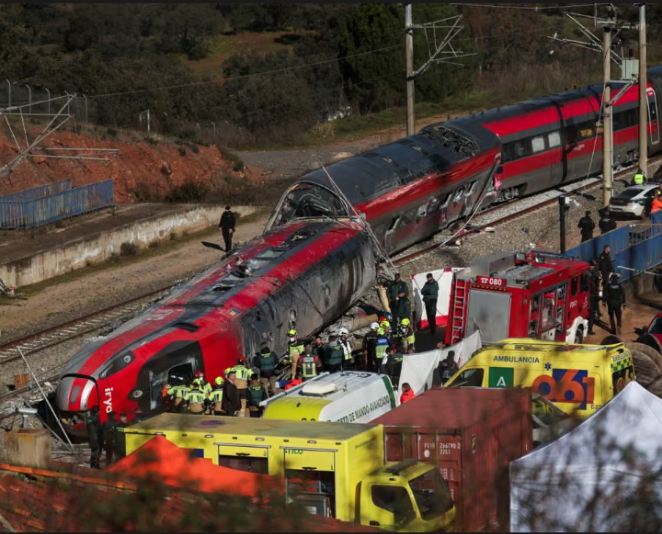
The train crash shocks Spanish town Adamuz in a way that will linger long after the wreckage is removed and the rail line reopens.
Residents say the sounds of sirens, the sight of damaged carriages and the stories shared in the early hours of the morning have become part of the town’s collective memory.
As Spain mourns the victims of the Adamuz train disaster, the small Andalusian town remains united in grief and resolve, determined to remember those who lost their lives while continuing to support the survivors of one of the country’s darkest rail tragedies in recent years.