

President Bola Ahmed Tinubu’s decision to overhaul Nigeria’s military leadership on Friday has triggered nationwide debate, reigniting questions about loyalty, reform, and the balance between perception and reality in Africa’s most populous democracy.
While the Presidency insists that the military shake-up was driven purely by a need to reinvigorate the armed forces and enhance national security, its timing—coming barely a week after rumours of an attempted coup—has stirred intense speculation across political and military circles.
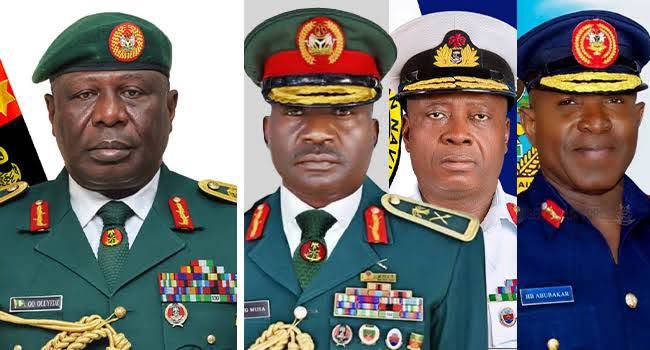
In a statement issued by Presidential spokesman Sunday Dare, the President approved the appointment of Major-General W. Shuaibu as Chief of Army Staff, Air Vice Marshal S.K. Aneke as Chief of Air Staff, and Rear Admiral I. Abbas as Chief of Naval Staff. The Chief of Defence Intelligence, Major-General E.A.P. Undiendeye, retained his position.
The announcement also confirmed General Olufemi Oluyede as the new Chief of Defence Staff, succeeding General Christopher Musa in what observers describe as one of the boldest military reorganisations in recent history.
Coup Rumours and the Politics of Perception
Barely a week before the announcement, online reports had circulated suggesting that a group of senior officers were plotting to overthrow President Tinubu’s administration.
The Defence Headquarters was quick to dismiss the claims as baseless, warning the public against spreading misinformation.
Brigadier General Tukur Gusau, Director of Defence Information, described the allegations as “false and malicious,” explaining that the few officers detained were being investigated for indiscipline rather than treason.
He clarified that the cancellation of the Independence Day military parade was an administrative decision, not a sign of unrest.
Still, the rumour gained traction among citizens wary of Nigeria’s coup-laden history.
Since independence in 1960, the country has experienced multiple military takeovers, leaving scars that continue to shape public psychology.
Senior Advocate of Nigeria (SAN) Olisa Agbakoba noted that the President’s quick response was politically astute.
“If it is true that there was even the slightest hint of disloyalty in the ranks, Tinubu acted wisely. Leadership demands pre-emptive moves to stabilise the system,” he said.
Tinubu’s Military Shake-Up: Reform, Not Reaction
Beyond the political drama, analysts believe Tinubu’s military shake-up underscores a strategic recalibration of Nigeria’s security architecture.
For years, insecurity has festered across the country, from Boko Haram insurgency in the North-East to banditry in the North-West, separatist agitation in the South-East, and oil theft in the Niger Delta.
Even the Federal Capital Territory—once regarded as impenetrable—has not been spared, with isolated kidnappings and raids surfacing on its outskirts.
The spread of violence into previously calm areas such as Niger, Kogi, and Kwara states has amplified fears of national vulnerability.
For Tinubu, whose administration faces growing discontent over economic hardship and subsidy reforms, restoring public confidence through decisive security action has become a political imperative.
The latest appointments, therefore, serve not only as a renewal of military command but also as a statement of authority and intent.
A senior presidency source told our correspondent, that the reshuffle was long overdue.
“The President is not reacting to rumours. This is about aligning the armed forces with his long-term vision for national security and operational efficiency,” the source said.
Institutional Renewal and Strategic Intent
Tinubu’s directive to the new service chiefs was clear: deliver results, restore professionalism, and rebuild public trust.
While such words are familiar, the context this time is different.
Nigeria’s armed forces have in recent years faced not just the challenge of fighting insurgents, but also of rebuilding morale, intelligence coordination, and civilian confidence.
Military analysts say Tinubu’s new team reflects a mix of operational experience and generational balance — a sign that the government wants fresh thinking without losing institutional memory.
Security expert Colonel Hassan Yakubu (rtd) told our correspondent, that the appointments could bring new momentum if backed by clear policy direction.
“The President has selected officers known for discipline and field competence.
What matters now is political will, funding, and accountability,” he said.
Opposition Voices Demand Transparency
However, opposition parties have questioned the motive and timing of the reshuffle.
The African Democratic Congress (ADC), in a statement signed by its National Publicity Secretary, Bola Abdullahi, described the decision as “abrupt and unsettling.”
The ADC argued that the government must clarify whether the shake-up was driven by genuine reform needs or fears of internal dissent.
“Such major changes cannot happen in a vacuum. Nigerians deserve to know the underlying reasons, especially given recent rumours,” the statement read.
It also warned that constant restructuring of the military hierarchy could disrupt stability and cohesion within the ranks.
“Frequent changes create uncertainty, especially when service chiefs are replaced before completing strategic programmes,” Abdullahi added.
Balancing Loyalty and Professionalism
Observers point out that Tinubu’s approach mirrors the classic challenge faced by Nigerian civilian leaders: managing loyalty without compromising professionalism.
Since assuming office in 2023, the President has made key appointments across critical security and intelligence agencies, consolidating his control while projecting reform intent.
Political analyst Chuks Nduka said the shake-up reflects both prudence and politics.
“Tinubu understands Nigeria’s delicate civil-military relationship.
The move is partly about ensuring loyalty and partly about demanding results. Both are essential for survival in a volatile environment,” he said.
He added that in a country where the military remains a powerful institution, even whispers of discontent can have far-reaching implications.
“In this case, perception management is as important as operational control.”
Insecurity, Poverty, and the Bigger Picture
Experts insist that military changes alone cannot solve Nigeria’s security crisis.
The real challenge lies in addressing the root causes — poverty, unemployment, and weak governance.
Political economist Nsikan Effiong argued that unless Tinubu’s administration pairs its military shake-up with socio-economic reforms, Nigeria risks repeating a familiar cycle.
“Insecurity is a symptom, not the disease. What fuels it is deprivation and inequality. Without jobs, education, and credible policing, even the best generals will struggle,” he said.
Effiong urged the President to strengthen intelligence-sharing frameworks between security agencies, invest in technology, and prioritise community policing as part of a holistic strategy.
Nigeria’s history offers sobering lessons. In 2001, President Olusegun Obasanjo sacked his service chiefs amid whispers of indiscipline.
In 2021, President Muhammadu Buhari replaced his entire military command after public outrage over escalating insurgent attacks.
In each instance, change was followed by short-term optimism but little long-term transformation.
Analysts warn that without systemic reform — in budgeting, training, and civilian oversight — reshuffles will continue to yield limited results.
Defence scholar Dr. Rukayat Bello believes Tinubu’s administration has a rare opportunity to break this pattern.
“If he backs his appointments with clear strategy and measurable targets, he could redefine the role of the military in Nigeria’s democratic consolidation,” she said.
Restoring Confidence and Containing Anxiety
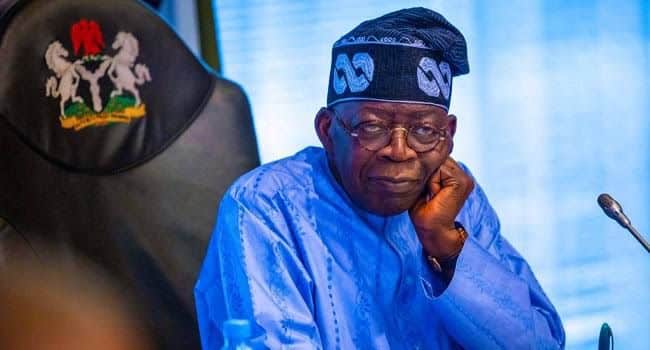
Ultimately, Tinubu’s military shake-up carries both symbolic and practical weight. It reassures the public of presidential control at a time of uncertainty, while signalling to the armed forces that performance and loyalty remain non-negotiable.
As coup rumours fade, the real test will be whether the new service chiefs can deliver tangible security improvements that ordinary Nigerians can feel.
For a nation still haunted by its past but yearning for stability, the coming months will reveal whether the shake-up marks the start of a genuine military reform or yet another cycle of expectations deferred.
Until then, Nigerians watch closely — hopeful that this time, change might finally mean progress.
About The Author


